


Lorestan saffron—often called “red gold”—was being sold in bulk to traders in Tehran and Mashhad, then exported under better-known regional names, according to farmers and agricultural officials interviewed for this report. Their central concern was not whether saffron could grow in Lorestan. It was whether small growers had the packaging, finance and shared market identity needed to sell it as a Lorestan product.
Editorial context: this is an archival report based on statements and figures published with the original article. Hectares, grower counts, yields, licences and funding expectations describe that period; they should not be read as current 2026 provincial statistics. The names, places and reported figures have been retained because they are the substance of the historical account.
Why Lorestan growers wanted their own saffron identity
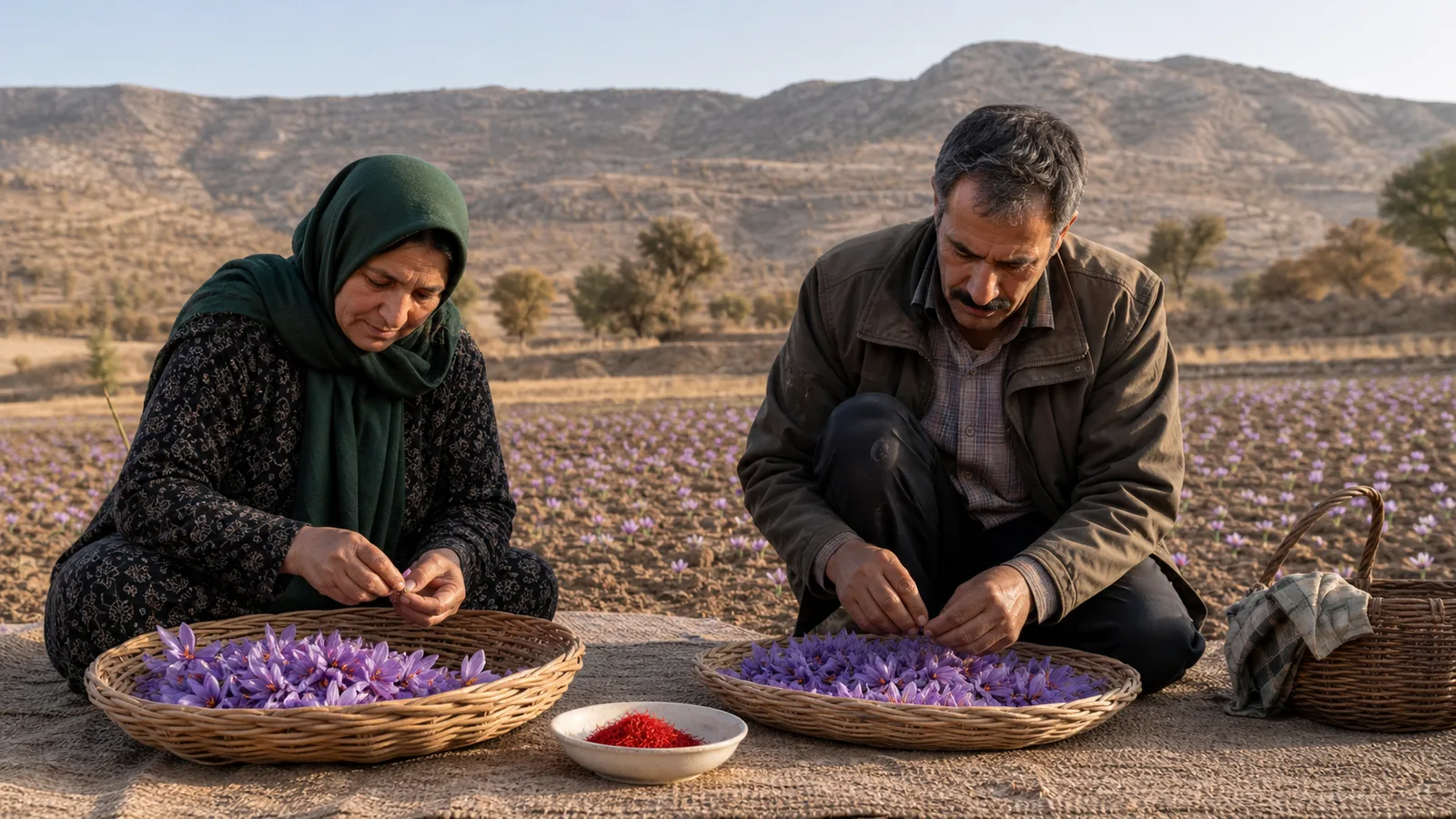
Saffron is harvested from the three red stigmas inside each Crocus sativus flower. Those dried stigmas—not a “flower flag”—are the spice sold by weight. Crocin contributes strongly to saffron’s colour, while several volatile compounds shape its aroma.
Wild crocus species have long been associated with the Zagros landscape, and farmers in the report argued that Lorestan’s conditions also suited cultivated saffron. They described good colour, aroma and essential-oil characteristics. Their difficulty was establishing a route from field to a clearly identified Lorestan package.
When a crop leaves the province in bulk, the origin can disappear from the final presentation. Mashhad has a well-established commercial association with saffron, so traders there already had the networks and packaging capacity that Lorestan’s smaller sector lacked. The result, interviewees said, was that value and recognition moved away from the place of cultivation.
Ali Delfan: production was possible, selling was difficult
Ali Delfan, a farmer in the Kamalvand area of Khorramabad, said he had allocated 1,000 square metres to saffron and harvested two to three kilograms a year. Those numbers are reproduced as his account, not presented as an independently audited yield.
Delfan’s complaint was direct: growing the crop was not the main obstacle. Local growers had no dependable buyer and insufficient packaging capacity, so much of their saffron went to buyers in Tehran and Mashhad. It then entered export channels under those better-known names.
He proposed farmer cooperatives that could buy the harvest, combine small quantities into marketable lots and help growers obtain finance. He also believed Lorestan saffron could compete with established producing provinces in aroma and taste. That quality claim was his assessment; a current comparison would require standardised laboratory and sensory testing across representative samples.
Maryam Tahmasebi: cultivation had not become institutionalised
Maryam Tahmasebi cultivated saffron in Biranshahr. She reported that 2,500 square metres produced about 1.5 kilograms a year. Access to saffron corms—the underground organs used to propagate the sterile crop—had once been difficult, she said, but local supply had begun to improve.
In her view, low cultivation was tied to limited farmer education and the absence of an organised programme. Training, suitable finance and sound land management could shorten the route to a viable crop, while poorly planned expansion could leave growers with corm and labour costs but no buyer.
Tahmasebi also described a packaging bottleneck. Small farmers could not establish individual packaging operations before reaching the required scale, yet they struggled to reach that scale while selling only in bulk. Cooperative processing and packaging offered one practical way to break that cycle. She also saw saffron work as a possible income source for rural women, particularly when local grading and packing kept more value near the farm.
The reported yield was twice the national average
Karim Khademi of the Lorestan Agricultural and Natural Resources Research Center explained why saffron was attractive in a water-constrained farming system. It grows through autumn, winter and early spring, then enters summer dormancy. Its lowest-activity period therefore overlaps with the season when many other crops place their heaviest demand on irrigation.
Khademi described saffron as a perennial, sterile plant propagated through corms. He said it had no single dominant pest in the area, while warning that wild boar, hedgehogs, rabbits and mice could damage fields. The old wording that it was not vulnerable to any particular disease or pest was too absolute: corm health, soil drainage, rodents and local field conditions all matter.
According to figures quoted by Khademi, Lorestan fields had produced about 10 kilograms per hectare against a national average of 5 kilograms. He also said tests placed Lorestan saffron in the “excellent” tier of the four-grade Iranian national system used in the account. These are important historical claims, but the article does not have the underlying sampling reports; they remain attributed rather than converted into present-day province-wide facts.
Khademi put the area under cultivation at roughly 60 hectares and identified Khorramabad as the strongest-yielding locality at that time. Because cultivation was still relatively new, only a small number of cooperative packaging units existed. He expected both acreage and packaging quality to expand and said the governor’s office had responded positively to funding proposals.
Why much of the crop was still sold in bulk
The deputy director of extension at Lorestan’s Agricultural Jihad Organization said training classes and workshops had been held around the province, including three conferences in Khorramabad during the preceding year. Even so, he put the number of growers at only about 40.
A subsidy helped farmers buy corms in the programme’s first year. No continuing credit scheme followed, according to the account, because cultivation remained voluntary and small. Some producers had not applied for packaging licences, and the limited harvest made a standalone facility difficult to justify. Bulk sale therefore remained the default.
This is a familiar market-structure problem. A small crop discourages investment in packaging, while the absence of packaging makes it harder to earn the premium that could support a larger crop.
Packaging and processing licences
Ishaq Taheri Moghaddam, then head of the provincial Agricultural Jihad Organization, said saffron production was concentrated in the Zagros part of Lorestan and that performance there was strong. He acknowledged the branding problem: high-grade local saffron was reaching the market under the Mashhad name.
Moghaddam said the organisation intended to expand production and establish a dedicated Lorestan identity. He pointed to licences issued during the previous two years for saffron packaging and processing as concrete steps towards that goal.
What a credible Lorestan brand would need
A regional name is useful only when buyers can trust what it represents. The interviewees’ proposals imply several practical requirements:
- traceability from farm lot to final package;
- consistent drying, storage and moisture control;
- documented grading and laboratory testing rather than origin claims alone;
- cooperative collection that gives small growers access to packaging and buyers;
- honest labels that identify Lorestan as the place of cultivation;
- current production data, renewed regularly instead of recycling an old headline.
Packaging by itself does not improve saffron, and Lorestan origin does not automatically make every lot excellent. A durable brand depends on repeatable quality and transparent provenance.
Lorestan saffron and the Mashhad name
The point of the original report was not to diminish Mashhad’s established saffron trade. It was to show what Lorestan growers lost when their crop entered that trade anonymously. Their saffron could be cultivated successfully, they argued, but without collective buying, finance, processing and origin-aware packaging, the province remained invisible to the final customer.
Lorestan saffron (red gold) being exported in the name of Mashhad was therefore a branding and infrastructure story as much as an agricultural one. The historical figures need current verification, but the underlying question remains clear: who receives recognition and value when a small region’s crop is sold in bulk?

![Exporting Saffron to Turkey + Price Guide [Complete 0 to 100]](https://img.rowhanisaffron.com/20260827003933/saffron-export-turkey-quality-inspection.webp)



