


The irregular status of Iranian saffron described in a 2017 ISNA report was a mismatch. Iran and Khorasan held an exceptionally important place in saffron production, yet the chain remained vulnerable to avoidable contamination, inconsistent drying, weak farmer finance, price speculation, unverified trade claims and the movement of valuable corms outside formal channels.
The article assembled interviews with Gholamreza Miri of Khorasan Razavi’s saffron trade organisations, National Saffron Council member Behzad Sadeghi, Mashhad customs official Masoud Atefi and an anti-smuggling commission secretary identified as Afshari. Their statistics describe the period around Iranian year 1395 (2016–2017). They should not be used as today’s market figures, but the operational problems they raised can still be examined.
Protecting flowers before they become dried saffron
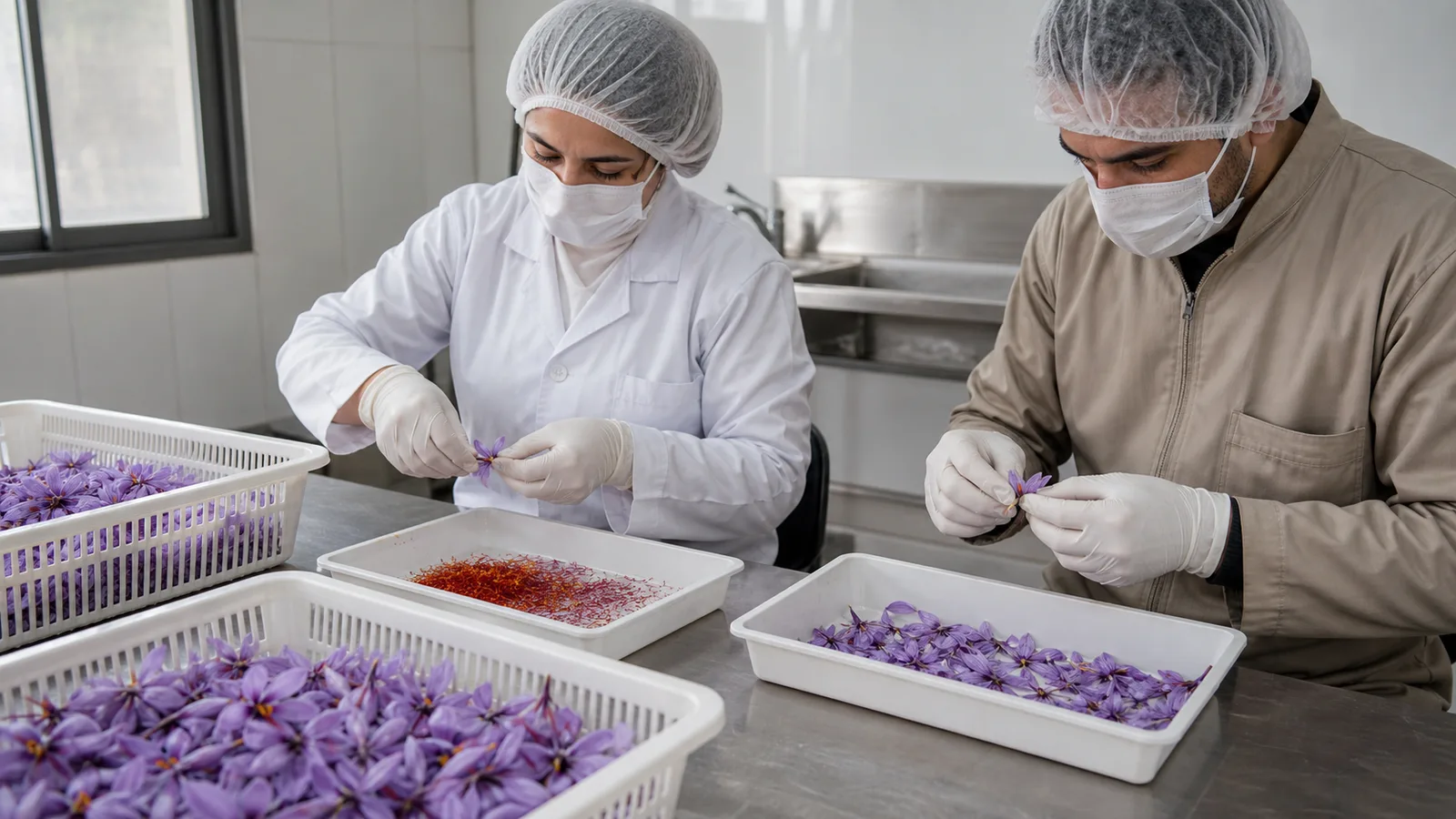
Miri began with handling at field level. Pickers, he said, should use clean gloves and place flowers in rigid, clean baskets rather than contaminated sacks or containers that compress them. The baskets should carry flowers to a suitable separation area without bruising the crop.
He also called for a hygienic hall approved by health authorities, with hair restraints and gloves for people separating stigmas. His warning that a 100- or 200-kilogram shipment could be rejected because of one hair was an interview example, not a published rejection rule. The durable principle is that foreign matter can cause a lot to fail a buyer’s specification.
The old translation said saffron should be packaged “immediately after separation with a dry heater” and suggested sun or natural drying necessarily destroys it. Stigmas must first be dried under controlled conditions; packing them while wet would trap moisture. Research on drying conditions and saffron volatile compounds shows that method and conditions influence aroma development. Time, temperature, final moisture and clean storage should be recorded for each lot.
Once dry, saffron needs a food-safe barrier against moisture, light and foreign odours. Aluminium, metal, glass or suitable food-grade polymer can work when the complete pack is compatible with the product. Material name alone does not guarantee hygiene or shelf life.
The employment estimates were important but inconsistent
Miri described a chain spanning production, distribution, processing, packaging and export and placed its employment capacity near one million people. He cited 120,000–130,000 producer households, 20,000–30,000 processing workers, about 50 exporters with 30–50 employees each and roughly 360 active saffron units employing two to five people.
He also used an assumed separation rate of three kilograms of flowers per worker to reach a total above one million. Later in the report, Sadeghi spoke of 190,000 farmers, an average household of five and about 900,000 livelihoods directly connected to saffron, while separately crediting the crop with 90,000 permanent jobs.
These figures use households, seasonal labour, permanent jobs and indirect livelihoods as different units. They cannot be added or compared without definitions. They do show why a sudden loss of farm income in central and southern Khorasan would affect far more people than registered exporters alone.
Export demand did not remove domestic market risk
The 2017 account said domestic consumption and trading activity had weakened while customs exports through the end of August had risen by about 6%. Miri listed exports to 47 countries, naming the United Arab Emirates, Spain, China, Germany, France, Italy, Australia, Norway, Belgium, Japan, Korea and Gulf markets among the leading destinations.
Another translated sentence said foreign saffron sold at “a maximum of 5 percent of the domestic price.” The direction and basis of that comparison are unclear, so it should not be quoted as a price ratio. Current price or export-growth claims require a date, grade, pack size, currency, customs code and source.
Miri argued that higher quality, producer protection, reliable export service and price stability were necessary to keep buyers from switching suppliers. Research on barriers to Iran’s saffron export similarly treats competitiveness as a value-chain problem rather than one production figure.
Speculation and forced selling weakened farmers
The report described brokers buying during harvest in expectation of a later rise. Some reportedly lost money when prices increased only slightly and then fell. Miri hoped speculative purchasing that created market tension would decline.
Sadeghi connected the same problem to limited liquidity. A grower with immediate bills may have to sell the seasonal crop at a price set by the buyer who has cash. That is not proof that every intermediary is harmful—aggregation, testing and distribution are real services—but opaque finance can transfer bargaining power away from the farmer.
What the proposed “Saffron Bank” meant
Miri described a Saffron Bank plan that had remained on paper. Under the proposal, saffron would be bought from farmers at an expert-approved price, analysed, labelled and placed under bank control. The bank would finance the purchase, while the stored saffron could be released to reduce manipulation or support delivery against longer-term export contracts.
He contrasted that idea with Spanish traders who, he said, could finance stored saffron at 1.5–2%. Neither the facility terms nor a comparable Iranian rate were documented in the article. The argument was about access to affordable inventory finance, not proof that one country was improperly controlling the market.
A reserve or warehouse-receipt system needs more than a building. It requires independent grading, insured storage, transparent ownership, audit trails, release rules and protection against double pledging. Without those controls, a “bank” could move price risk rather than reduce it.
The report also said saffron had not yet been offered on the exchange because it occupied little space, stored well, changed price through the year and was already traded through established merchant relationships. That was a historical market description; later exchange developments should be assessed from their own dated records.
Quality and productivity were presented as the alternative to endless expansion
Sadeghi estimated world consumption at 320–330 tonnes a year and associated much of that volume with Khorasan Razavi and South Khorasan. He warned that Afghanistan and China could replace Iranian supply if cultivation in Khorasan collapsed. Those are 2017 interview claims, not a current production forecast.
He framed saffron as particularly important in drought-affected central and southern Khorasan because summer-irrigated crops such as cotton, sugar beet and tomatoes faced tighter water constraints. He said production might be cheaper in wetter western or northern regions, but water availability alone does not determine cost or quality.
The article called the potential loss of Khorasan saffron a “fourth national disaster” and compared it with Lake Urmia. That rhetoric conveyed urgency; it was not a technical risk classification. A crop can recover when viable corms, suitable fields, knowledge and markets remain, although rebuilding a damaged regional system may be slow and costly.
Sadeghi quoted around 80,000 hectares under saffron and later calculated with 90,000 hectares. He placed average yield at 3.5 kilograms per hectare and set 10 kilograms as a target, arguing that the same crop could then come from 30,000 hectares and avoid irrigation across 60,000 hectares. Yield does not scale that cleanly: field age, corm density, weather, labour, disease and input limits differ. Pressurised irrigation can improve control in some systems, but it cannot by itself triple yield.
The economic claims need their original currency and period
One broken translation said saffron brought “2000 billion USD” to the Torbat Heydarieh–Birjand region. The later comparison with oil and Iranian policy context indicate that the source meant about 2,000 billion tomans, not US dollars. The report also mentioned six million unemployed people and said saffron generated permanent work for 90,000.
Sadeghi said saffron delivered three to four times the per-person share of oil income to 190,000 people. The article did not show the calculation. These statements should remain historical advocacy figures unless supported by the underlying accounts.
The comprehensive saffron plan needed funding and measures
A comprehensive plan approved under a previous government was described as covering production through export and capable of resolving the sector’s problems within four years if funded. Sadeghi referred to Iranian years 1387 or 1388 (approximately 2008–2010) and a $400 million export objective, then suggested a properly funded plan could lift export value above $1 billion.
A four-year promise or billion-dollar target is not an outcome measure. A credible plan would separately track farm yield, water productivity, corm disease, flower-to-dried-spice loss, laboratory compliance, farmer price, formal export value and buyer retention.
Adulteration claims require testing, not origin stereotypes
The report alleged that “white saffron”—the pale style portion beneath the red stigma—was bought cheaply for Dubai, dyed, mixed with red saffron and sold under a Dubai brand for five to six million tomans per kilogram. It also said Dubai did not grow saffron.
The account did not provide laboratory reports, transaction records or enforcement cases. Deliberate colouring and origin misrepresentation are serious fraud allegations and must be established lot by lot. The current ISO 3632-1:2025 saffron specification and appropriate analytical methods provide a stronger basis than judging a product by the trading city on its label.
What the six-month customs figures reported
Masoud Atefi supplied a detailed snapshot from Khorasan Razavi customs for the first six months of Iranian year 1395. The translated report gave these figures:
- packs above 30 grams: 47,044 kg valued at $67,303,669;
- 10–30 gram retail packs: apparently 10,095 kg valued at $15,192,544 (the source rendering “10,95” is ambiguous);
- unpowdered packs below 10 grams: 1,071 kg valued at $1,690,481;
- powder in 10–30 gram packs: 21 kg valued at $38,893;
- powder below 10 grams: 16 kg valued at $35,559.
The report described year-on-year changes of 113% in weight and 122% in value for packs above 30 grams; 64% and 63% for 10–30 gram packs; 62% and 61% for sub-10-gram unpowdered packs; 91% and 113% for 10–30 gram powder; and 83% and 79% for sub-10-gram powder. It is unclear whether each percentage means growth or an index relative to the previous period.
It then compared total exports of 52,911 kg worth $75,764,249 in the earlier six-month period with 58,247 kg worth $84,261,136, calling those increases of 10% and 11%. Atefi listed the UAE, Spain, China, Hong Kong, France, Australia, Canada, the United Kingdom, Turkey and Iraq as destinations and said standard-compliant saffron exports were exempt from duties.
These totals do not reconcile neatly with every subcategory in translation. They should be preserved as the report’s customs snapshot, not recombined into a new statistic.
Corm movement was a separate strategic concern
The final part dealt with saffron corms—called onions in translation—not dried spice. Officials reported three Dogharun customs seizures totalling 98 kg and valued at 6.93 million rials. Afshari then cited 143,900 kg of smuggled corms in the prior year and 199,868 kg in the first six months of the current year.
He said valuation depended on corm size: a two-gram corm had little value, while corms above eight grams were sold around 4,000–5,000 tomans per kilogram. The units and prices are historical and may contain translation errors.
The article also claimed a 120,000-ton surplus of corms, restrictions on legal movement to other provinces or abroad, and Afghanistan as the main destination. Seizures were associated with Torbat Heydarieh, Zaveh, Gonabad and Kashmar, especially southern parts of Khorasan Razavi. The huge surplus figure is not supported by a method and should not be treated as verified.
Officials wanted an agricultural programme for surplus corm use beyond replanting. Any movement policy must balance germplasm strategy with corm health: undocumented transport can spread corm rot and other pests as well as move productive material.
What a more regular saffron system would look like
The 2017 report repeatedly returned to five needs:
- clean flower handling, controlled drying and verifiable quality;
- affordable, transparent finance that does not force harvest-time sales;
- measured productivity gains instead of unsupported yield targets;
- formal trade data separated from estimates and informal movement;
- traceable corm and saffron lots that can be audited from source to buyer.
Those needs are more useful than repeating a 75% share of world demand, a 47-country list or a billion-dollar forecast without a date. Iran’s saffron status becomes more stable when each flower, dried lot, payment, test and shipment is handled in a way the next participant can verify.
Historical source: ISNA, as cited by the original 2017 post.

![Exporting Saffron to Turkey + Price Guide [Complete 0 to 100]](https://img.rowhanisaffron.com/20260827003933/saffron-export-turkey-quality-inspection.webp)



