


The Iranian saffron market has long had an unusual imbalance: Iran grows most of the world’s saffron, yet an overseas buyer does not automatically look to Iran for the benchmark price. A government-backed exchange programme set out to change that. Its vision was ambitious—to make the Republic of Iran a leading reference for saffron pricing—but it was a policy goal, not a guarantee that one exchange would become the sole global source.
What Iran’s global pricing vision meant
A useful benchmark gives buyers and sellers a price they can understand and compare. In the case of saffron, that price also needs a defined grade, origin, delivery point, transaction date and quantity. Without those details, two quotations per kilogram may describe very different products.
Iran’s production scale made the idea attractive. Officials argued that a country responsible for most of the crop should have a stronger role in price discovery instead of following quotations formed farther down the supply chain. The proposed Iranian saffron exchange was meant to bring growers, warehouses, traders and exporters into a visible market where bids and completed trades could be recorded.
Hossein Shirzad—sometimes written Shirezad in English—was not the agriculture minister, as the old article implied. He headed the Central Organization for Rural Cooperatives and served as a deputy agriculture minister. He described exchange trading as part of an effort to modernize the market, support farmers and create a more credible base for exports.
What happened to the 67 tonnes purchased from farmers?
The historical quantities need careful wording. An official Iranian Agricultural News Agency report says the rural cooperative organization bought more than 67 tonnes during the Iranian year 1396, which ran across 2017 and early 2018. Of that amount, about 63.901 tonnes came from Khorasan Razavi and 3.343 tonnes from South Khorasan.
Not all 67 tonnes were “sold on the exchange.” The same report separates roughly 1.4 tonnes represented by commodity-deposit receipts from 65.8 tonnes purchased physically from farmers. The programme used both routes. Combining them into a claim that more than 65 tonnes traded through the exchange overstates what the source records.
The purchase was a market-support intervention as well as a trading experiment. The organization bought physical stocks when growers needed an outlet, while the receipt system tested a way to sell standardized warehouse inventory. Some saffron was intended for export, but a government purchase and a completed export are separate events.
How exchange trading was designed to work
Iran’s saffron commodity-deposit receipts were formally launched in Mashhad in February 2017. An approved warehouse accepted a lot, checked it against its rules and issued a tradeable receipt for the stored product. That allowed ownership to change without carrying jars or cartons from one buyer to another for every trade.
The launch report emphasized daily price discovery, smaller transactions and faster settlement. Futures contracts followed in May 2018, giving participants a tool for managing future price risk. Futures can help a grower or trader plan, but they can also create losses; they are not a guaranteed support price.
For the Iranian saffron market, the attraction was transparency. The exchange could show the grade represented by a receipt, the volume offered and the price accepted. It could also set storage and sampling rules. That is more informative than an anonymous quotation, though it still describes transactions within one venue rather than the entire world market.
For a fuller timeline and explanation of these instruments, see our guide to Iranian saffron in global markets.
Could Iran become the world’s saffron price reference?
It could become an influential reference, but production share alone cannot make it happen. A benchmark earns authority when enough independent buyers and sellers use it, the contract is liquid, the grade is repeatable and transaction data remain accessible. Overseas participants must also be able to arrange payment and delivery.
Officials continued to pursue that idea. In July 2019, Deputy Agriculture Minister Ali Akbar Mehrfard said the ministry was seriously seeking to make Iran the world’s first saffron reference through commodity-exchange trading. The wording reported by IANA described a goal being actively pursued, not an announcement that the exchange had already become the world’s sole reference.
An Iranian quotation also has to be translated into the buyer’s landed cost. Currency conversion, financing, freight, insurance, duty and delivery time sit between a domestic exchange price and the amount paid abroad. If those steps are difficult or opaque, trade may continue to form prices through established importers even when the crop originates in Iran.
Was exchange certification meant to be compulsory for exports?
The historical vision included a future in which saffron exports would carry certification connected to the commodity exchange. That idea was presented as a way to make quality visible and prevent inconsistent product from weakening the Iranian name.
It should not be rewritten as a current rule that every Iranian export can occur only with an exchange certificate. The available historical sources describe an intended direction. They do not establish a permanent, universal export requirement in force today. Exporters must follow the current customs, food-safety, origin and destination-market requirements that apply to the particular shipment.
Exchange documentation can still add value. A warehouse record can connect a traded lot to a stated quantity and acceptance specification. It does not replace every laboratory analysis, sanitary document or certificate of origin, nor does it prove that the product will satisfy every importing country’s rules.
Quality is what turns a quotation into a useful benchmark
Saffron cannot be priced credibly as though every red thread were identical. Moisture, foreign matter, floral waste and the chemical characteristics linked to colour, aroma and taste all affect the lot. Sampling matters because a clean surface layer should not stand in for the whole consignment.
The Food and Agriculture Organization now describes Iran as producing more than 90% of global saffron and is working with Mashhad University on authenticity testing and post-harvest guidance. ISO 3632-1:2025 provides current international specifications for dried saffron in filament, cut-filament and powder forms. An exchange grade can complement those methods when its warehouse rules and evidence are clear.
This is the link between pricing and trust. A published number becomes meaningful abroad only when a buyer knows what quality it represents and can receive the same specification consistently.
What the programme could do for farmers
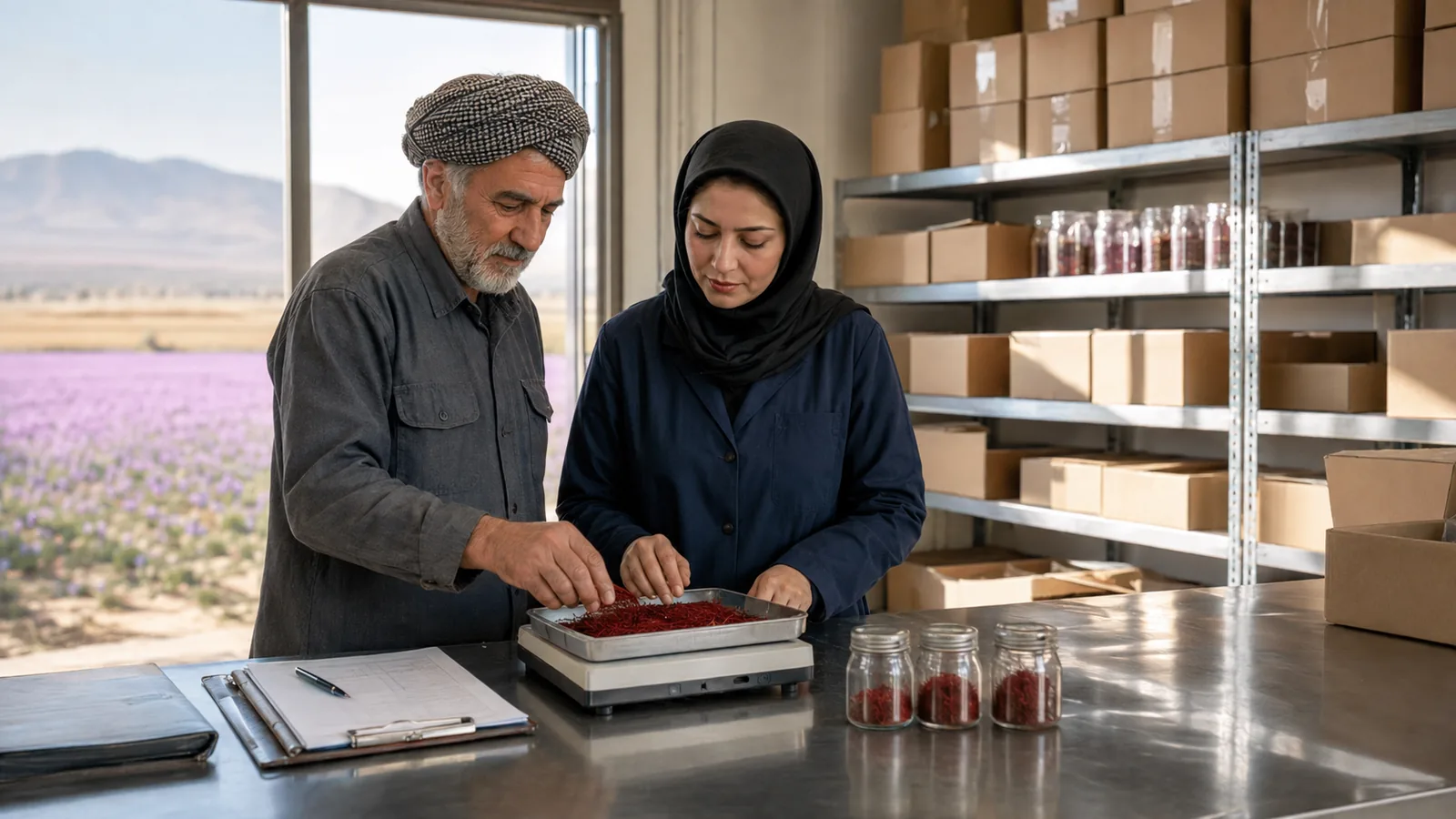
For growers, the exchange offered an alternative to selling immediately after harvest to the first available intermediary. A farmer who could deliver an eligible lot to an approved warehouse might receive a receipt, sell it through an authorized route and compare visible bids. Cooperatives could help smaller farms combine lots and handle testing or storage.
There are limits. Warehouse charges, broker fees, minimum quantities, rejection risk and payment timing affect whether the route is genuinely useful. A transparent market can reduce some information imbalances without removing every intermediary. Warehouses, processors, laboratories and exporters perform necessary work; the question is whether their costs and responsibilities are visible.
Stable prices cannot be promised either. Better infrastructure and deeper trading may reduce avoidable confusion, but harvest size, quality, currency conditions and overseas demand will still move the market. Producers and consumers do not automatically receive the same benefit from every price change.
How to read the historical production and consumption figures
The original account said Iranian saffron production grew from about 30 tonnes in Iranian year 1368 (1989–90) to more than 300 tonnes at the time of the speech. It also gave rough annual estimates of 200 tonnes exported and more than 80 tonnes consumed domestically, based on approximately one gram per person.
These numbers preserve the scale described in the historical statement, but they are not current statistics. “Today” meant the article’s reporting period, not the day a reader opens this page. Domestic consumption is especially difficult to infer by multiplying a rounded per-person estimate, because household use, food manufacturing, stock changes and informal trade are not measured by that calculation.
The 2018 IANA report contains another caution. It lists world production at 378 tonnes and Iranian production at 336 tonnes, while printing Iran’s share as 78%. The tonnages calculate to about 89%, so those figures should not be repeated as though they reconcile. More recent FAO wording—over 90%—is a better current description, with the same reminder that crop-year estimates can vary.
Shirzad was also quoted in the period as saying Iran held close to 85% of production. That estimate belongs to the historical exchange argument; it is retained here without treating it as a precise current market share.
What would make the vision credible in practice?
Iran does not need to be the only place where saffron is traded to become the most useful point of reference. It needs a benchmark that market participants trust. That requires enough completed trades, stable grade definitions, independent testing, transparent warehouse rules and prompt publication of price and volume.
It also requires a workable export route. A price formed in Tehran or Mashhad has limited global influence if overseas buyers cannot pay, insure a shipment or confirm delivery. Branding and traceability matter after the auction as well; otherwise a standardized Iranian lot can still lose its origin identity when it is repacked abroad.
Readers following Iran saffron export news, saffron market news or October price headlines should first check the publication date. Then ask whether the figure is a support purchase, warehouse receipt, futures trade, physical export or forecast. Each describes a different point in the chain.
The original vision was valuable because it asked Iran to turn production leadership into transparent commercial leadership. The exchange can be part of that answer. It becomes a genuine global reference only when quality evidence, real participation and an accessible export system make its prices useful beyond the exchange floor.

![Exporting Saffron to Turkey + Price Guide [Complete 0 to 100]](https://img.rowhanisaffron.com/20260827003933/saffron-export-turkey-quality-inspection.webp)



