


Iran’s national saffron brand was unveiled in Germany during Anuga 2019, according to an announcement from the Birjand Chamber of Commerce and Iran’s National Saffron Council. The presentation in Cologne introduced both the national brand and a collective saffron mark to an international food-trade audience.
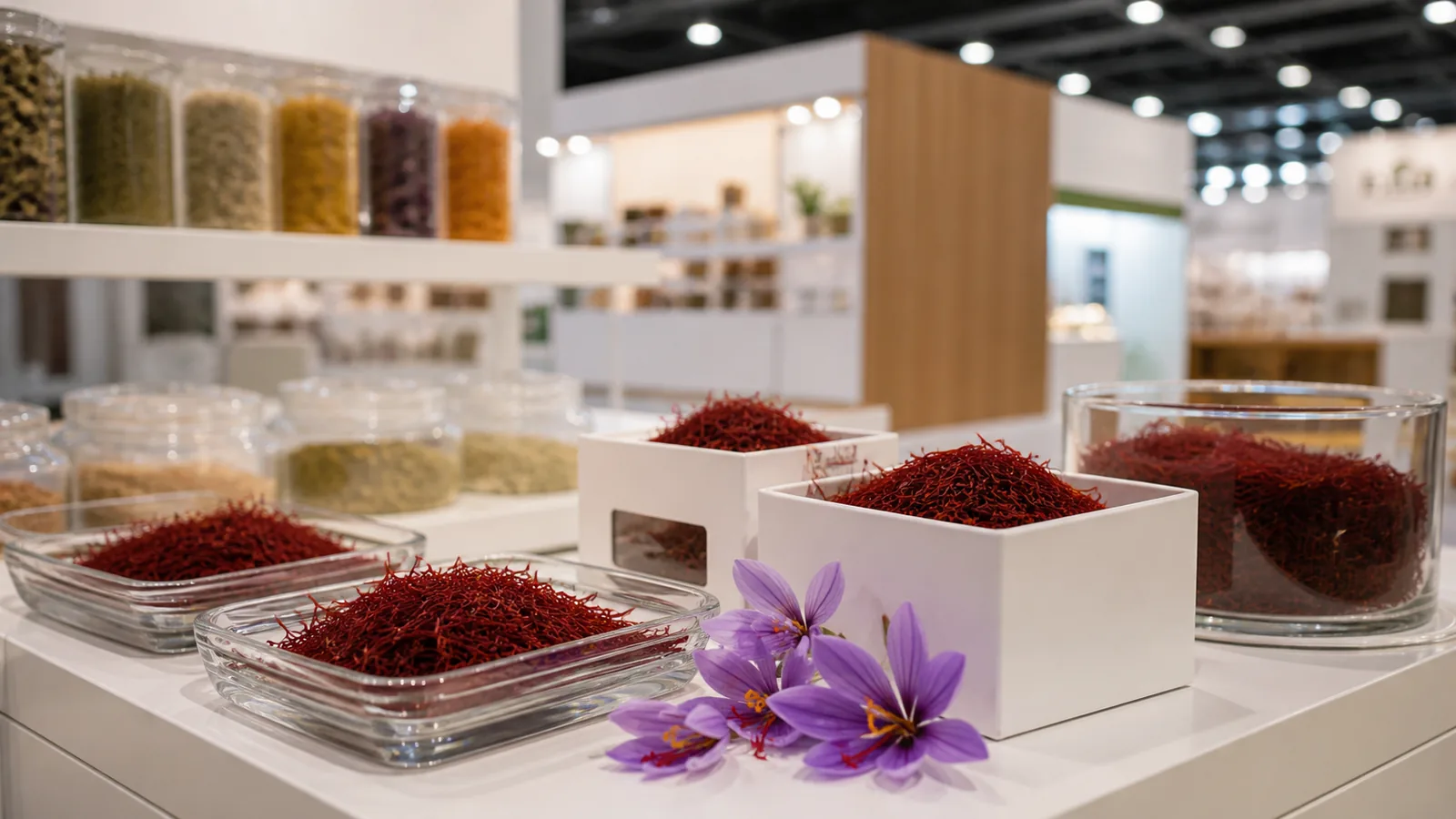
For anyone looking up an Iran saffron brand or saffron Germany event, this article refers specifically to the October 2019 Anuga exhibition. It is a historical report, not an announcement of a current fair or a newly launched label.
The national saffron presentation at Anuga
Mohsen Ehtesham, then head of Iran’s National Saffron Council and the Birjand Chamber of Commerce, described Anuga as an opportunity to present Iranian saffron to buyers working in retail, food service and catering.
The Iranian delegation unveiled the national saffron brand and collective sign in the presence of Iran’s consul general in Frankfurt, the chairs of the National Saffron Council and the Birjand and Ardabil chambers of commerce, the chair of the Iranian Chamber’s Agriculture Commission, the head of the Medicinal Plants Union and a group of exporters.
Why the Cologne fair mattered
Anuga brings several specialist food exhibitions together at one venue. The event’s official website still describes the format as ten trade shows under one roof, covering a wide range of products and routes to market.
The 2019 edition ran in Cologne from 5 to 9 October. An official Anuga factsheet records 7,972 exhibitors and 169,653 visitors for that edition. Those verified totals replace the rough and inconsistently translated estimates in the original report.
Iranian companies and products at the fair
Ehtesham said 26 Iranian companies participated across nuts, barberry, saffron, pistachios, raisins, figs and dates. Saffron therefore appeared within a wider presentation of Iranian agricultural and food products rather than as the delegation’s only focus.
The national brand was intended to give Iranian saffron a more coherent identity in export markets. A collective mark can also help several eligible producers present a shared origin or standard, though an unveiling alone does not show how widely a mark was later adopted.
South Khorasan’s barberry export context
The same announcement discussed work by the Birjand Chamber to promote barberry from South Khorasan. Ehtesham said exports had reached about 400 tonnes, compared with less than 50 tonnes around five years earlier, and linked trade-fair exposure with that growth.
Those numbers were presented by the speaker as historical trade results. They should not be used as current export volumes without a newer customs or chamber dataset.
What the unveiling did and did not prove
The Anuga presentation gave the proposed national saffron identity international visibility and put it in front of a large professional audience. It also placed Iranian exporters alongside thousands of food businesses from around the world.
However, the ceremony itself did not establish later market share, consumer recognition or compliance by every saffron exporter. Those outcomes would require separate evidence about registration, governance, adoption and sales after 2019.
A dated milestone for Iranian saffron
Read in its proper timeframe, the story records a specific export-promotion milestone: Iranian trade and saffron organizations used Anuga 2019 in Germany to unveil a national brand and collective mark, with 26 Iranian food companies represented at the fair.
The lasting relevance lies in the challenge the event was trying to address. Producing saffron and building a recognizable, trusted export identity are different jobs, and the Cologne presentation was an attempt to connect the two.

![Exporting Saffron to Turkey + Price Guide [Complete 0 to 100]](https://img.rowhanisaffron.com/20260827003933/saffron-export-turkey-quality-inspection.webp)



