


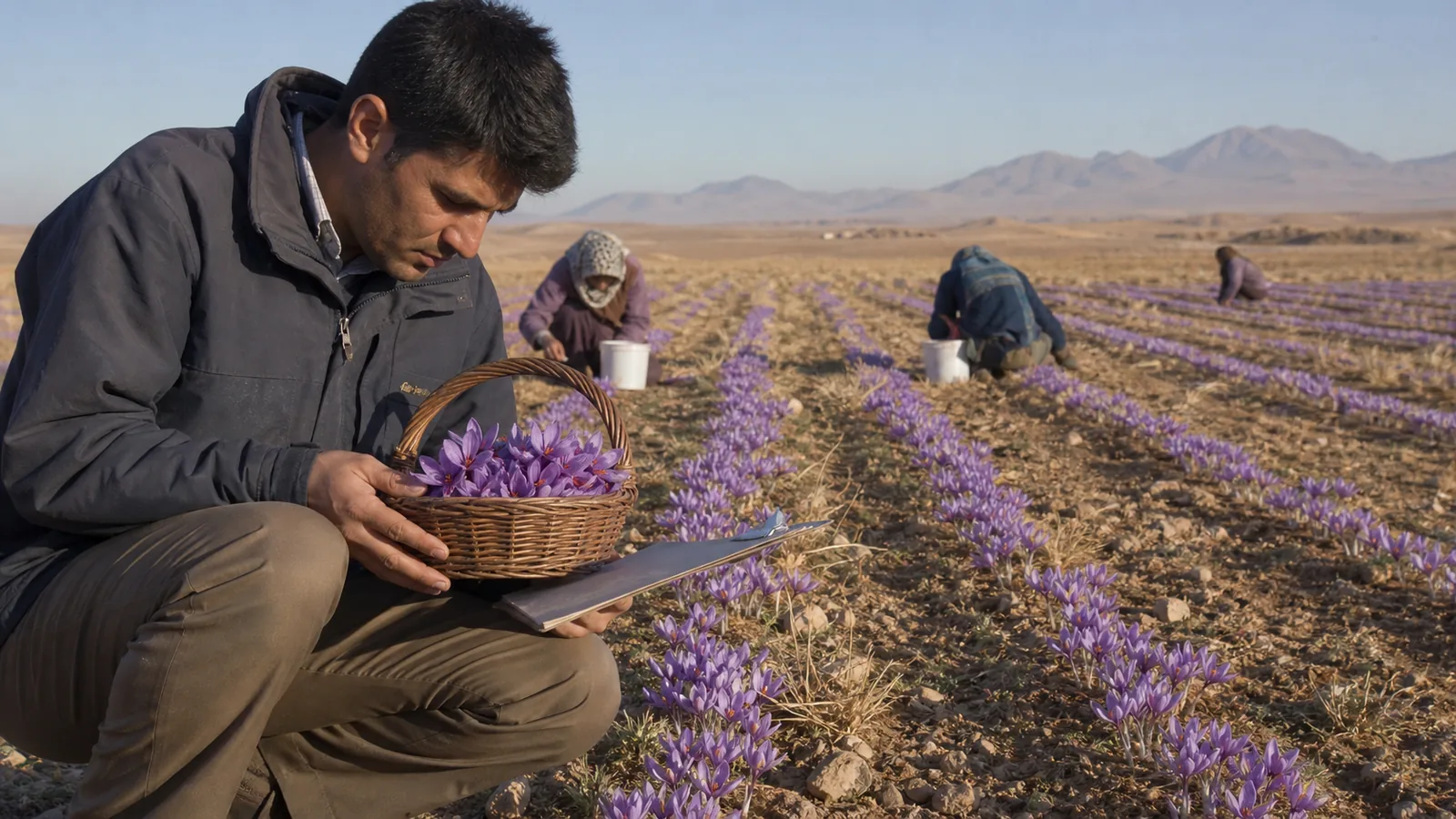
Iranian saffron production statistics in 2012 show an industry that was already dominant worldwide and still expanding at home. The most consistent official figures we found record 254.060 tonnes from 73,118 hectares in the 2011–2012 crop year, followed by 261.520 tonnes from 79,394 hectares in 2012–2013. Iran was therefore producing more than 250 tons of saffron around this period, although the exact total depends on which crop year a report means.
This article was first published in 2013 from a translated market report. We have kept its people, places, trade figures and price discussion because they form a useful historical record. Where a number can be checked against later official data, it is clarified below. Where the underlying document cannot be recovered, the claim remains clearly attributed rather than being presented as a verified current fact.
The official production figures around 2012
An Iranian proposal submitted to the Codex Committee on Spices and Culinary Herbs reproduces statistics from the Ministry of Agriculture-Jahad. It gives the following sequence:
- 2010–2011: 239.244 tonnes from 67,297 hectares;
- 2011–2012: 254.060 tonnes from 73,118 hectares;
- 2012–2013: 261.520 tonnes from 79,394 hectares;
- 2013–2014: 311.073 tonnes from 84,738 hectares.
The source defines a crop year as October to October. That matters here: a news item dated during 2012 or 2013 may refer to the crop being harvested, the previous completed crop year, or a forecast for the next one. Saying simply “2012 production” can conceal that difference.
The original report referred to roughly 75 thousand hectares of saffron farms in the Khorasan provinces, a prior harvest above 240 tonnes and an annual total of over 250 tons. Those rounded statements fit the scale of the official 2011–2012 series. A separate 2013 agricultural paper described about 255 tonnes from 70 thousand hectares, which shows why contemporary sources do not always give identical boundaries or totals.
Did Iran produce 95 percent of the world’s saffron?
The report described Iran as supplying over 95 percent of world saffron. The later Codex proposal used 96 percent, while current FAO material generally uses a lower rounded share of over 90 percent. These percentages belong to different dates and estimates. They all support the same central point: Iran was the world’s first and largest producer by a wide margin, but “95 percent” should be read as a period estimate rather than an unchanging constant.
For the broader and more recent picture, including why production, cultivation and export figures should not be mixed, see our separate guide to saffron production statistics. This page stays focused on the 2012-era record.
Khorasan, farmers and the spread to other provinces
Razavi Khorasan and South Khorasan were the centre of the industry. Flowers were picked during a short autumn harvest, then their stigmas were separated and dried with care. The translated report estimated that about 170 thousand farmers were involved. We have not located the original employment table behind that estimate, so it should not be used as a precise workforce count.
Ali Hosseini, identified in the report with Iran’s National Saffron Council and the South Khorasan producers and exporters association, said cultivation was no longer confined to the northeastern provinces. The copy referred to saffron activity across 15 provinces and named Yazd, Isfahan, Kerman, East Azerbaijan, Tehran, Markazi—rendered as Arak in the translation—Qom and Semnan.
It also mentioned about 83 thousand hectares in the expanding crop programme. That does not match the final 2012–2013 figure of 79,394 hectares exactly, but it sits between that year and the 84,738 hectares reported for 2013–2014. It is best understood as a contemporary expansion estimate, not a reason to replace the completed crop-year series.
Why cultivation was expanding
Hosseini linked part of the expansion to drought and low rainfall. Saffron is suited to dry and semi-dry regions and its irrigation calendar can make it attractive where other crops are difficult to sustain. “Less water” is still a relative description, however. A saffron field needs suitable soil, timely irrigation and sound management; planting it does not remove local water constraints.
The original forecast had expected production to rise with the cultivated area, but heat and difficult weather were said to have reduced the anticipated harvest. That distinction is important. More planted hectares do not guarantee a proportional increase in dried saffron because field age, corm quality, temperature, rainfall, irrigation and labour all affect yield.
Production and exports were different measurements
The original article cited customs figures of 111 thousand and 552 kg of saffron and saffron powder, valued in its translation at $349 million, 551 thousand and 622, for the first ten months of the reporting year. The punctuation is visibly unreliable, but the intended quantity appears to be 111,552 kilograms and the intended value US$349,551,622.
The later Codex submission, citing the Iran Customs Office, reports a full-year 2012 export total of 139.223 tonnes worth US$418,862,315. A ten-month figure can reasonably be lower than a full-year one, so the two sets are not necessarily contradictory. We have not found the original monthly customs return needed to verify the translated partial-year value, and neither number is a farm-production total.
Spain and the United Arab Emirates were important destinations and trading centres. Some Iranian saffron was imported in larger quantities, then sorted, packaged or marketed again for other markets. That commercial route can make a trading country look like a producer unless the reader checks origin as well as the country of dispatch.
The packaging and tariff debate
The 2013 copy criticised policies that treated packages above 30 grams as bulk and referred to a five-percent export tariff. It also argued that more value from packaging and marketing should remain with Iranian growers and exporters. These details describe the debate at the time. They are not current customs advice, and buyers or exporters should check today’s rules with the relevant authority before acting.
The underlying concern was straightforward. Producing the crop is only one part of the value chain. Grading, quality control, traceability, packaging, brand ownership and access to customers determine how much value stays with the producing region.
Hosseini also called for a clearer export policy and wider work on saffron’s applications so the industry could serve markets in more than 50 countries. The machine-translated copy inserted the word “Fennel” into this passage, but the article, speaker and surrounding sentences are all about saffron. We have not repeated that translation error as if it named a second crop.
What the old price passage appears to mean
The original English translation is too garbled to support a clean price comparison. It appears to say that domestic prices had risen sharply while an international quotation fell from approximately US$2,200–2,500 per kilogram to US$1,600–1,800 per kilogram. It also attributes part of the movement to exchange-rate changes.
Those figures are preserved as historical claims, not as a price guide. They do not identify a saffron grade, contract terms, packaging, currency-conversion date or data series. Each of those details can change the result. Anyone researching today’s market should use a current, like-for-like quotation rather than carrying a 2012 price forward.
How to read these Iranian saffron production statistics
The most defensible conclusion is that Iran produced roughly a quarter of a thousand tonnes of saffron in the crop years around 2012, cultivated approximately 73,000 to 79,000 hectares, and remained overwhelmingly the largest producer. Production continued to be concentrated in Khorasan even as saffron planting reached other provinces.
The data also show why a historical statistic needs a date and a definition. Planted area is not harvested output. Output is not exports. A forecast is not a final crop-year total, and a bulk trading route through Spain or the UAE does not change the agricultural origin of Iranian saffron.
Sources and review note
We reviewed this article on 28 August 2026. Production, cultivated-area and export figures come from the Iranian proposal for a Codex standard for dried saffron, which identifies the Ministry of Agriculture-Jahad and Iran Customs Office as its statistical sources. The independent 2013 production comparison comes from the FAO AGRIS record on saffron production decline. Current context on Iran’s global share and water-scarce growing environment comes from FAO’s page on the Qanat-based saffron farming system in Gonabad.

![Exporting Saffron to Turkey + Price Guide [Complete 0 to 100]](https://img.rowhanisaffron.com/20260827003933/saffron-export-turkey-quality-inspection.webp)



