


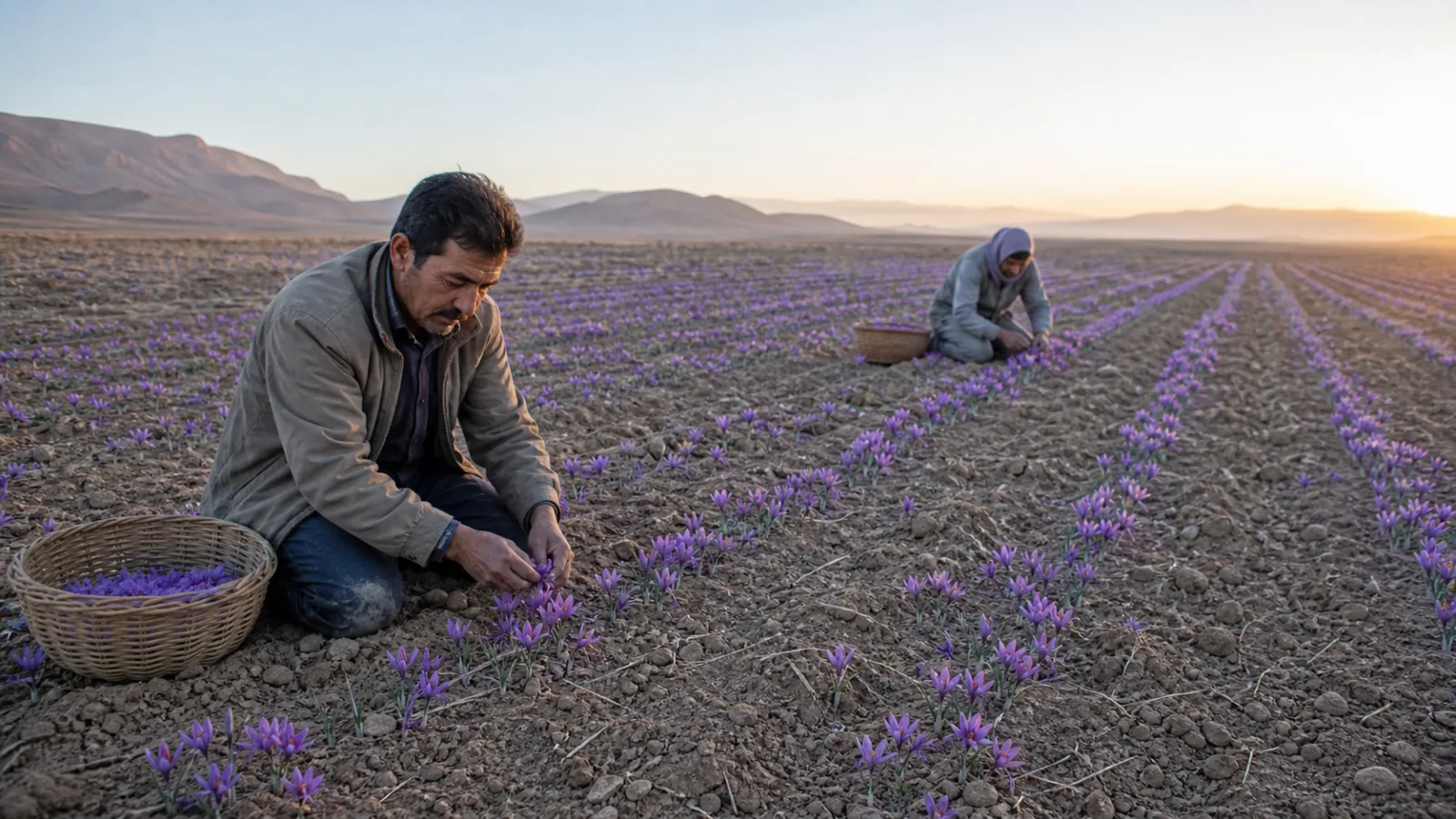
Iran is ranked first in saffron production in the world. Current FAO material describes Iran as the global leader and estimates that it produces roughly 85–90% of the world’s saffron. That makes Iran the largest saffron-producing country by a wide margin, but production, exports and share of the world market are different measures and should not be combined.
Iran’s first-place position in saffron production
In 2025, the Food and Agriculture Organization put Iran’s share of global saffron production at 85–90%. FAO’s account of the Qanat-based Saffron Farming System in Gonabad also identifies Iran as the world’s largest producer and describes a share above 90% in the context of that heritage system.
These percentages come from different FAO pages and reporting contexts, so a narrow range is more honest than treating one number as permanent. Crop volume changes from season to season, and no single page provides a live census of every saffron-producing country. The stable conclusion is the rank: Iran remains the largest producer of saffron in the world.
Production share is not export-market share
The 2019 interview behind this article attributed a 96% “world market” figure to Hossein Shirzad, then managing director of Iran’s Central Organization of Rural Cooperatives. In context, the statement appears to refer to Iran’s production dominance, not a measured share of all saffron exports or global retail sales. A producing country may consume part of its crop domestically, while another country imports, packs and re-exports saffron.
For that reason, three questions need separate answers:
- Who grows the most saffron? Iran ranks first by production.
- Who reports the most direct exports? This depends on the year and the customs dataset.
- Who earns the final retail value? Growers, processors, brands and distributors may be in different countries, and comprehensive global retail data is not supplied by customs statistics.
This distinction protects the genuine strength of Iranian saffron production without turning an unclear historical percentage into a broader claim than the evidence supports.
Where saffron is grown in the world
Iranian production is concentrated in the dry eastern provinces, especially Khorasan Razavi and South Khorasan. The original interview said much of the crop was cultivated at elevations of about 1,350–2,000 metres. Elevation can shape temperature, frost exposure and harvest timing, but it does not create quality on its own. Soil, irrigation, corm health, flower handling, stigma separation and drying all matter.
Saffron is also grown in Afghanistan, India’s Kashmir region, Spain, Greece, Morocco and other smaller producing areas. The 2017 Codex project document for a worldwide saffron standard likewise identified Iran as the dominant producer while noting Kashmir, Greece, Morocco and Spain. So the answer to “where is saffron grown in the world?” is broader than one country, even though Iran accounts for most production.
Gonabad offers one distinctive Iranian example. Its qanat system brings groundwater to an arid landscape without pumping it to the surface first, supporting farms in a region where water is scarce. FAO recognizes this as a Globally Important Agricultural Heritage System. Our article on Gonabad’s qanat-based saffron landscape explains how that heritage fits the crop.
Super negin quality needs a real specification
Shirzad described Iranian super negin as a high-quality form with long red stigma sections and little or no yellow or white style. That is a recognizable commercial description, but visual grade names are not complete laboratory specifications. Thread length and colour can help a buyer describe the lot; they do not prove aroma, purity, moisture or freedom from adulteration.
The old English text also referred to “below-1% saffronal content.” That wording is not a reliable expression of saffron quality. Safranal is associated with aroma, and the ISO test method reports characteristic absorbance under defined conditions rather than a simple ingredient percentage. The current ISO 3632-1:2025 specification covers dried saffron in filament, cut-filament and powder forms. A buyer should ask which edition and test method a report uses instead of relying on the mistranslated percentage.
The historical export figures are broadly checkable
Shirzad said Iran had supplied more than 250 tonnes of saffron worth over $352 million to international markets, with reported per-kilogram values between about $970 and $1,300. The article did not define the reporting period precisely, but the scale is close to official trade data from the same era.
The WITS presentation of UN Comtrade data for 2018 records Iranian saffron exports at about $351.1 million and 279,608 kg. Those are aggregate customs figures under HS 091020. They include different grades, shipment dates and destinations, so their average unit value is not a price list for a particular lot.
Iran’s production lead gives it enormous importance in the world saffron market, but earning value also depends on verified quality, dependable delivery, direct customer relationships and accurate origin. Production volume alone does not determine the margin retained by farmers or Iranian businesses.
Why saffron pricing is sensitive for Iran
Shirzad called Iranian saffron export-oriented and argued that pricing had to protect both foreign demand and the economic return to growers. If farm prices fall below sustainable production costs, growers may reduce care or leave the crop. If a commercial offer is uncompetitive for its grade and terms, buyers can source from other producers or reduce orders.
Afghanistan and India were named in the interview as potential competitors. Competition is not simply a race to the lowest number per kilogram. A supplier can compete through authenticity, consistent lots, post-harvest care, documentation, packaging and service. Our article on developing the foreign-business side of Iranian saffron looks at those capabilities.
The 67-tonne support purchase
The interview recalled a sharp domestic price decline in Iranian year 1396, when saffron reportedly fell below 3 million tomans per kilogram. Shirzad said the rural cooperative, acting for the Ministry of Agriculture Jihad, purchased close to 67 tonnes to support producers.
The surviving English translation mangles the names of the grades acquired, turning them into unrelated words. It is safer to preserve the documented total and say that several commercial grades were involved than to repeat corrupted grade labels as fact. The article does not supply purchase notices, dates, prices by grade or the later disposal record, so it cannot establish the full cost or market effect of the intervention.
Physical trading, warehouse receipts and futures
For the 1396–1397 crop period, Shirzad described an effort to modernize saffron trading through a physical market, commodity-deposit or warehouse-receipt mechanisms, futures trading and product standardization. These tools address different needs.
- A physical market matches a defined lot with a buyer for delivery.
- A warehouse receipt represents product stored in an approved facility under stated conditions.
- A futures contract sets standardized terms for a later month and can help participants manage price risk.
- Product standards make bids more comparable by defining what qualifies for the contract.
None of these tools guarantees a fair outcome by itself. Contract size, testing, warehouse access, fees, market participation and payment timing determine whether small growers can use the system or mainly observe prices set by larger holders.
Storage and the pace of fresh-crop sales
Shirzad attributed the later price level to storage capacity, farmers releasing new saffron slowly and continuing demand for the previous crop. Those factors can tighten immediately available supply, particularly if buyers need a specific grade. Storage is useful only when it protects the threads from moisture, light, heat and contamination and the lot remains traceable.
He also said transparent exchange offers could help establish price floors for different Iranian saffron types ahead of the next crop. A visible reference can improve negotiation, but a floor is meaningful only when the specified grade, eligible warehouse, transaction volume and costs are known.
What Iran’s first-place rank should mean
Iran’s leading position rests on farmers, skilled harvest labour, generations of regional knowledge and a landscape suited to the crop. FAO’s recent estimate of roughly 85–90% of world production confirms that the title remains accurate. The older 96% statement should be read as a production-dominance claim, not a proven share of every export or retail sale.
The long-term opportunity is to connect that production strength to reliable testing, careful post-harvest work, traceable origin and markets that return more value to the people producing the crop. Rank establishes scale. Quality integrity and commercial capability determine what that scale is worth.

![Exporting Saffron to Turkey + Price Guide [Complete 0 to 100]](https://img.rowhanisaffron.com/20260827003933/saffron-export-turkey-quality-inspection.webp)



