


Investment for saffron cultivating in Central Province can work only when the land, water, corms, labor and route to market are assessed together. This article is a historical profile of one grower’s trial in Iran’s Markazi Province, not a current farm-for-sale listing or a promise of profit. His experience is valuable precisely because it included leased-land problems, borrowing, trial and error, and a first crop that did not immediately deliver the hoped-for return.
How the Central Province experiment began
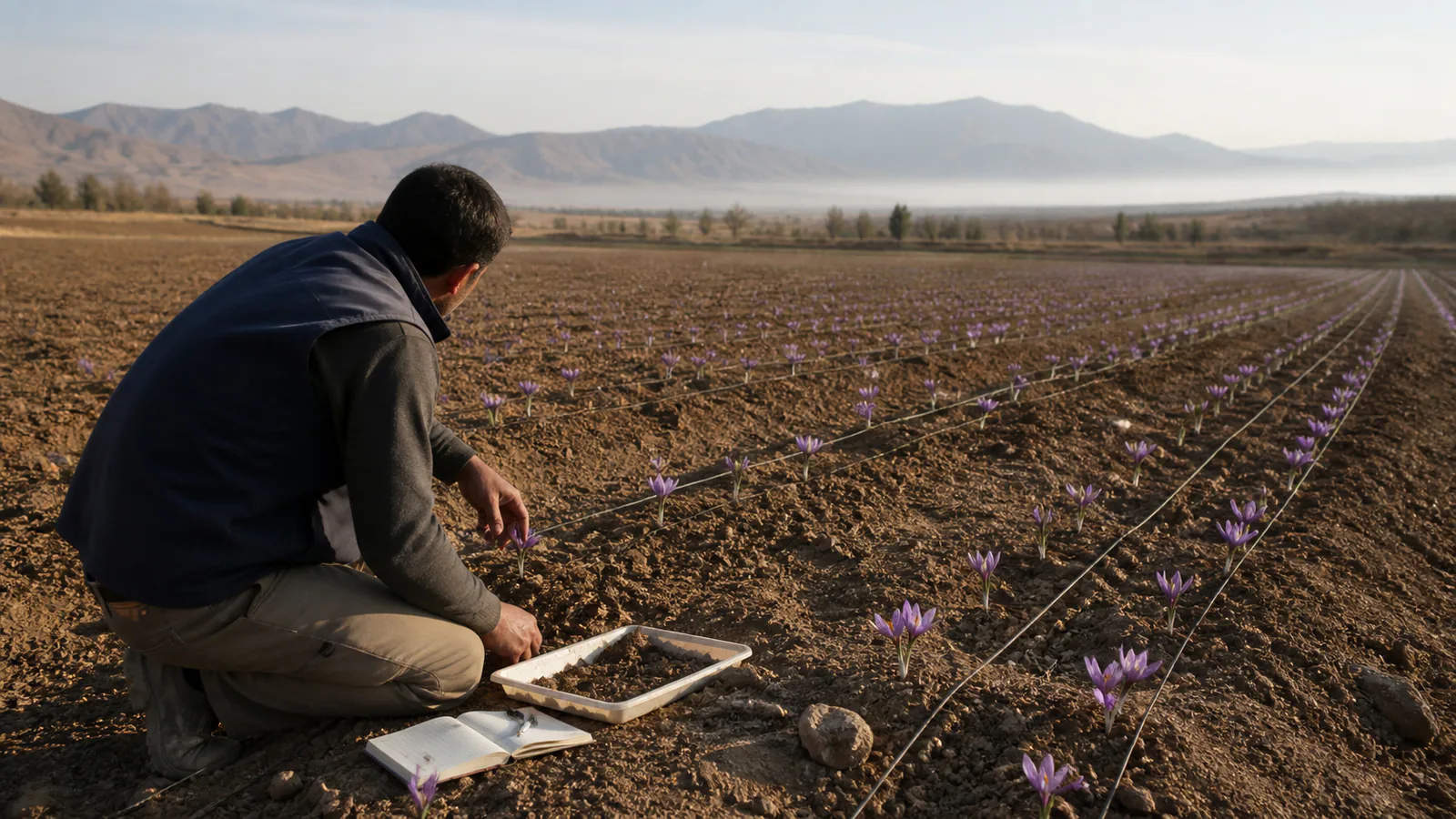
The original ISNA Central Region story followed an agriculture graduate identified as Mir-Davoudi. He had grown lower-water medicinal plants including mint, chamomile and chicory. Their performance encouraged him to test whether saffron could fit the same constrained environment.
Access to suitable land was his first major obstacle. The article says that in Iranian year 1368, equivalent to 1989–90, he leased a field with help from his son, who was studying agriculture. They cleared agricultural pests and first planted corn. After that crop, they prepared the ground again and moved toward saffron.
This sequence matters. Saffron was not treated as an effortless “red gold” purchase. The grower learned the field, carried the cost of rent and preparation, and changed crops as experience accumulated.
What he learned from farms in Mashhad and Qom
Mir-Davoudi visited saffron farms around Mashhad and Qom and compared their ecosystems with districts neighboring Arak. He concluded that parts of Markazi Province with similar seasonal conditions could support saffron. That was a field-based hypothesis, not proof that every parcel in the province was suitable.
Modern research supports the need for site-level caution. Saffron quality varies with temperature, rainfall, soil conditions, cultivation practice and plant health. A regional reputation cannot replace analysis of the exact field.
The hard lesson from leased land
Saffron is a perennial corm crop. Establishment expenses occur before the field reaches a mature production pattern, while corm multiplication and yield develop across seasons. A short or insecure lease can put the grower in the worst position: paying for preparation and establishment without controlling the land long enough to recover value.
The profile says Mir-Davoudi used agricultural credit to cover part of the rental and cultivation cost. Despite the spending and many experiments, he said the leased field did not produce the economic return he wanted. The harvest still gave him technical experience and a path forward, but experience is not cash flow.
Later, cooperation with the Amir Kabir Hotel gave him access to a three-hectare space for medicinal plants, especially saffron, reducing the immediate problem of rented land. The story ends with the practical point that new saffron growers need both land and education.
Is this saffron farm for sale?
No. This page does not advertise land, a farm, a lease or an investment product. A past search impression for “saffron farm for sale” likely came from the discussion of leased fields and investment. Anyone considering a real purchase should verify ownership, water rights, permitted use, soil condition, existing corm stock, disease history, equipment and liabilities through qualified local professionals.
Do not value a field by multiplying its area by a headline saffron price. Dry stigma yield is small, variable and labor intensive. Product grade, harvest timing, drying, buyer terms and rejected lots can change revenue.
What a current investment review should include
Land and tenure
- clear ownership or a lease long enough for the intended production cycle;
- permission for irrigation, structures, storage and access;
- soil drainage, texture, salinity, pH and previous crop/disease history; and
- secure access for workers and harvest transport.
Water and climate
Saffron is often promoted as a low-water crop, but “low water” does not mean “no water.” Flower emergence and corm development depend on rainfall and irrigation timing. Research on Iranian production shows substantial provincial differences in water footprint and economic water productivity. Confirm the source, legal right, quality, delivery cost and seasonal reliability of water.
Corms and plant health
Use correctly identified Crocus sativus corms from a traceable supplier. Inspect lot size, vigor, injury, rot and pest risk before purchase. Moving infected corms can introduce a multi-year problem into clean soil.
Labor and post-harvest capacity
Flowers open during a concentrated period and need prompt picking. Stigmas then require careful separation and controlled drying. A field plan without available labor, clean workspace, drying capacity, packaging and batch records is incomplete.
Market and finance
Model conservative yields, not the best season. Include corms, land, soil preparation, irrigation, labor, drying, testing, packaging, finance, crop loss and the time before revenue. Define who will buy the product and how quality will be measured before planting.
Why low water use alone is not an investment case
The earlier article began with medicinal plants chosen because water was scarce. Saffron can be valuable in arid and semi-arid farming systems; the FAO-recognized qanat-based system in Gonabad is a strong example of crop knowledge adapted to limited water.
That success depends on land and water governance, local experience, labor and market structure. Transplanting the crop without those systems can disappoint. The Central Province case itself shows that biological suitability and financial suitability are different questions.
The enduring lesson from Mir-Davoudi’s story
Mir-Davoudi did not describe his first leased-land results as an easy economic success. He valued the scientific knowledge earned through trials, visits and mistakes, then sought a more workable land arrangement. His first harvest relieved some of the fatigue, but it did not erase the cost.
For a prospective grower in Markazi Province, that is the useful conclusion: start with a test plot and a written production budget, validate the exact field, obtain training, secure tenure, and expand only after real local yield and quality data support the decision.

![Exporting Saffron to Turkey + Price Guide [Complete 0 to 100]](https://img.rowhanisaffron.com/20260827003933/saffron-export-turkey-quality-inspection.webp)



