


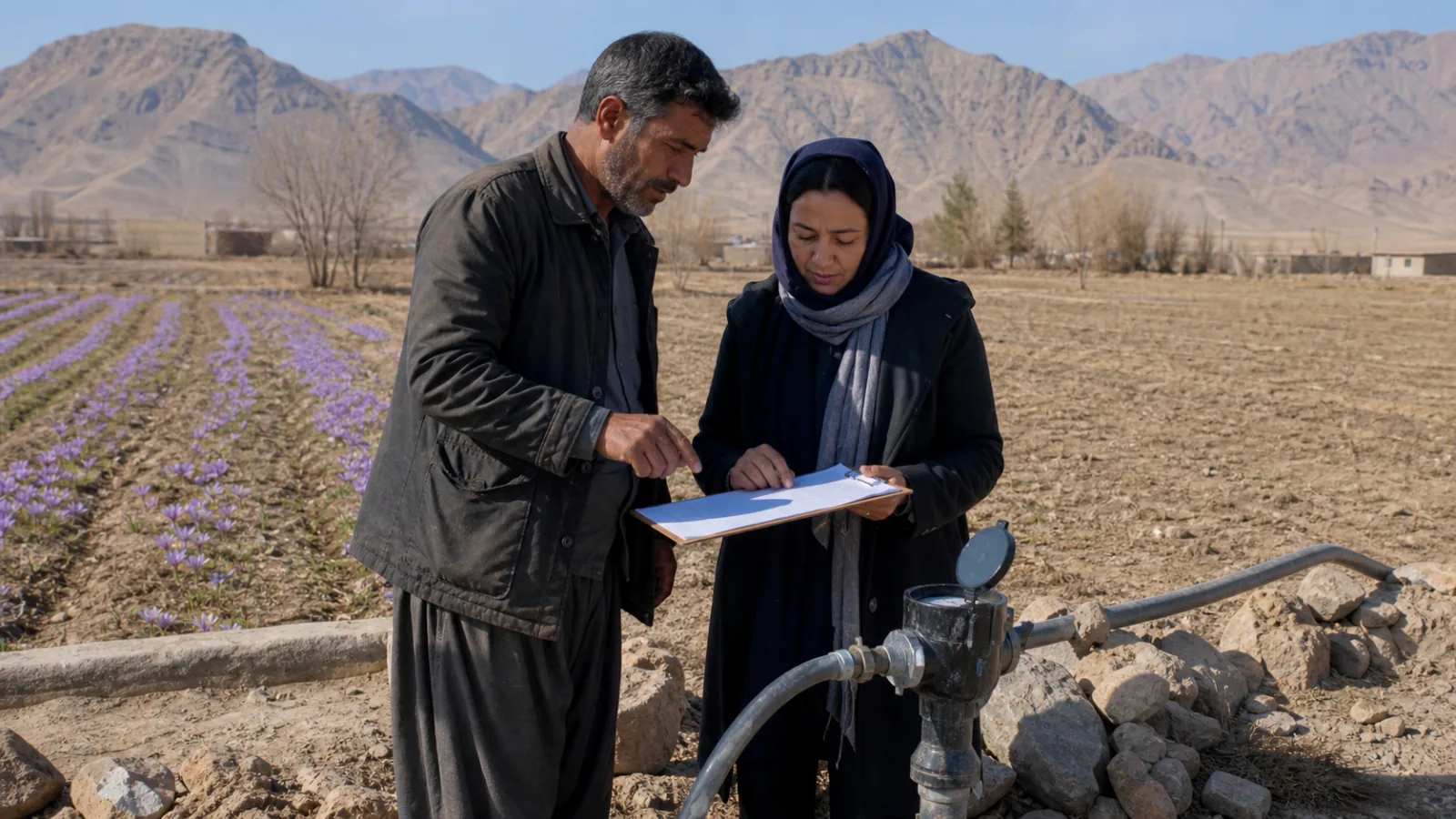
Increasing cultivation of saffron in Kerman province was presented as part of a historical shift away from more water-intensive crops. Abbas Saeedi, then head of Kerman’s Agriculture Jihad organisation, said shrinking water resources made a revised cropping pattern necessary and that farmers were showing interest in saffron.
The announcement also reported 200 hectares of saffron farms in northern Kerman and forecast five tonnes for the province. Those figures describe different geographic scopes, so they cannot safely be divided to claim a 25-kilogram-per-hectare yield.
Why Kerman was reconsidering its crop pattern
Saeedi identified water-intensive crops as a problem for Kerman and said the province was working to reduce them while promoting crops with lower water demand and economic potential. The old translation called them “water species”; the issue was crop water use, not plant taxonomy.
A crop-pattern reform should compare total water withdrawals, timing, yield, income variability and groundwater effects. Saffron may use less irrigation than some alternatives, but expanding it does not create new water or repair an overdrawn aquifer.
Facilities offered to farmers also matter. A change of crop can require suitable corms, field advice, finance, labour planning, drying equipment, quality testing and a market—not only permission to plant.
What the 200 hectares and five-tonne forecast mean
The report put northern Kerman’s saffron area at 200 hectares. Its five-tonne forecast was stated for Kerman province as a whole. It did not provide the full provincial area, bearing area, field-level yields or a final weighed total.
Dividing five tonnes by the northern 200 hectares would mix a province-wide numerator with a subregional denominator. A valid yield calculation needs the dry weight and bearing hectares from the same boundary and season.
The figures are historical estimates, not current statistics. A present-day comparison should identify the reporting year, whether the number is a forecast or result, and whether newly planted fields are included.
Kerman is not one uniform saffron climate
A later climatic-zoning study indexed by FAO AGRIS evaluated altitude, slope, frost, rainfall and temperature across Kerman. It found more favourable areas around the foothills of Baft, Bardsir, Zarand and Shahrbabak, while substantial southern and eastern areas were classed as unfavourable.
That evidence supports a targeted approach. A province can contain both suitable and unsuitable districts, and a map still cannot replace soil, drainage, water-quality and field-history checks.
Zarand and Dasht-e Khak
The historical statement singled out Zarand, especially Dasht-e Khak, as an important saffron area. “The plain of soil” in the old English version was a literal rendering of the place name Dasht-e Khak, not a generic soil description.
A dated IANA report on saffron in Zarand later named Dasht-e Khak, Sarbanan, Jorjafak and Hatkan among the county’s saffron-growing districts. It reported 410 hectares in Zarand and a 1,200-kilogram forecast for that reporting year.
Those later figures help identify the geography, but they do not retroactively replace Saeedi’s earlier 200-hectare statement. Both need their own dates and scopes.
Harvest timing and field logistics
Saeedi said harvesting had begun and would continue in Kerman until late December. The exact window varies across the province because elevation, autumn temperature, irrigation timing and corm condition affect flowering.
A late provincial end date does not mean every field flowers for the whole period. Growers need daily field checks, early picking, shallow ventilated containers, prompt stigma separation and controlled drying during each field’s shorter peak.
Our guide to saffron cultivation covers the corm, soil, water and harvest decisions behind that schedule.
“Desirable quality” needs a disclosed test
The announcement said studies had found Kerman saffron quality desirable, but it did not identify the samples, laboratory, year or results. Appearance or strong aroma alone cannot establish a commercial category.
The ISO 3632-1 saffron specification defines recognised categories and requirements. A meaningful quality statement should name the sampling method, moisture, extraneous matter and laboratory values relevant to colouring strength, bitterness and aroma.
Quality also depends on harvest and post-harvest practice. A suitable climate cannot compensate for slow flower handling, contaminated surfaces, uncontrolled drying or poor storage.
Farmer interest is not the same as durable profitability
Saeedi linked farmer interest to good harvests and yields in Kerman. That response is understandable, but one strong season does not establish the return across a multi-year saffron cycle.
A farm budget should include corm establishment, land preparation, irrigation, replacement losses, peak labour, separation, drying, testing, packaging, finance and sales. It should model low, middle and high yield and price cases rather than a single forecast.
Public support is safest when it helps farmers measure those variables and reach transparent buyers. Encouraging area alone can create excess planting, weak lots or a marketing bottleneck.
How expansion should be measured
A responsible Kerman cultivation programme would publish:
- new, total and bearing hectares by district;
- water delivered and groundwater source by field;
- verified dry yield and quality distribution, not only an average;
- corm source, survival and disease losses;
- labour hours, drying capacity and rejected lots;
- realised farm-gate price, payment time and buyer concentration.
The historical announcement captured a genuine policy direction: Kerman wanted economically useful crops that placed less pressure on limited water. The safe conclusion is to expand only where field evidence, water accounting and a complete value chain support it—not to treat every part of the province or every forecast tonne as equivalent.

![Exporting Saffron to Turkey + Price Guide [Complete 0 to 100]](https://img.rowhanisaffron.com/20260827003933/saffron-export-turkey-quality-inspection.webp)



