


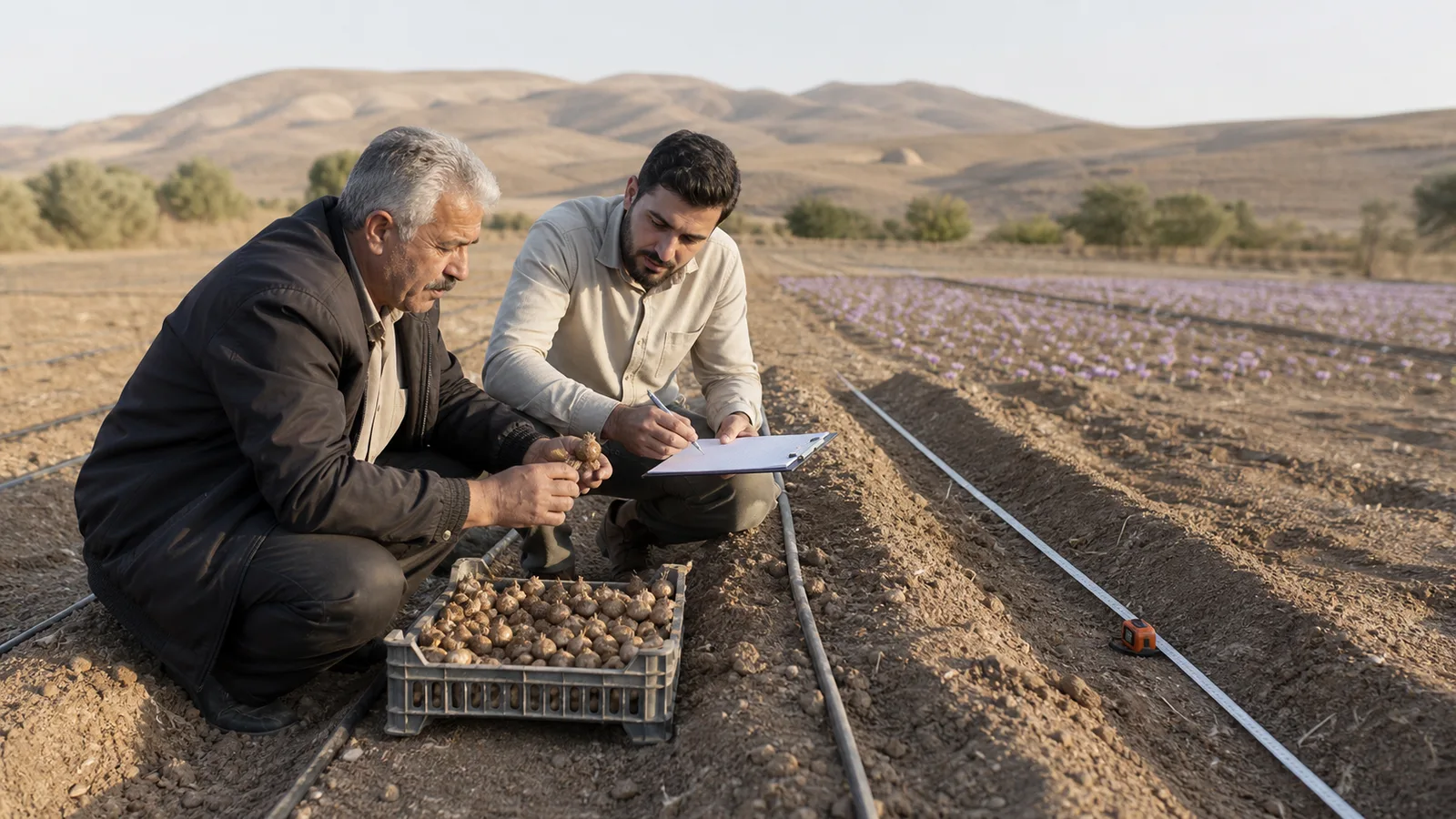
Saffron cultivation in Iran increased by 5,000 hectares in the historical report behind this article, rising from 69,000 to 74,000 hectares. Hashem Naghibi of the Razavi Khorasan agricultural authority described the expansion as relatively good, while reporting a 15% production increase in the province from 218 to 250 tonnes.
Those figures are a dated snapshot, not current acreage or output. They are most useful for understanding the relationship between new land, average yield, rural employment and market capacity.
The five-thousand-hectare increase
Moving from 69,000 to 74,000 hectares is an increase of about 7.2%, not 5,000%. The title refers to the absolute area added. That distinction matters because acreage headlines are easily misread.
The reported output increase from 218 to 250 tonnes is approximately 14.7%, consistent with the article’s rounded 15% statement. Production rose faster than cultivated area in that comparison, but the figures alone cannot show why.
Weather, field age, corm density, irrigation timing, labour and post-harvest losses can all change output. Newly planted saffron also does not behave like a mature field in its first season.
Razavi Khorasan’s role
The source said saffron was cultivated in 29 counties or cities of Razavi Khorasan and attributed more than 80% of Iran’s saffron area and production to the province. These are historical shares and should remain attached to the report’s period.
Zaveh was identified as the province’s leading production centre, with about 11,000 hectares and more than 38 tonnes of dried saffron. The implied average is roughly 3.45 kilograms per hectare, close to the article’s provincial average of about 4 kilograms after allowing for rounding and different field conditions.
A later agricultural report also described Zaveh at around 11,000 hectares and approximately 40 tonnes. That consistency supports the scale of the original statement without turning it into a current number.
The 330- and 310-tonne world figures
The article put world saffron production at 330 tonnes and Iran’s contribution at 310 tonnes, or 94%. The percentage is arithmetically consistent: 310 divided by 330 is about 93.9%.
It does not reconcile neatly with the earlier 250-tonne provincial figure unless the numbers cover different years, estimates or geographic scopes. Production statistics for a crop can also vary between forecasts and final reports.
For present analysis, use a dated source that defines dried product, crop year and coverage. Do not combine the 218→250 provincial comparison with the 310 national estimate as if they came from one final ledger.
The “117 million households” translation error
The stored English text says 117 million households in Razavi Khorasan were involved in saffron production. That is impossible for the province and is clearly a translation or unit error.
The intended figure was likely around 117,000 households or people, but the surviving post does not show the original unit clearly enough to assert which. Later reports have used figures around 119,000 families and 130,000 people in the province. This article therefore preserves the damaged number as an error and does not convert it into a false exact count.
The underlying point remains: saffron supports a large rural workforce, especially during the short harvest and separation period. Employment estimates need a definition—households, permanent workers, seasonal workers or person-days—before they are compared.
Why more land is not automatically better
Acreage expansion can raise total output, but it can also spread healthy corms, skilled labour, water and drying capacity too thinly. A field planted because saffron is fashionable may underperform if the site drains poorly or the grower has no buyer for the finished grade.
Before planting, the farm plan should cover:
- soil condition, drainage and water quality;
- corm source, health, density and replacement plan;
- labour for rapid picking and stigma separation;
- drying capacity for peak flower days;
- saleable-yield assumptions across field ages; and
- a buyer specification and conservative price scenario.
A new hectare that produces weak or poorly dried saffron can add cost without adding durable value.
Measure saleable yield, not only dried weight
The reported average of four kilograms per hectare should be treated as a benchmark, not a promise. The farm should record dried weight by plot and then identify what portion meets the intended specification.
Lot rejection, excess moisture, yellow style material, foreign matter and inconsistent drying can reduce saleable output. Improving these points may create more accepted product from existing fields before another hectare is planted.
Our overview of saffron cultivation in Iran keeps national acreage and production estimates with their dates. The historical five-thousand-hectare increase belongs in that timeline, but the farm decision should be made from local records.
What the expansion should teach
The 69,000-to-74,000-hectare change showed strong farmer interest and Razavi Khorasan’s dominance. The 218-to-250-tonne production rise showed that output could move differently from area. Zaveh demonstrated how one established centre combined land, skill and processing at scale.
The safer conclusion is not “plant more saffron.” It is to expand only when field suitability, labour, drying, quality evidence and demand grow together. Hectares are easy to count; profitable, traceable kilograms are the result that matters.

![Exporting Saffron to Turkey + Price Guide [Complete 0 to 100]](https://img.rowhanisaffron.com/20260827003933/saffron-export-turkey-quality-inspection.webp)



