


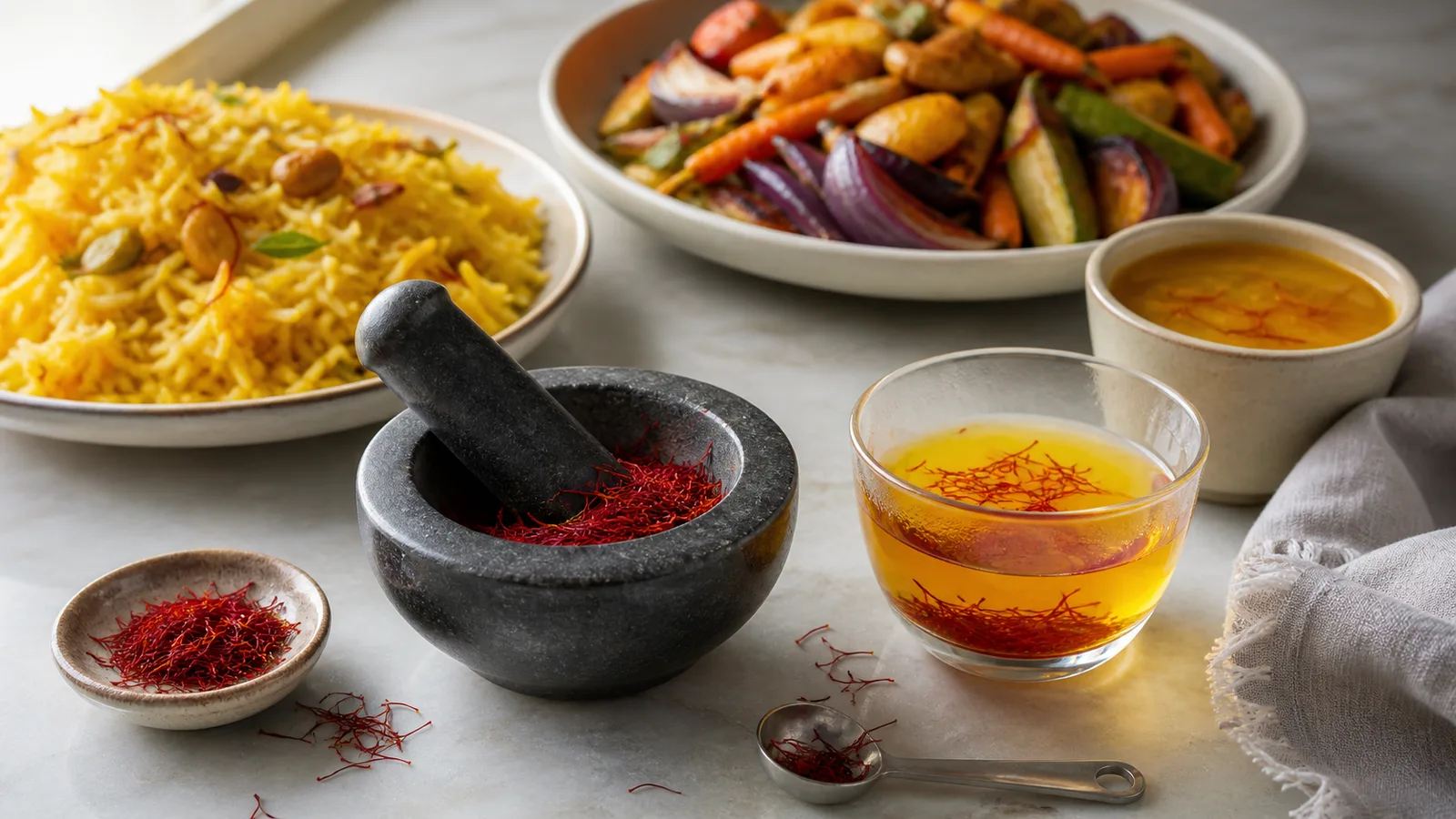
The most reliable method for using saffron in cooking is to lightly crush a small pinch, steep it in a few tablespoons of warm water for 10–20 minutes, and add the golden infusion to the dish. For a meal serving four to six people, about 0.05–0.1 g is usually enough. Add some where it can color the food evenly, then reserve a little for the final stage if you want a fresher aroma.
Saffron consumption does not need to be complicated. Among saffron uses, cooking is the most direct: good threads, restrained quantities, correct blooming, and protection from excessive heat will do more for a recipe than using a large dose. These saffron consumption methods work in Persian and international dishes: rice, stews, chicken, meats, seafood, vegetables, bread, desserts, milk, tea, and other beverages.
How to prepare saffron for cooking
Blooming gives the water-soluble color compounds time to disperse before the spice meets a large pot of food. It also avoids the uneven result of dropping a dry clump into one corner of a dish. If you want to know how to use saffron in cooking, this is the core technique.
A dependable warm-water method
- Measure a small amount. Start with 0.05–0.1 g for four to six servings. Thread count is only approximate because length and thickness vary.
- Crush lightly. Use clean fingers or a small mortar. Aim for short pieces, not an anonymous fine powder.
- Add warm water. Cover the saffron with 2 to 4 tablespoons of water at roughly 60–80°C (140–176°F).
- Cover and wait. Let it infuse for 10–20 minutes.
- Use both parts. Add the liquid and softened threads unless a perfectly smooth finish is important.
This answers the practical part of how to get the most out of saffron: use enough liquid to spread it, keep the cup covered, and give it time. A spoonful of sugar in the mortar is optional for tea or dessert, but sugar is not needed to extract the spice.
Milk, stock, and ice methods
Warm milk can bloom saffron for custard, kheer, rice pudding, or a drink, although its color is easier to judge in water. Unsalted stock works for savory dishes when its flavor will not overpower the saffron. Ice blooming is a slower traditional method; it is not necessary for good results and has no automatic quality advantage over controlled warm water.
Our complete saffron infusion guide compares these methods in more detail.
When to use saffron: before or after cooking?
The useful answer to “do you add saffron before or after cooking?” is often both, in small portions. Timing depends on the food.
- Rice: mix some infusion with a portion of cooked or parboiled rice for even gold color. Add it during the final steaming or fold it through just before serving.
- Stews and sauces: add most of the infusion during the later part of simmering, once you know the final liquid volume. Very long boiling can flatten the aroma.
- Chicken, meat, fish, or vegetables: use a little in the marinade or cooking liquid for penetration, then brush or spoon a small reserved portion on near the end.
- Bread and desserts: put the infusion into the wet ingredients so it disperses through the batter or dough. Reserve a little for syrup, glaze, or garnish if appropriate.
- Tea and milk: add the finished infusion after the base drink is brewed or heated.
So, when to use saffron is not governed by a single “always add it at the end of cooking” rule. Earlier addition spreads color and flavor; later addition protects more of the volatile aroma. Splitting the infusion gives you both. It preserves aroma, not unproven medicinal properties.
How much saffron to use
For most home cooking, start with these practical ranges and adjust in a later batch:
- Four to six servings of rice, stew, soup, or sauce: 0.05–0.1 g
- One cup of tea or milk: 8–15 threads, approximately 0.02–0.04 g
- A large festive dish serving eight to twelve: 0.1–0.2 g, depending on other ingredients
These are culinary starting points, not medical doses. Strong spices, tomatoes, coffee, dark stock, smoke, or heavy sweetness may hide saffron; the answer is usually to simplify the pairing rather than keep adding more.
The old article called 1 gram per day a recommended maximum. That is not a useful cooking target: 1 g is many times a normal culinary portion, and there is no single universal daily limit that fits every person, product, or medical circumstance. A 2026 systematic review of human saffron safety data found that medicinal use was generally tolerated but that gastrointestinal effects were the most frequently reported adverse events; higher doses and prolonged medicinal use deserve clinical oversight.
If you are trying to decide how much saffron to use in cooking, begin at the low end. A balanced dish should smell distinctly floral and hay-like, taste gently bitter, and look golden—not medicinally strong or harsh.
What does saffron do to food?
The use of saffron in cooking is mainly sensory:
- Color: crocins dissolve into water and create a yellow-to-gold tone.
- Aroma: safranal contributes a distinctive dry, floral, honeyed scent.
- Taste: picrocrocin contributes gentle bitterness that balances rich or sweet food.
What is saffron used for in cooking? It creates a flavor and aroma that no food dye can reproduce. It does not need a health-benefit claim to justify its place in a recipe.
How to use saffron in food
Rice and grains
Spoon the infusion over a small portion of cooked basmati, then fold that golden rice through the platter or arrange it on top. In risotto, paella, or pilaf, add the infusion after the grains have begun absorbing liquid so you can judge the final color.
Stews, sauces, and soups
Saffron works best in a base that is not dominated by burned spices or an excessive quantity of tomato. Add it late enough to remain aromatic, but allow several minutes for the flavor to integrate.
Chicken, meat, fish, and vegetables
For a marinade, mix a measured infusion with yogurt, citrus, oil, or grated onion. Keep raw-protein marinade separate from any saffron mixture used as a finishing sauce. Roasted cauliflower, carrots, squash, potatoes, and onions also carry saffron well.
Milk, sweets, and baking
Kesar is another name for saffron, so how to use kesar in food follows the same method: bloom first, then add the measured liquid. Zafran is another transliteration; for anyone searching “zafran how to use,” the answer is the same. It pairs naturally with cardamom, rosewater, pistachio, almond, citrus, vanilla, and dairy. Too many perfumes together can obscure it.
How to eat saffron is therefore mostly a question of how to use it in a suitable food or drink. Culinary saffron is normally dispersed through a recipe rather than swallowed dry by the spoonful.
Choosing high-quality saffron
Buy threads from a reliable, trustworthy source that can identify origin, lot, and quality basis. Reputable suppliers should be able to support purity and grade claims. Genuine saffron threads are deep red, often with a slight trumpet-shaped end, and have a complex dry aroma. A bright uniform powder is harder to assess and may contain additives, permitted color, another plant, or undeclared filler.
The old warning about cornflower or artificial essence reflects a real concern—adulteration—but appearance alone cannot prove purity. Laboratory testing is the stronger evidence. ISO 3632 specifies analytical approaches for dried saffron, including characteristics related to color, bitterness, aroma, moisture, and foreign matter.
Storing saffron properly
Light, heat, moisture, oxygen, and strong odors reduce saffron quality. Keep dry whole strands in a clean airtight glass container, preferably opaque or stored inside a cool, dark cupboard. Use a small container so there is less air around the spice, and open it only with dry hands or a dry spoon.
Do not store saffron above the cooker, beside a sunny window, or in a damp refrigerator. Buy an amount you can use while its aroma remains fresh. Prepared infusion belongs in a clean covered container in the fridge and should be made in a modest quantity rather than treated as shelf-stable.
Preparing saffron tea safely
For one cup, lightly grind 8–15 threads into short pieces, cover with 240 ml hot water, and steep for 5–10 minutes. Lemon, cardamom, mint, or a small amount of honey can be added for flavor. Powdered saffron is harder to authenticate, so begin with visible threads when possible. The old direction to use a teaspoon of saffron in half a cup of boiling water could deliver far more spice than a normal cup needs.
Saffron tea is a food or beverage, not an “effective” daily medical treatment. A normal culinary cup is different from an extract, capsule, or high-dose preparation. People who are pregnant, take anticoagulant or antiplatelet medicines, have low blood pressure, or plan repeated concentrated use should discuss supplements or medicinal quantities with a qualified clinician. Reported adverse effects in medicinal studies include nausea and headaches, but the evidence does not justify telling every cook that saffron will thin the blood, cause skin yellowing, or produce a fixed list of symptoms at exactly 1 gram.
The short version
How is saffron used? Measure a pinch, crush it lightly, bloom it under cover, and place the infusion where it can spread. Use modest amounts, choose timing for the dish, store the remaining threads well, and judge the result by aroma and balance. The same guidance applies whether the label says saffron, kesar, or zafran.

![Exporting Saffron to Turkey + Price Guide [Complete 0 to 100]](https://img.rowhanisaffron.com/20260827003933/saffron-export-turkey-quality-inspection.webp)



