


Making money from Iranian saffron is less about finding a single high price and more about controlling the value chain. The crop must be grown well, dried cleanly, tested, graded, packed for a real customer and sold through a route that can be repeated. A business that handles only one step can still succeed, but it needs to know who performs—and earns from—the steps around it.
What the original National Saffron Council interview argued
This article began as a 2020 report of remarks by Mohsen Ehtesham, identified as chairman of Iran’s National Saffron Council. He described the council as a national organisation of producers and exporters and said its role was to coordinate activity from production through export.
At the time, Ehtesham said the council had spent eight years implementing a national quality-improvement plan. He also discussed international registration of an Iranian saffron brand and a strategic plan for production and export that had been sent through government and trade-development bodies for approval.
Those remarks are useful historical context, not a statement of the council’s present legal powers or the current status of every proposal. Readers interested in one milestone can also review our archive on how Iran’s national saffron brand was presented in Germany.
Where saffron businesses actually create value
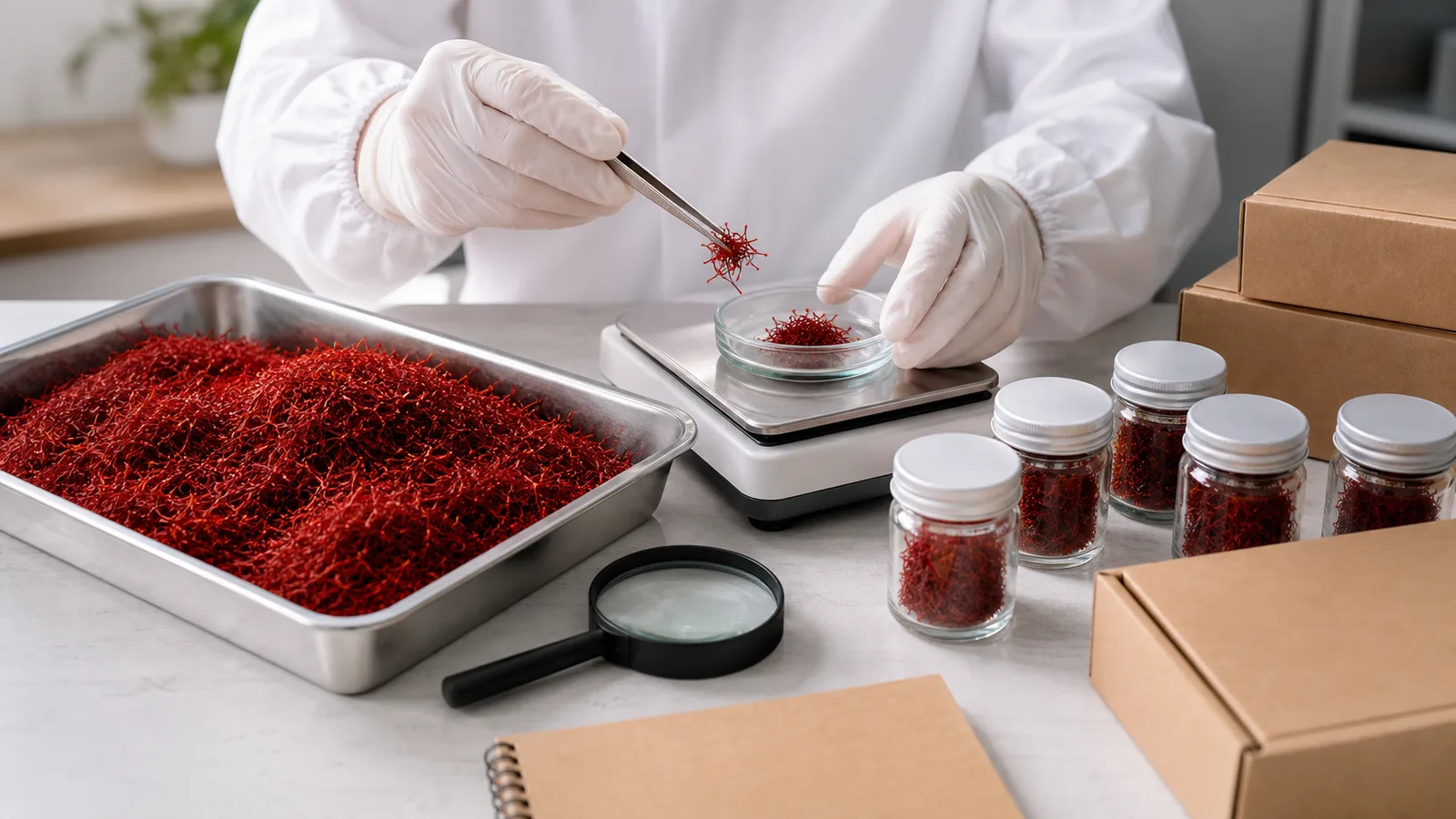
A kilogram of flowers, fresh stigmas, dried bulk saffron and small retail packs are not the same commercial product. Each stage adds work, cost and risk:
- Farm production: healthy corms, field management, harvest timing and flower-picking labour.
- Stigma separation: fast, hygienic handling before flowers deteriorate.
- Drying: controlled moisture removal that protects aroma, colour and shelf stability.
- Cleaning and grading: removing foreign matter and separating products by defined characteristics.
- Testing: confirming identity, moisture, quality parameters, residues and microbiological requirements for the intended market.
- Packaging: protecting the spice from moisture, light, odour and tampering in a size customers want.
- Distribution and marketing: reaching buyers, documenting provenance, supporting the product and earning repeat orders.
A UNIDO study of Iran’s saffron value chain found that substantial value was added after bulk export through activities such as resorting, packaging, marketing and retail. The durable lesson is not that every grower should become an international retailer. It is that a business should choose its position deliberately and understand where the final customer’s payment goes.
1. Earn from reliable production
For a grower, revenue begins with saleable dry stigma, not planted area. Before expanding, calculate expected yield by field age, labour during the short flowering window, corm replacement, water, nutrition, weed control, drying loss and the grades a buyer will accept.
Do not build a plan around the best yield or highest quoted price. Use conservative, normal and strong scenarios. Include a poor flowering year and a delayed payment. If the business fails under modest changes, the margin is too fragile.
2. Earn from post-harvest quality
Flowers lose quality while waiting. A post-harvest service can organise collection, hygienic separation and consistent drying for multiple farms. Its value comes from reducing delay and variability, not from making unsupported claims about one province or grower.
Keep lots traceable. Record the farm, harvest date, handling time, drying method, final weight and storage conditions. Never blend a questionable batch into a stronger one to hide a problem.
3. Earn from testing and transparent grading
“Premium” is not a useful grade by itself. Buyers need a written specification and evidence that the delivered lot matches it. A testing and quality-assurance business can help producers sample correctly, interpret laboratory results and prepare the records required by a destination market.
FAO’s recent work with Iran’s saffron sector has emphasised production practice, post-harvest management, safety, traceability, modern marketing and digital branding. That combination appears in the FAO account of its quality-integrity workshop. Branding works best after the product and records are dependable.
4. Earn from packaging that serves a buyer
Small packs can earn more per gram than a bulk shipment, but they also add container, design, filling, labelling, compliance, warehousing, breakage, marketing and fulfilment costs. The right pack depends on the channel: a chef, distributor, gift buyer and supermarket may each need something different.
Good packaging protects the threads and makes inspection possible. It should not create a large, expensive box around a tiny amount merely to look luxurious. Accurate weight, batch information, storage guidance and tamper evidence build more durable trust.
5. Earn from products that use saffron meaningfully
Saffron can be sold as an ingredient in prepared foods and beverages when the product is properly formulated, manufactured and labelled. A product must offer more than a saffron name on the front. The customer should be able to taste, smell or see a meaningful contribution from the spice, and the business must control stability and dosage.
Do not turn preliminary research or traditional use into a treatment claim. Food, supplement and cosmetic rules differ by market. Check the destination’s requirements before investing in a formula or printed packaging.
6. Earn from specialised B2B service
Not every opportunity requires owning saffron. Businesses can provide aggregation, sampling, laboratory coordination, traceability systems, compliant labels, photography, translation, freight documentation, temperature- and humidity-aware storage, or buyer support. The strongest service solves a costly problem and can show the result.
Balance production with real demand
Ehtesham argued that supply must grow in proportion to consumption and that producers, exporters, medicinal-plant organisations, agricultural associations and rural cooperatives needed to work together. That principle is sound: more production without new demand can depress farm prices or move inventory into storage.
Demand planning should be concrete. Identify target countries and buyer types, packaging sizes, annual purchasing cycles, price sensitivity, payment terms and competing origins. A letter of interest is not the same as a paid repeat order.
Fair farmer prices cannot be declared in isolation
The old interview said Iran’s production position should allow it to determine the market price and called for a base price in Khorasan. It also sought price stability for farmers and consumers. A fairer return is a legitimate goal, but a global price cannot simply be announced by one organisation. Quality, supply, inventories, buyer alternatives, currency, finance and transparent competition still shape transactions.
Better routes to fairness include clear grades, reliable market information, competitive buying, enforceable contracts, warehouse and finance options, lower post-harvest loss, and a larger share of sales made under the producer’s or exporter’s own identity.
Exporter qualification and consumer rights
Ehtesham proposed qualification cards for specialist exporters. In his account, the aim was to reduce destructive competition, smuggling and the use of disposable export credentials while creating accountability for marketing and product quality. He also called for consumer protection from production through packaging, inside and outside Iran.
Qualification can improve trust only when criteria are public, proportionate and independently enforced. A mandatory collective mark must not become a substitute for batch testing, legal export documentation or the exporter’s responsibility to a customer.
The interview also said private-sector and government representatives in Razavi Khorasan and South Khorasan had approved discussion of delegating some industry, mining and trade authority to the council. That records the proposal as it was reported in 2020; it does not establish that such authority was ultimately transferred or remains in force.
The proposed branding fund
The interview proposed collecting 0.5% of the value of saffron exports into a council fund. Committees involving industry, agricultural, trade and council bodies would direct the money to quality, production research, marketing, branding and market positioning.
That is a historical proposal, not a fee this article tells exporters to pay. Any current levy, authority or application procedure must be checked against current law and official instructions. A shared fund also needs published governance, eligible uses, procurement controls and measurable results.
Currency return and export compliance
The 2020 remarks asked the public sector to resolve problems around returning export currency, arguing that the rules encouraged smuggling and one-use exporters. These are time-sensitive legal and financial issues. A seller must obtain current advice on customs, sanctions, banking, foreign-exchange return, tax, food law and destination-country documentation before accepting an order.
A practical unit-economics check
Before choosing a saffron business model, calculate revenue and cost at the same unit. For a retail pack, begin with the collected selling price and subtract saffron, testing, package, filling, rejected units, marketplace or distributor margin, payment fees, freight, returns, marketing, tax and overhead. For farming, calculate per hectare and per saleable gram rather than per flower or wet stigma.
Run the calculation again with a lower selling price, lower yield, higher labour cost and slow payment. Include the working capital tied up while saffron is stored. Profit is what remains after those costs and risks—not the difference between a farm-gate quote and a retail price seen online.
The best route is evidence-led
The National Saffron Council interview was right to focus on quality, coordination, branding, consumer rights and moving beyond anonymous raw exports. Those aims are also visible in official programmes for better production, processing, distribution and export. They do not promise easy income.
Choose one customer problem, verify the rules, test the product or service at small scale, record every cost and build repeat demand. That is how Iranian saffron becomes a business rather than a hopeful price calculation.

![Exporting Saffron to Turkey + Price Guide [Complete 0 to 100]](https://img.rowhanisaffron.com/20260827003933/saffron-export-turkey-quality-inspection.webp)



