


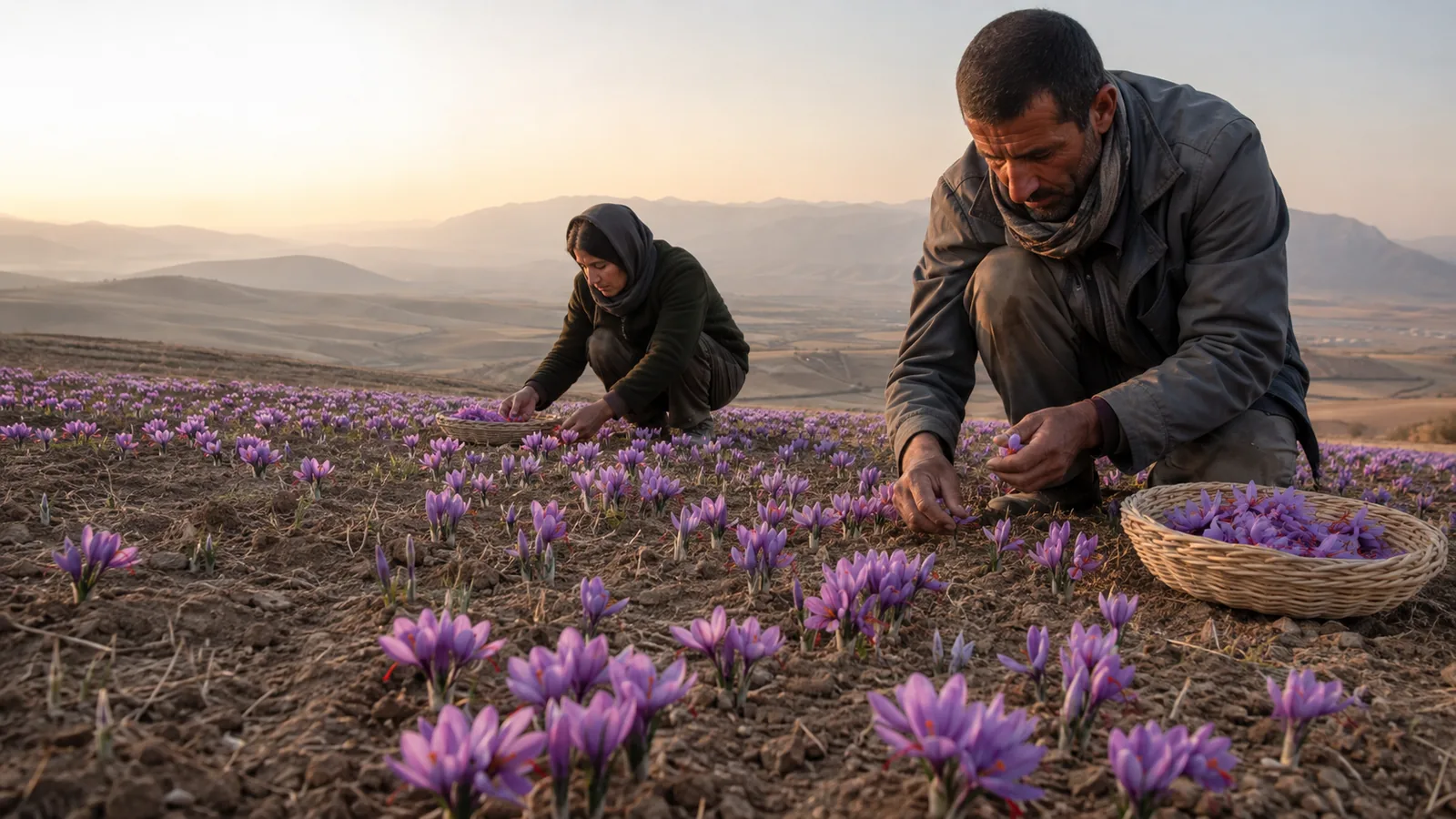
Saffron production in Kermanshah entered its 2025 harvest with 830 hectares reported under cultivation and a provincial forecast of about six tonnes of dried saffron. Picking had begun in the warmer districts, while colder fields were expected to remain active into December.
The 2025 Kermanshah saffron harvest at a glance
The figures came from Rahman Feyz-Ghorbani, horticulture director at the Agricultural Jihad Organization of Kermanshah Province, in a report carried by ISNA. Of the province’s 830 hectares, 200 hectares had been planted during the year. Those new fields were important to the longer-term cultivation area, but they could not be expected to contribute like established fields in their first season.
Feyz-Ghorbani forecast roughly six tonnes for the harvest, compared with 3.5 tonnes reported for the previous year. These are dated official estimates from the 2025 report, not current production statistics or a guarantee of the final crop.
Why new fields lower the average yield
Saffron is grown from corms and is normally kept in the ground for several seasons. The report placed the strongest production in the third and fourth years. It gave a mature-field average of about nine kilograms per hectare in Kermanshah, while a first-year field might produce only around 100 grams per hectare.
That difference helps explain the provincial forecast. A rise in planted area does not produce an equal rise in dried saffron during the same season. New corms must establish, and the stand changes as daughter corms develop. Field age, corm size and density, irrigation and seasonal weather all affect the eventual number of flowers and dried stigmas.
A field study indexed by FAO AGRIS also identifies age and location as important to saffron yield and corm development. The Kermanshah saffron suitability research found favourable conditions in several parts of the province, but suitability is not a promise that every farm will reach the same yield.
Where saffron was being grown in Kermanshah
The 2025 report named Kermanshah city, Dalahu, Sonqor and Koliai, Harsin and Eslamabad-e Gharb among the active cultivation areas. It said saffron was grown across much of the province but not in the hotter Qasr-e Shirin district. The corrected name Sonqor and Koliai replaces the damaged place name that appeared in the earlier English version.
Kermanshah contains marked differences in elevation, temperature and rainfall, so the flowering calendar does not move in step everywhere. Research on agricultural suitability in the province has identified favourable land in Kermanshah, Mahidasht, Eslamabad, southern Javanrud, Ravansar, Kangavar, Gilan-e Gharb and Sarpol-e Zahab. That broader suitability map and the districts named in the news report describe different things: one models potentially suitable land, while the other records places where cultivation was reported.
Harvesting moved from warmer to colder districts
Picking had already started in warmer parts of the province when the article was published on 23 October 2025. Feyz-Ghorbani expected the season to continue through December in colder areas. This staggered timing is useful for understanding saffron harvest news in 2025: “harvest began” referred to the first active districts, not to every Kermanshah field opening on one day.
The flowers need prompt attention once they open. Picking is usually concentrated in the cooler part of the day, followed by careful separation and drying of the stigmas. A longer provincial season can spread activity geographically, but each individual lot still depends on timely handling.
How to interpret the six-tonne forecast
The headline forecast sits reasonably beside the area figures, but it should remain a forecast. If 200 of the 830 hectares were new and produced only a small first crop, the established area would carry almost all of the provincial total. Actual output could then change with field age, flowering, labour availability and drying losses.
The comparison with the previous year’s 3.5 tonnes describes a substantial expected increase. It does not establish the percentage ultimately harvested because this report did not include a final post-season result. Readers comparing years should use one consistent measure—preferably dried saffron—and check whether the acreage includes non-bearing new fields.
What the quality claim does and does not show
Feyz-Ghorbani said testing placed Kermanshah saffron among high-quality products capable of competing in domestic and international markets. The earlier article called the crop exceptional and highly sought after, but it did not publish the laboratory, sample size, test values or sales evidence needed to support those broader claims.
The fair conclusion is narrower: provincial officials reported favourable test results. A buyer should still request results for the actual lot, including its product form and agreed specification. Colour, aroma, bitterness, moisture, foreign matter and handling can vary between fields and processors; a province-wide reputation cannot replace a representative sample.
From a larger crop to a stronger local industry
More planted hectares create work during cultivation, picking and stigma separation, but the lasting value depends on what happens after harvest. Controlled drying, clean storage, lot identification, suitable packaging and access to buyers determine whether the crop can be sold as a recognised Kermanshah product rather than as anonymous bulk saffron.
That challenge is explored further in our article on promoting and branding Kermanshah saffron. Production and branding should be read together: expansion without consistent post-harvest control can increase volume while leaving much of the commercial value elsewhere.
A dated record of Kermanshah’s 2025 season
This article preserves the specific facts people searched for in the 2025 harvest report: 830 hectares under saffron, 200 newly planted hectares, a six-tonne forecast, the earlier 3.5-tonne crop, mature-field yields near nine kilograms per hectare and very low first-year output. It also preserves the reported harvest window from late October into December.
Those numbers show a province expanding its saffron area while waiting for young fields to mature. They should be used as a snapshot of that season. A present-day farm or purchasing decision needs the latest local field data and a lot-specific quality assessment.

![Exporting Saffron to Turkey + Price Guide [Complete 0 to 100]](https://img.rowhanisaffron.com/20260827003933/saffron-export-turkey-quality-inspection.webp)



