


A historical agricultural account reported harvesting more than 1 ton of saffron in North Khorasan. Its principal estimate was 1.5 tonnes from about 360 bearing hectares, within a total saffron area of 570 hectares, and it identified Farooj, Esfarayen and Shirvan as the province’s main growing counties.
The reported 1.5-tonne harvest
Haidar Namvar, then described as director of horticultural affairs for the North Khorasan Agricultural Jihad organization, announced a harvest of one and a half tonnes. That equals 1,500 kilograms of dried saffron.
Namvar’s figures distinguish 570 hectares planted from 360 hectares described in the old translation as “fertile.” In agricultural reporting, bearing and non-bearing area are clearer terms. On that reading, about 210 hectares had not yet entered the productive calculation.
Checking the four-kilogram average
The report gave an average yield of four kilograms per hectare. Applied to 360 bearing hectares, four kilograms gives 1,440 kilograms, close to the rounded 1.5-tonne provincial total. The arithmetic is broadly consistent.
It would not be consistent to divide the same output by all 570 planted hectares and still call the result a bearing-field yield. Reporting both planted and productive area prevents that kind of confusion.
Why the old figures appear to conflict
The surviving English text combines several time references. It mentions 470 hectares and a 1,700-kilogram crop, then says this was more than 30 percent above “last year.” Elsewhere it returns to 340 hectares, a three-kilogram average and another reference to the previous year.
Those lines may come from reports for different seasons, but their dates are missing. The safest reading is to preserve each figure without forcing them into a single year-by-year series. In particular, 1,700 kilograms is larger than 1,500 kilograms, so it cannot be described as the preceding result and the smaller figure as an increase without additional evidence.
The earlier 340-hectare account
A second passage said 340 hectares of agricultural land had been allocated to saffron and that about three kilograms of pure dried saffron could be harvested per hectare. Multiplying those values gives roughly 1,020 kilograms, which explains the headline’s “more than 1 ton.”
The same passage said 340 hectares had been planted in the previous year. Because no increase was stated between those two identical area figures, this may describe established area rather than a new 340-hectare expansion. The article does not guess where the missing date belongs.
Farooj had the largest planted area
Namvar assigned the largest saffron area to Farooj, at 400 hectares, followed by Esfarayen at 120 hectares. He also said most provincial saffron was associated with Farooj and Esfarayen, with a smaller amount cultivated in Shirvan.
The old English renders these places as “Farooji” and “Asflayas.” The established county names Farooj and Esfarayen preserve the intended geography. The page also keeps Shirvan County explicit because that term was the only visible exact-page Search Console query.
Later official data show substantial growth
A dated 2020 report from the provincial agricultural authority described a much larger sector: 3,997 hectares and 20 tonnes of saffron in North Khorasan, with an average yield of six kilograms per hectare.
That release reported saffron in all eight counties. Farooj alone accounted for 2,453 hectares and about 14 tonnes, while Shirvan and Esfarayen ranked second and third. These later figures confirm the direction of growth but do not replace the older 1.5-tonne snapshot.
Traditional cultivation and field life
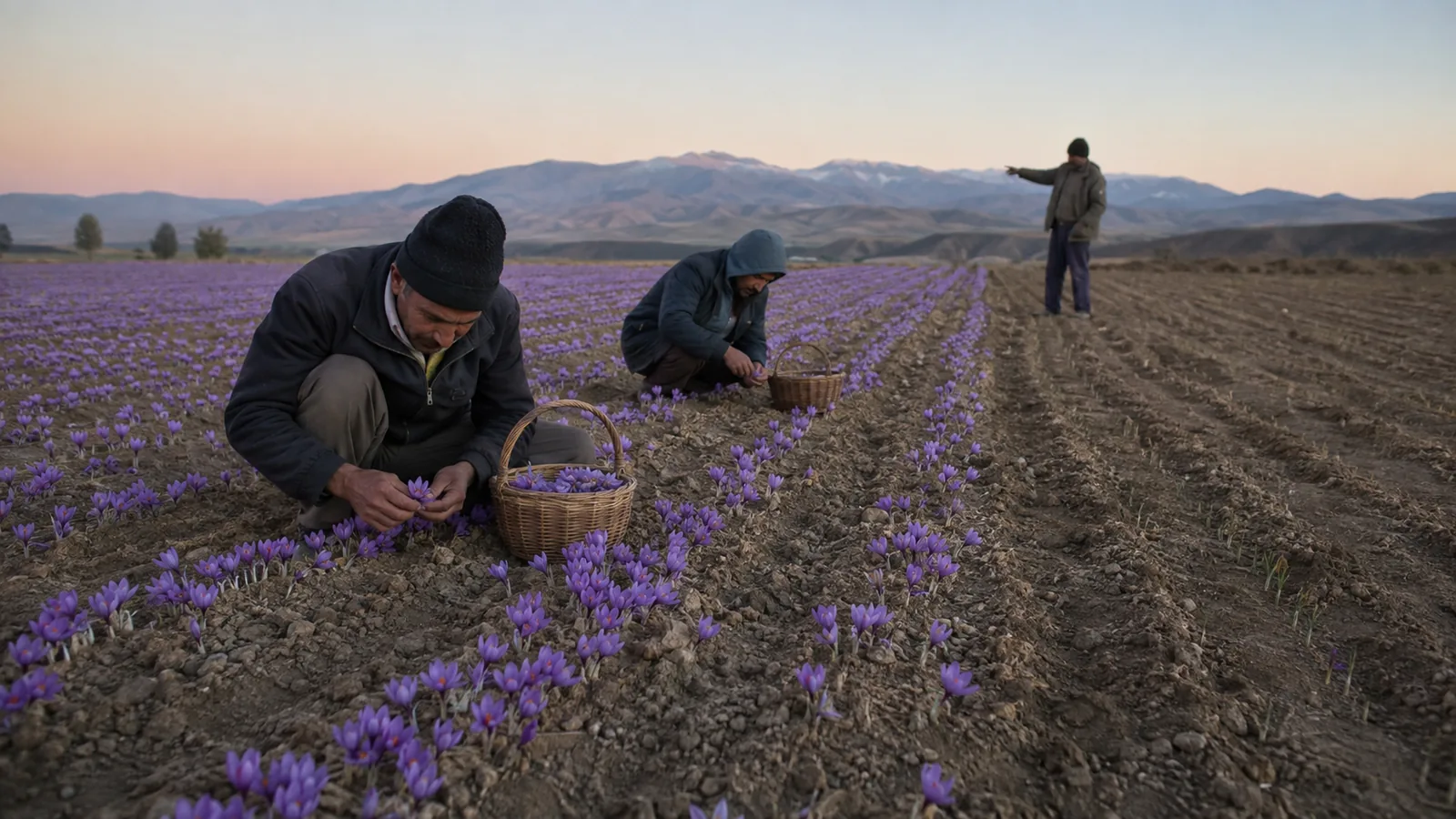
Namvar described cultivation in the province as traditional. He said the most useful production period was five to six years, although a field could continue to be harvested for up to ten years.
Field longevity is not a fixed promise. Corm density, soil condition, weeds, disease, irrigation, nutrition and local climate determine whether keeping an older planting is worthwhile. Growers should compare yield and quality over time with the cost and risk of lifting and replanting corms.
What “pure saffron” should mean
The three-kilogram passage calls the product “pure saffron.” Purity should mean that the dried material is genuinely saffron and free from undeclared foreign matter; it does not establish grade, origin or quality by itself.
Commercial assessment also considers moisture, foreign material, thread composition, cleanliness and validated analytical characteristics. A regional yield statement cannot substitute for examination of the individual lot.
The price line cannot be recovered safely
The old text gives a price of “230 to 39 thousand tomans” per kilogram. The range is malformed, lacks a date and may have lost zeros or separators in translation. Recasting it as 2.3 million, 3.9 million, 23 million or another amount would be guesswork.
For that reason, the price phrase is preserved here as an identified data-quality problem rather than a historical quotation suitable for calculation. Current buyers and growers need a dated price for a named grade and market.
Harvesting is only the first stage
The reported tonnage refers to dried saffron, not the much heavier fresh flower crop. Flowers need prompt collection and separation, followed by controlled drying and storage. Delays or excessive heat can reduce the quality and value of the finished threads even when field yield is good.
As cultivation expands, shared processing, lot records and transparent grading become more important. They help small farms keep their identity through the supply chain and allow buyers to compare material on evidence rather than a regional reputation alone.
Market support in North Khorasan
By 1399, North Khorasan was included in Iran’s formal saffron support-purchase programme. The official provincial instructions offered warehouse and physical-purchase routes for specified Negin and first-grade Pushal saffron.
That later policy is useful context for a growing production region. It is not evidence for the unreadable price in Namvar’s older statement, and the two should not be merged into one season.
How to quote this harvest accurately
The headline remains a sound summary of the oldest recoverable account: North Khorasan harvested more than one tonne of saffron. Within the body, the best-supported version is an announced 1.5 tonnes from roughly 360 bearing hectares, inside 570 hectares planted, at an average near four kilograms per hectare.
The 470-hectare/1,700-kilogram passage and the 340-hectare/three-kilogram passage are retained as separate historical references because their chronology is incomplete. Later official data show striking growth, but keeping the periods apart protects the meaning of both the original report and the newer record.

![Exporting Saffron to Turkey + Price Guide [Complete 0 to 100]](https://img.rowhanisaffron.com/20260827003933/saffron-export-turkey-quality-inspection.webp)



