


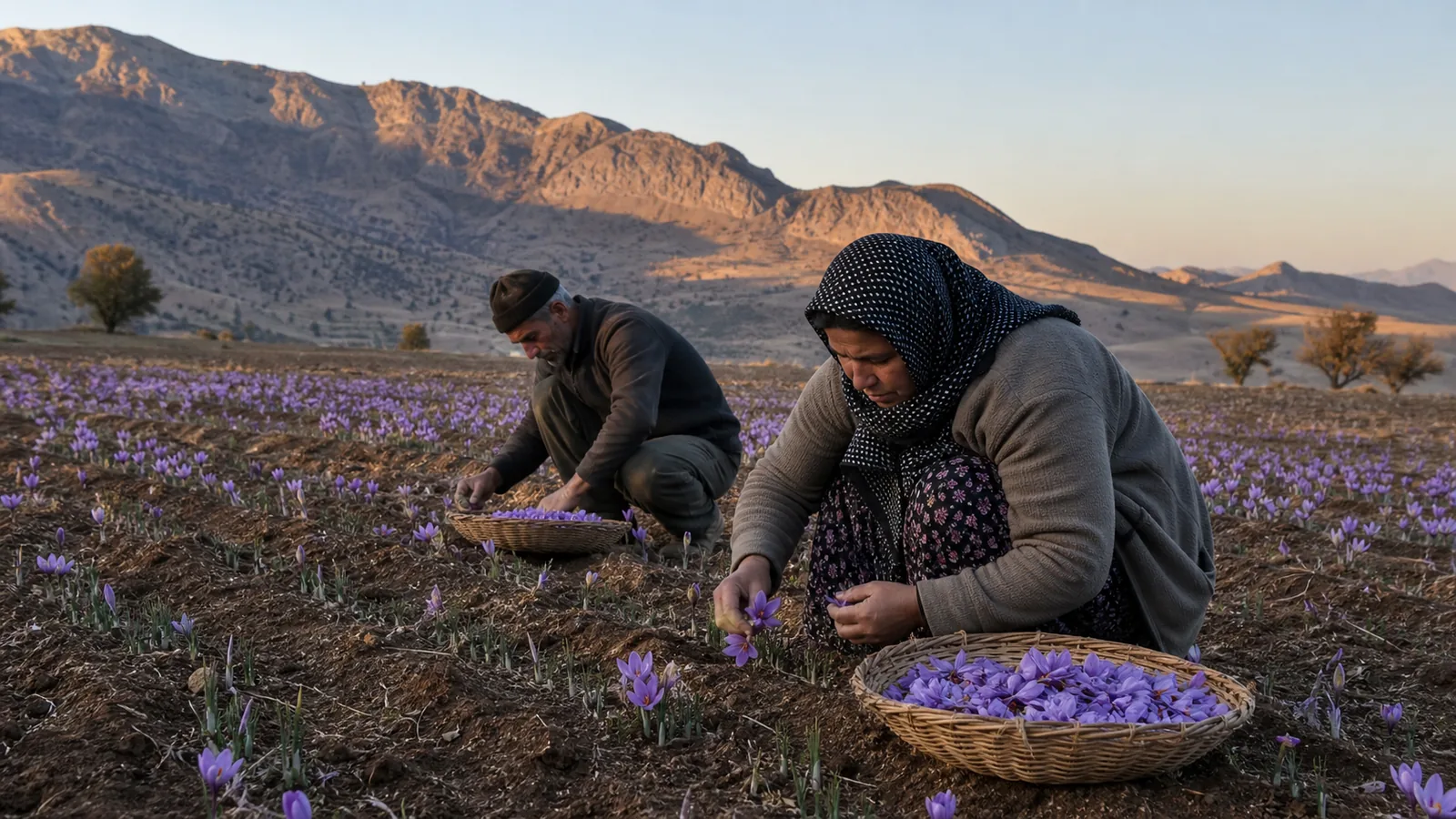
The Farsan saffron harvest ended with 18 hectares under cultivation, 12 of them productive, according to the city’s agricultural director. Ebrahim Shirani reported an average yield of two kilograms of dried saffron per productive hectare and described the result as encouraging for a crop still developing in the area.
Farsan is part of Chaharmahal and Bakhtiari Province, about 35 kilometers from the provincial capital, Shahrekord. Three related reports show how the local harvest fitted into a larger expansion: the province moved from a reported 105 hectares to 250 hectares in later coverage, introduced corms from Khorasan, and began addressing the processing and branding needed to sell saffron under its own identity.
The figures come from different reporting periods and should not be combined as if they describe one season. They are retained here as historical snapshots of a growing provincial crop.
What the 18-hectare Farsan harvest showed
Shirani, identified in the destination report as director of Farsan’s Jihad Agriculture office, said six of the city’s 18 planted hectares had not yet reached the productive stage. Saffron fields take time to establish, so the harvested area can be smaller than the total planted area during expansion.
At the stated average of two kilograms per productive hectare, the 12 productive hectares imply roughly 24 kilograms of dried saffron. That total is a calculation from the two reported figures, not a separate official production announcement. Actual output could differ if “average” was rounded or if parts of the productive area were harvested unevenly.
The two-kilogram yield was lower than the four- and five-kilogram provincial averages cited in related reports. That is not necessarily a contradiction. The reports concern different geographic scopes and likely different seasons, while field age, corm density, soil, weather, irrigation, harvest timing, and drying losses can all change the final yield.
Why growers in Farsan were interested
The local report emphasized saffron’s relatively low water requirement, tolerance of difficult conditions, ability to grow in a range of suitable soils, and ease of storing and transporting the dried product. Those features can make the crop attractive in a high-elevation province where water use and the economics of conventional crops matter.
Low water demand does not mean no management. Growers still need suitable drainage, healthy corms, careful planting depth and density, timely weed control, and enough moisture at the right stages. Harvesting and stigma separation require intensive labor over a short period. The small weight of the final spice also hides the large volume of flowers and handwork behind it.
Shirani said applicants interested in medicinal-plant cultivation could approach the relevant agricultural organization and rural financial institution about facilities. The report did not specify the loan terms, eligibility, or whether every applicant received support, so this remains a description of the program route at that time rather than current financing advice.
The first provincial snapshot: 105 hectares
In an earlier province-wide harvest update, Shirani reported 105 hectares under saffron, an increase of 30 hectares from the preceding year. He expected an average harvest of about four kilograms per hectare and named Farsan, Kiar, and Ben as the principal producing counties.
He also said 120 tonnes of saffron corms had been brought from Khorasan during that year. Establishing one hectare was estimated to require about 20 million tomans for corms alone. Both figures belong to that historical reporting period; corm price, planting density, transport, and currency conditions make them unsuitable as present-day budgets.
The report described a planting as capable of yielding for up to ten consecutive years, while the Farsan article referred to six to eight years. These are not guaranteed productive lifetimes. Daughter corms multiply, fields become crowded, disease risk and soil conditions change, and commercial growers may lift and replant sooner to protect yield and quality.
The later provincial snapshot: 250 hectares
Two near-duplicate reports attributed a later 250-hectare provincial figure to Hamidreza Danesh, deputy for plant production improvement in the provincial agricultural organization. Danesh put the provincial average yield at five kilograms per hectare and cited a period price near 10 million tomans for one kilogram of saffron.
The increase from 105 to 250 hectares is best read as expansion between reporting periods, not as two competing totals for the same date. The stored articles do not provide enough consistent calendar information to calculate an annual growth rate. Keeping both numbers with their speakers and context is more accurate than choosing one as “current.”
Danesh named Shahrekord, Kiar, Farsan, and Borujen as favorable areas identified through provincial research. One of the reports also locates Chaharmahal and Bakhtiari in the Zagros Mountains of southwestern Iran, a geography that helps explain the repeated emphasis on elevation and temperature range.
Planting material came from Khorasan
Danesh said corms supplied from Razavi Khorasan and South Khorasan were brought in with licenses and health certificates. That detail matters. Saffron is propagated vegetatively rather than from true seed in normal commercial cultivation, so a field begins with corms. Moving diseased, damaged, or poorly identified planting material can spread problems and undermine the investment before the first harvest.
The articles sometimes translate the planting material as “seed” and sometimes as “onion.” Corm is the more accurate horticultural term. Licensing and plant-health documentation do not guarantee yield, but they provide traceability and reduce avoidable phytosanitary risk when a province expands acreage quickly.
Planting and harvest calendar
Danesh described planting from early September to early October and harvesting from early to late November. The dates reflect the local report and can shift with elevation, weather, field conditions, and management. Farmers normally prepare well before flowers appear because the harvest window itself is short.
Once flowering begins, picking is usually done early and repeated as new flowers open. Stigmas need to be separated and dried promptly. A province increasing from dozens to hundreds of hectares must therefore expand trained seasonal labor and drying capacity alongside the planted area; otherwise, a larger flower crop can still lose value after harvest.
Why officials compared the crop with Khorasan
Danesh argued that the province’s altitude and pattern of warm days and cool nights supported saffron quality capable of competing with Khorasan. This was an official quality assessment, not the result of a blind laboratory comparison reported in the stored articles. Climate can influence flowering and compound development, but finished quality also depends on cultivar material, harvest timing, stigma separation, drying, moisture, storage, and adulteration control.
Khorasan remained important even within the comparison. It supplied planting material and already had the established processors, trading networks, reputation, and export channels that the newer region lacked. Describing Chaharmahal and Bakhtiari as a “rival” captures ambition, but building an independent market identity required more than producing a visually good crop.
The branding gap
Shirani said saffron grown in Chaharmahal and Bakhtiari was being sent to Khorasan and exported under the Khorasan name. He expected the province to seek the licenses needed for its own branding as production grew. That practice meant local growers could reach an existing market, but their province did not necessarily receive recognition at the point of sale.
A credible regional brand needs traceability from field to package, consistent grading, hygienic processing, laboratory documentation where buyers require it, and enough volume to serve customers reliably. Packaging alone cannot create origin value. If saffron from different regions is pooled without clear records, neither growers nor buyers can evaluate the claimed local qualities.
What the Farsan harvest means in provincial context
The 18-hectare Farsan report is valuable because it shows the expansion at field level. Twelve productive hectares averaging two kilograms each are modest beside a 250-hectare provincial headline, yet they reveal the transition from planting to commercial harvest and the uneven yields that accompany a developing sector.
The wider reports add the missing system around those fields: certified corm supply, extension advice, finance, seasonal labor, processing, marketing, and origin branding. Chaharmahal and Bakhtiari’s climate may offer a sound basis for saffron, but the crop’s long-term value depends on maintaining quality and giving growers a transparent route to market under an accurately documented origin.

![Exporting Saffron to Turkey + Price Guide [Complete 0 to 100]](https://img.rowhanisaffron.com/20260827003933/saffron-export-turkey-quality-inspection.webp)



