


A historical report marked the beginning of saffron harvest from 29 hectares of Kashan farms. It expected more than 100 kilograms of dried saffron, identified Alavi in the Niasar district as the main growing village and recorded a three-and-a-half-kilogram average yield.
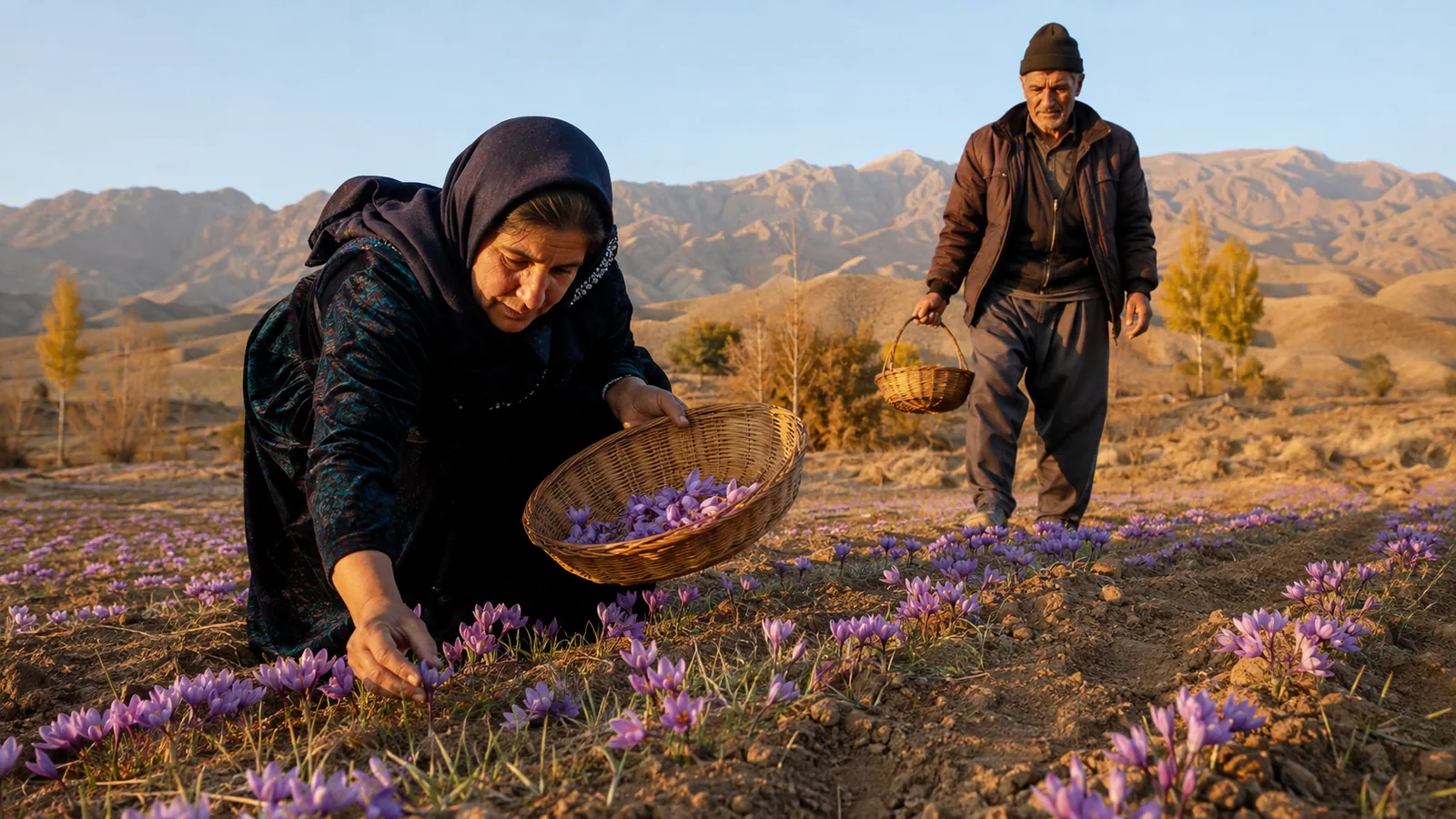
The 29-hectare Kashan harvest
Sayyed Mostafa Ghamsari, then associated with Kashan’s crop-production improvement department, announced that harvest had begun across 29 hectares. The figure describes the county’s cultivated area for that period, not the size of one farm.
The report does not preserve a clear publication year. Its 29-hectare area and expected crop should therefore remain tied to this historical harvest rather than being presented as Kashan’s current saffron scale.
Why the 100-kilogram forecast is consistent
Ghamsari gave an average of about 3.5 kilograms of dried saffron per hectare. Multiplying 29 hectares by 3.5 kilograms gives 101.5 kilograms, which supports his forecast of more than 100 kilograms from the county’s farms.
This is a consistency check, not proof of the final harvest. Yield can change with the proportion of bearing land, field age, corm condition, irrigation, weather, flower density, picking speed and drying losses.
Alavi village had the largest area
The largest area under saffron in Kashan was attributed to Alavi village in the Niasar district. That local detail matters because growing conditions vary across the county: elevation and temperature affect when flowers appear, while soil and water management influence field performance.
Alavi continued to be recognised as an important Kashan saffron centre in later years. Historical and newer area figures should still be kept separate, because expansion over time does not change what the 29-hectare report originally measured.
Hassanarood’s eight-kilogram result
The highest field yield mentioned in the account was eight kilograms of dried saffron per hectare in Hassanarood village. That was a local maximum, not the county average. It was more than twice Ghamsari’s 3.5-kilogram overall figure.
A high result from one field may reflect mature corm beds, careful cultivation, favourable weather or the way productive area was counted. It should not be promised as the normal return from a new planting.
A short flowering and harvest window
Ghamsari placed flowering in November and said the flowering period lasted about 15 days. In practice, the exact start shifts with altitude and seasonal temperatures, but the short window explains why organisation matters.
Flowers are usually gathered promptly, often early in the day, and then moved quickly to separation. When many fields bloom together, labour, clean containers and drying capacity must be ready before the first substantial flush.
From fresh flower to dried saffron
The headline’s expected 100 kilograms refers to dried saffron, not harvested flower weight. Pickers collect whole flowers; the stigmas are separated and dried to produce the spice. The reduction in mass is substantial.
Clean handling protects the crop during that transition. Flowers should not remain crushed in deep, warm piles, and separated stigmas need controlled drying and protected storage. More field yield does not help the grower if post-harvest handling lowers the value of the lot.
Water needs in a dry region
The old report recommended saffron for water-constrained areas because it has a relatively modest irrigation requirement and normally does not need summer irrigation while the corm is dormant. That is a useful comparison with many summer crops, not a claim that saffron grows without water.
Timely autumn and spring management still matters. Soil texture, rainfall, drainage and local climate determine the amount and timing of irrigation. Waterlogging can be as damaging as shortage where soil does not drain adequately.
Late-summer corm planting
Ghamsari said planting begins in late summer before the weather cools. The old English calls the planting material an “onion,” but saffron is established from corms. Using the correct term prevents confusion with an edible bulb crop.
Planting time must allow the corms to establish before the flowering season. Growers also need sound planting material, suitable depth and spacing, and a field without a known burden of corm disease.
Later Kashan production was much larger
A dated official report from 2020 described more than 650 kilograms from 110 hectares of Kashan farms, with an average of six kilograms per hectare. It also said the county’s saffron was sold in Isfahan, Qom and Tehran as well as other markets.
Those figures show expansion after the 29-hectare snapshot. They do not justify replacing the historical headline, because the two accounts describe different years and different production scales.
What changed between 29 and 110 hectares
The later area was nearly 3.8 times the earlier 29 hectares, while the reported production grew by more than six times from the 100-kilogram forecast to above 650 kilograms. Part of the difference reflects a higher stated average yield: six rather than 3.5 kilograms per hectare.
This comparison is illustrative. The earlier number was a forecast and the later number a reported harvest, and the share of mature bearing fields is not given on the same basis. It shows direction, not a controlled experiment.
Processing and local value
The 2020 report also called for packaging facilities to help turn saffron into a more valuable local business. Useful facilities do more than put threads in a box. They provide clean separation, controlled drying, protected storage, grading, representative sampling and traceable lots.
For villages such as Alavi and Hassanarood, shared services can be more practical than asking every small grower to purchase the same equipment. Transparent grades and payment rules are essential if better handling is to return value to the farm.
How to read this Kashan harvest record
The historical account is internally coherent: 29 hectares at an average 3.5 kilograms gives just over the expected 100 kilograms, while an eight-kilogram result in Hassanarood stands as the local maximum. Alavi held the largest planted area in the Niasar district, and flowering was concentrated in a roughly 15-day November window.
Later official data document strong growth, but each set of figures keeps its own date and meaning. That preserves the value of the original harvest report while giving readers enough context to avoid mistaking it for current Kashan production.

![Exporting Saffron to Turkey + Price Guide [Complete 0 to 100]](https://img.rowhanisaffron.com/20260827003933/saffron-export-turkey-quality-inspection.webp)



