


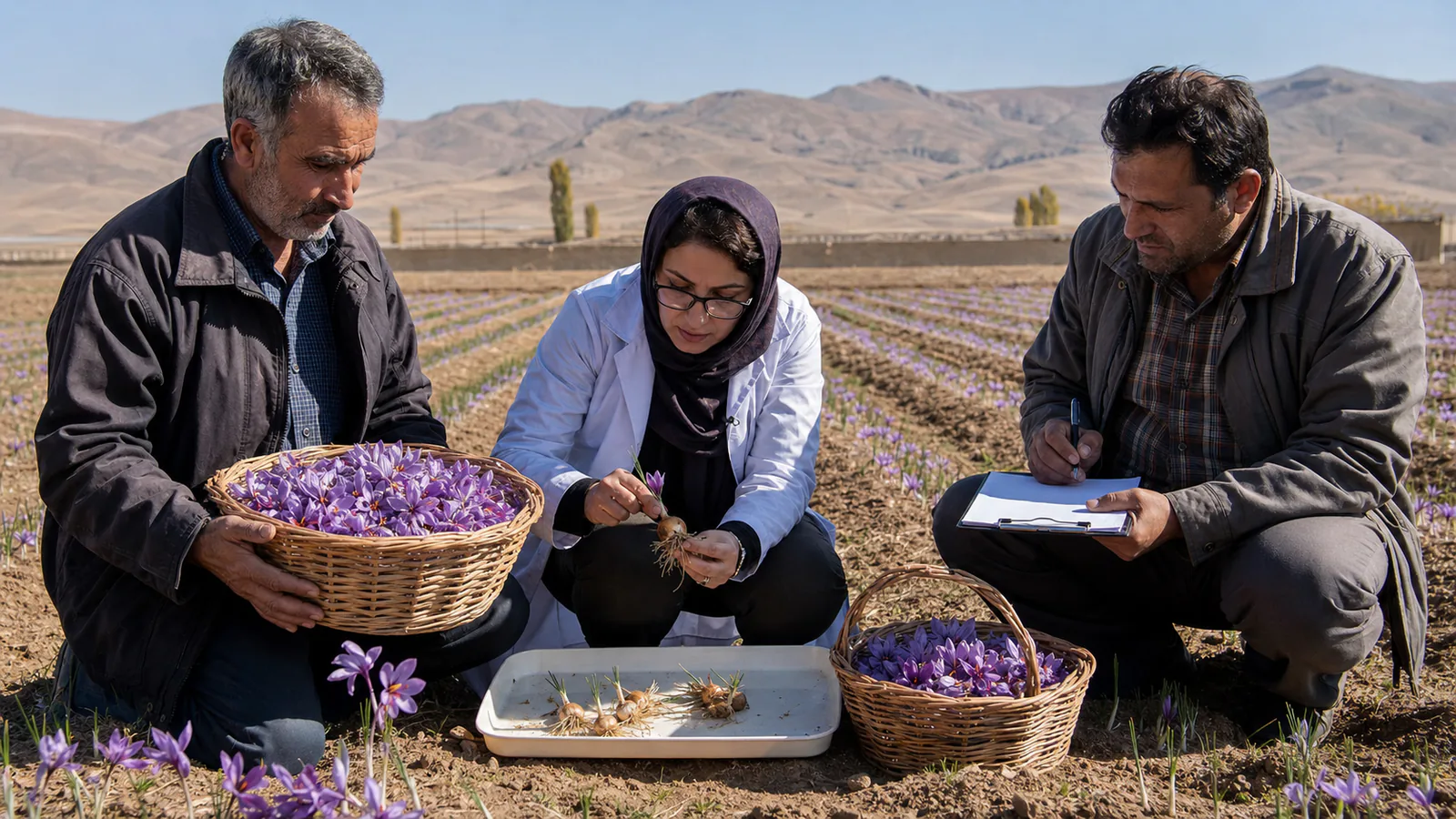
A historical East Azerbaijan report forecast 320 kilograms of saffron from Marand, while a separate cooperative report recorded more than 150 kilograms from 50 hectares across the province. A neighboring West Azerbaijan account put its much smaller production at about 35 kilograms. These figures describe different places, organizations, and reporting periods, so they belong in one regional explanation—not in a single total.
The original destination uses “harvesting 320 kg” in its title, but its body identifies 320 kilograms as an expectation for that year. No final weigh record is supplied. Preserving the distinction between forecast and completed harvest is essential when comparing the three reports.
What the 320 kg East Azerbaijan figure meant
Jalal Rahimzadeh, identified as the agricultural authority in Marand, said the city’s climate could support saffron and expected 320 kilograms to reach domestic and export markets in the reported season. He spoke during a saffron harvest event in Bonab Jadid, a town in Marand County northwest of Tabriz.
The article also predicted a 15% increase over the previous period. It does not give the prior-year weight, productive saffron area, field-age distribution, or final result, so neither the 320-kilogram forecast nor the percentage can be independently reconciled.
A broken sentence mentions 11,000 hectares of agricultural land in Marand. It does not say that all 11,000 hectares were planted with saffron, and the number must not be used as the denominator for saffron yield.
The report’s 1,000 kg statement needs context
The destination later says Marand produces more than 1,000 kilograms of saffron annually. That appears inconsistent with a 320-kilogram city forecast unless the numbers cover different areas, seasons, or definitions.
The surviving translation does not resolve the discrepancy. A current or historical statistical table would need to identify the geographic boundary, reporting year, harvested area, and whether each figure was a forecast or measured dry output. Both statements are preserved here, but the 1,000-kilogram line should not be used to “correct” the 320-kilogram headline without that evidence.
This is a common problem in short agricultural news reports: a ceremony may focus on one district or program while a later sentence shifts to a larger administrative area. Clear labels matter more than choosing the larger number.
Cooperatives reported more than 150 kg from 50 hectares
A separate assigned source said saffron-grower cooperatives in East Azerbaijan harvested more than 150 kilograms from 50 hectares. On the minimum reported weight, that equals at least three kilograms per hectare.
The cooperative report described about two billion rials of investment, equivalent arithmetically to 40 million rials per hectare if it applied evenly across all 50 hectares. It also claimed a 10% increase from the previous year. These are dated nominal figures; the source gives no investment breakdown, harvest year, starting value, grade, or inflation adjustment.
It associated the cooperatives with 250 young people, job seekers, and agricultural graduates in permanent and seasonal work. Because the sentence combines employment types, the total cannot be interpreted as 250 full-time permanent jobs. A complete employment record would separate workers, person-days, seasonal contracts, and year-round roles.
What the East Azerbaijan reports show together
The 320-kilogram Marand forecast and the 150-kilogram cooperative harvest are related by province but not necessarily by membership or area. The 50 cooperative hectares may overlap part of Marand’s production, lie elsewhere in East Azerbaijan, or cover a different season. Adding the two figures would risk double counting.
The useful comparison is qualitative:
- the Marand report describes a city-level forecast, Bonab Jadid harvest activity, and a 15% growth expectation;
- the cooperative report supplies a measured “more than 150 kg,” 50 hectares, historical investment, and employment claims; and
- neither gives enough field-level data to establish a current provincial yield or total.
The cooperative source also contains an unrelated Maragheh pesticide-distribution item and general geography. Those passages do not help a visitor seeking East Azerbaijan saffron production and do not substantiate the harvest figures, so they are not carried into the article.
Saffron production in neighboring West Azerbaijan
Ismail Karimzadeh, identified as the head of West Azerbaijan’s agricultural authority, put provincial saffron production at about 35 kilograms in the report’s headline. The article described cultivation as small but growing, often on plots from roughly 100 to 1,000 square metres.
The source does not give total planted area or a reporting year, so no provincial yield can be calculated. Its 35-kilogram figure should not be combined with East Azerbaijan’s numbers; it is a separate benchmark showing that saffron development was at a much smaller scale in the neighboring province.
Karimzadeh said producers sold their saffron directly and that the agricultural authority was not involved in buying and selling. The article does not identify buyer types, prices, grades, or contracts. “Direct” could mean sales to consumers, traders, shops, or processors and should not automatically be equated with a higher farmer return.
The West Azerbaijan cost figures were historical estimates
The source gave an establishment cost of about 300 million rials per hectare and mentioned approximately 10 million rials connected with harvest, with cost varying by output. Its translation around “one or two rounds” is incomplete and cannot support a detailed cost model.
These nominal amounts are not current quotations. The report gives no year-specific input list, corm quantity, labor rate, irrigation infrastructure, equipment, financing cost, or expected field life. A present-day budget must price each item again and separate establishment costs from annual harvest and post-harvest costs.
Regional comparisons also need the same accounting boundary. One report’s “investment” may include corms and irrigation, while another may count only cooperative finance. Dividing historical totals by hectares can show scale, but it does not make unlike budgets comparable.
Pest claims require identification before control
Karimzadeh said a kind of bee fed on saffron flowers and rodents ate the underground corms. The report provides no species identification, damage survey, photographs, or economic threshold.
Rodent damage to corms is physically plausible, but a broad reference to a “bee” is not enough to diagnose a pest or justify control. Bees can be ordinary flower visitors; the observed insect, injury, and yield effect would need to be identified by a qualified local plant-protection specialist.
The article also said corms came mainly from Khorasan. Moving planting material between regions can introduce health and adaptation risks. Growers should obtain traceable, inspected corms and reject material showing rot, lesions, or pest damage rather than relying on province of origin as a guarantee.
Could saffron cultivation help Lake Urmia?
The West Azerbaijan source described saffron as a promising lower-water crop and suggested that larger-scale development might help preserve or revive Lake Urmia if approved. That is an aspiration, not an effect demonstrated by the article.
FAO’s current Lake Urmia water-efficiency project emphasizes integrated water management, localized agricultural practices, efficient irrigation, and measurable reductions in pressure on basin resources. Replacing a crop can help only if it reduces actual net water consumption at basin scale and the saved water is not used to expand irrigated area elsewhere.
Saffron’s seasonal pattern and relatively modest water demand can make it worth evaluating, but suitability, irrigation source, soil, salinity, market capacity, and cumulative planted area still matter. No single crop can “revive” the lake on its own.
Iran’s global share changed from the old report
The destination attributed 60% of world saffron production to Iran. That figure is dated and conflicts with newer official context. In 2025, FAO described Iran as producing about 85–90% of global saffron.
Different years and methods can produce different shares, so the old 60% claim remains part of Rahimzadeh’s historical statement rather than a current statistic. The newer percentage also does not validate East Azerbaijan’s provincial forecasts; global share and local output are separate measurements.
FAO’s same update stresses production practice, post-harvest handling, safety, traceability, marketing, and branding. Those capabilities determine whether new regional production becomes saleable, trusted value rather than simply more planted area.
How to assess saffron expansion in the Azerbaijan provinces
Before expanding beyond small trial plots, a regional program should document suitable soils and water, healthy corm supply, field age, realistic yields, harvest labor, drying capacity, quality tests, buyer specifications, and farm economics. Forecasts should later be replaced with final measured results.
East Azerbaijan’s reports show organized activity through Marand and cooperatives. West Azerbaijan’s report shows smaller plots, direct sales, uncertain pest observations, and interest tied to water pressure. These are different stages of development and should not receive the same planting recommendation.
For another example of how area, dry output, labor, and market support must be read together, see the historical Neyshabur saffron harvest.
What the combined regional record establishes
The safest conclusions are narrow: Marand officials forecast 320 kilograms and 15% growth; East Azerbaijan cooperatives reported more than 150 kilograms from 50 hectares with dated investment and employment claims; and West Azerbaijan reported about 35 kilograms, small plots, direct sales, historical cost estimates, corm sourcing concerns, and hopes for lower-water development.
The reports do not establish a current provincial total, prove a 1,000-kilogram Marand figure, or show that saffron expansion by itself would restore Lake Urmia. They do show what future reporting needs: final weights instead of forecasts, unambiguous geographic boundaries, measured hectares, quality results, verified water savings, and net farmer returns.

![Exporting Saffron to Turkey + Price Guide [Complete 0 to 100]](https://img.rowhanisaffron.com/20260827003933/saffron-export-turkey-quality-inspection.webp)



