


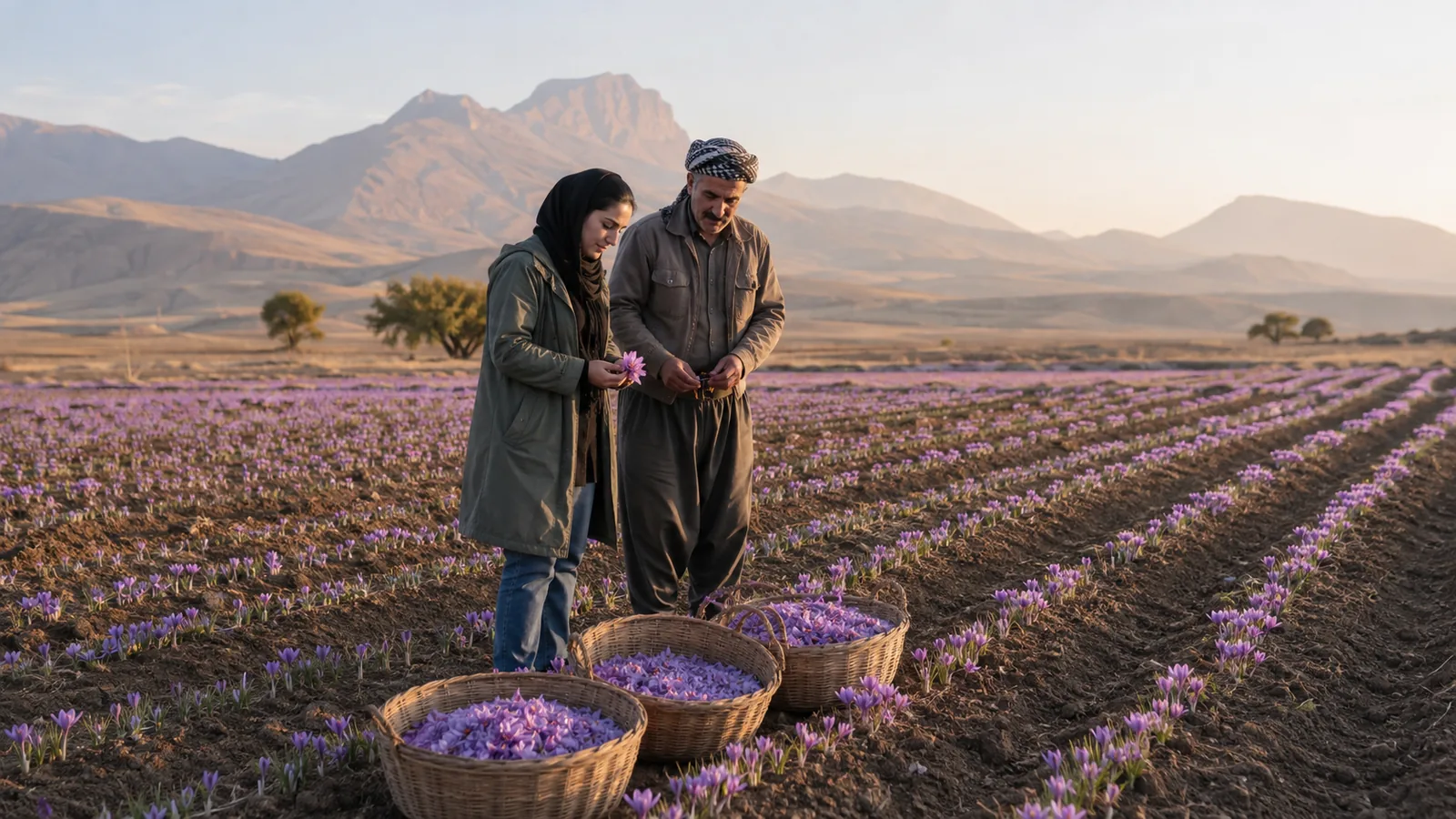
A historical forecast expected 38 kilograms of saffron from 15 hectares in Kermanshah city. The report identified the main growing districts, discussed the quality of the local crop and recorded a fertiliser recommendation that needs careful, field-specific interpretation.
The 38-kilogram production forecast
Shahriyar Ghasemi, then identified as the director of Kermanshah city’s Agricultural Jihad office, forecast a harvest of about 38 kilograms of dried saffron. The crop was expected to come from 15 hectares of saffron fields.
Those figures imply an average of roughly 2.5 kilograms per hectare. It is a simple calculation from the historical forecast, not a guarantee for an individual farm. Yield varies with the age of the bed, corm health, planting density, irrigation, weather and the share of land mature enough to flower.
Where saffron was grown in Kermanshah city
The report placed the largest areas in Chaghanarges, Kuzaran, Sar Firuzabad, Bilavar and Mahidasht. English spellings of these local names vary; they are also seen as Chaqanarges, Kozaran, Sarfiroozabad, Bilvar and Mahi Dasht.
These are districts and rural areas within the wider Kermanshah setting, not separate claims about the whole province. Keeping that distinction prevents a city-level production forecast from being mistaken for a provincial total.
Why the local crop was described as high quality
Ghasemi described Kermanshah saffron as high quality and connected that assessment with suitable planting and observance of technical requirements. The statement records the official’s view at the time; it is not laboratory evidence that every lot from the region has the same grade.
Quality is determined after harvest as well as in the field. Flowers need prompt picking and separation, followed by controlled drying and protection from moisture, light and contamination. A regional reputation is strongest when individual batches are traceable and their characteristics can be tested.
Kermanshah’s claimed historical connection to saffron
The original report also called Kermanshah a historical cradle of saffron cultivation and expressed an ambition to revive the crop. The surviving English translation breaks down at this point, so the statement is best retained as an attributed local claim rather than presented as a settled account of saffron’s origin.
What can be said more securely is that saffron cultivation has been promoted in western Iran and that Kermanshah’s varied climate has supported trials and expansion. Research indexed by the UN Food and Agriculture Organization has examined why farmers in Songhor and Sahneh adopted saffron, including the economic, technical and institutional factors around the decision.
From 15 hectares to later expansion
The 15-hectare figure belongs to the period covered by this article. It should not be read as Kermanshah’s current saffron area. Later official reporting documented much broader cultivation.
In a 2022 account, the provincial Agricultural Jihad organization said 450 hectares of saffron were under cultivation in Kermanshah. That later provincial number shows expansion, but it uses a different geography and reporting date from the 38-kilogram city forecast.
What the fertiliser passage actually says
The historical text asks growers to use 50 to 100 kilograms of nitrogen fertiliser per hectare, divided between two irrigations, to strengthen the saffron “onions” and improve the next season’s average yield. In botanical terms, saffron grows from corms rather than onions.
The translation gives “alum” in parentheses, but the context is unclear and the word should not be treated as a usable field instruction. Nor should the quoted nitrogen range be copied directly into a fertiliser plan without knowing the product concentration, soil condition, irrigation method and existing nutrient supply.
A safer way to plan saffron nutrition
Growers need a representative soil test and local agricultural advice before applying nitrogen. Excessive or poorly timed nutrition can encourage leaf growth without providing the expected improvement in flowers, while unsuitable applications can waste money or affect soil and water.
A field plan should record the actual nutrient source and concentration, the amount applied, timing, irrigation and the bed’s response. Splitting an appropriate dose may reduce loss in some conditions, but that decision belongs to a qualified local adviser familiar with the farm.
Corm strength and the following harvest
The report’s interest in “strengthening” corms reflects saffron’s multi-year production cycle. Leaves that remain after flowering help support the underground corm system for the next season, so field care continues after the visible harvest has ended.
Healthy planting material, suitable depth, drainage and control of damaged or diseased corms matter alongside nutrition. A grower assessing a weak bed should look for the cause rather than assume that more fertiliser is the only answer.
The short harvest window
A 38-kilogram forecast may sound modest beside later provincial totals, yet producing that amount requires many flowers to be picked and processed within a short period. Labour and drying capacity can become the practical limit when several fields flower together.
Shallow clean containers, prompt stigma separation and an orderly drying process help protect the crop. Records should keep fresh-flower weight separate from dried-saffron weight, since the two figures are not interchangeable.
About the population figure
The original page gives 1,083,833 as the population of Kermanshah in 2016 and notes that the city’s inhabitants are predominantly Kurdish. The population figure is background for the wider urban area described by the old report; it is not a count of saffron growers or agricultural workers.
Retaining that distinction keeps demographic context from being used to exaggerate the scale of the local saffron sector.
How to read this Kermanshah forecast
The historical article’s core message is straightforward: officials expected about 38 kilograms of saffron from 15 hectares in Kermanshah city and identified Chaghanarges, Kuzaran, Sar Firuzabad, Bilavar and Mahidasht as the principal growing areas.
Its quality and heritage statements remain attributed to Ghasemi. Its fertiliser passage is preserved but carefully bounded, because a translated number from an old news report should never replace a current soil test or field-specific recommendation.

![Exporting Saffron to Turkey + Price Guide [Complete 0 to 100]](https://img.rowhanisaffron.com/20260827003933/saffron-export-turkey-quality-inspection.webp)



