


Gilan’s plains were tested as a place to multiply saffron corms, not as the province’s preferred area for flowering and spice production. An archived field programme in Talesh reported that transferred corms grew from about 4 grams to more than 8 grams in nine months and that six tonnes of planting material became 15 tonnes over two years.
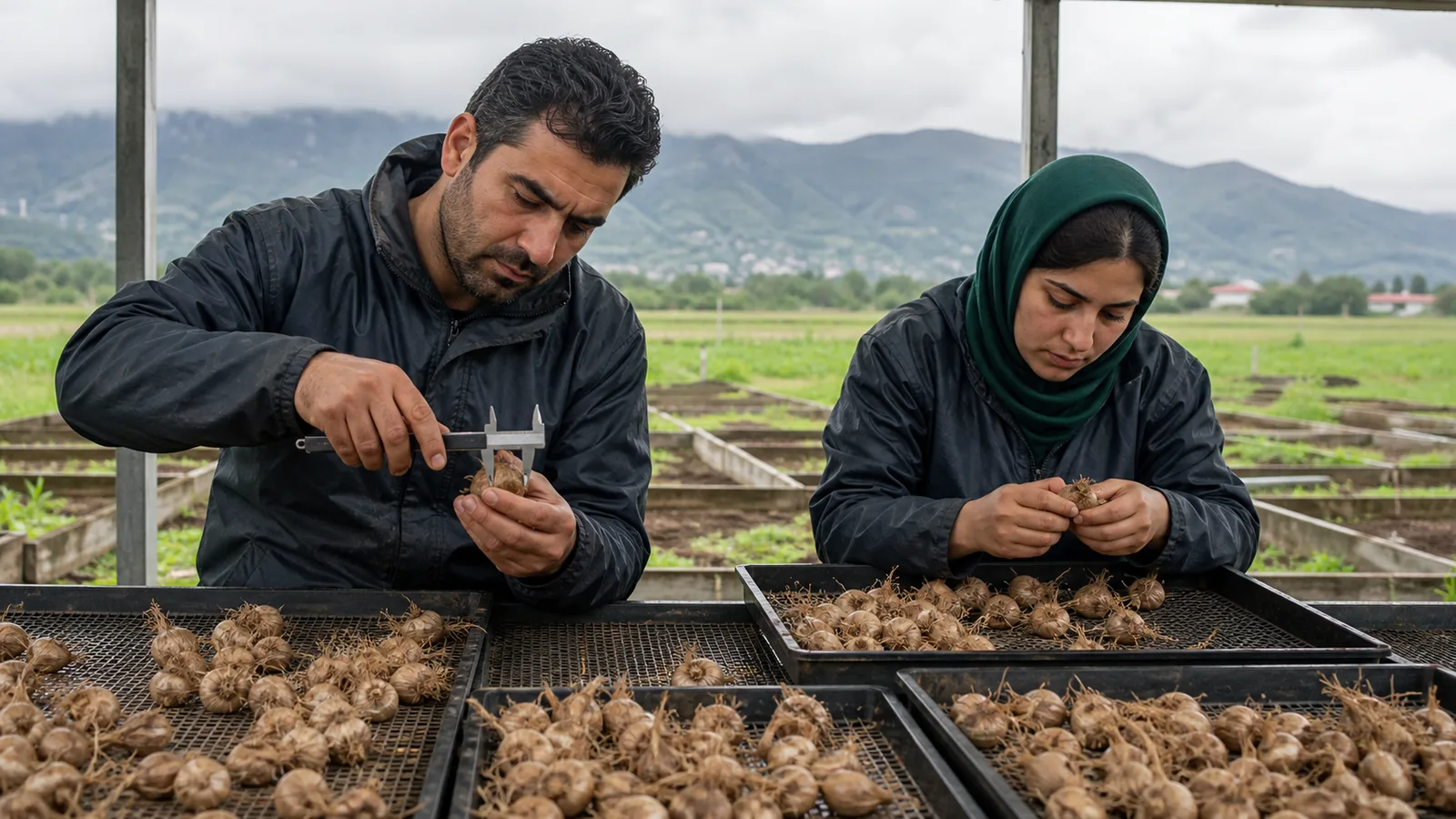
The original headline called this “Gilan plain lands prone to saffron onion propagation.” The correct botanical term is corm, not onion. The results are interesting, but they came from one reported programme and do not prove that all moist plain soils in Gilan are suitable.
Corm production and saffron production are different
Manouchehr Parsafar, identified as Director of Horticulture Affairs at the Gilan Agricultural Jihad Organization, drew a clear distinction. He said the provincial plains were not favourable for saffron flowering, yet their rich, moist soils could support saffron corm propagation.
This is biologically plausible as a production concept. Cultivated saffron is sterile and reproduces vegetatively: a mother corm supports daughter corms during the growing cycle. A field can therefore be managed primarily to produce healthy planting material, while another site is managed for flowers and dried stigmas.
The objectives are related but not identical. Dense leaf growth and daughter-corm mass do not guarantee good flowering at the same wet site. Corms also need summer conditions that avoid persistent moisture and rot.
The Talesh trial
Parsafar said that in Solar Hijri year 1390—mainly 2011–2012—the agricultural organizations of Gilan and Khorasan Razavi coordinated the transfer of about six tonnes of saffron corms. They were planted on roughly one hectare in Talesh.
After nine months, he said individual corm weight increased from about 4 grams to more than 8 grams. A larger corm can store more reserves for future growth and flowering, although weight alone does not establish freedom from disease or predict the exact stigma yield at another site.
Across the two years described, the original six tonnes reportedly produced 15 tonnes of corms. Sixty percent of that material weighed more than 8 grams per corm. In mass terms, 15 tonnes is 2.5 times the initial six tonnes.
What the reported multiplication does not tell us
The article gives total mass and a weight threshold, but it omits several measurements needed to evaluate the trial:
- the number and size distribution of corms planted;
- the number of daughter corms harvested;
- fresh-versus-dry weighing conditions;
- losses, rot and rejected planting material;
- soil analysis, irrigation and rainfall;
- fertiliser and labour inputs; and
- flowering performance after the corms were moved.
Without those data, the result supports a promising local experiment, not a universal one-year corm-production formula.
The comparison with Khorasan needs caution
The archived translation says Khorasan Razavi has “low soil content,” producing weak, small corms with “less fruit,” and that a process taking three years there took one year in Gilan. “Low soil content” and “fruit” are not meaningful agronomic descriptions in this context; the source may have referred to low fertility, organic matter or corm productivity.
No paired trial, soil test or corm-size distribution is supplied for Khorasan. It is therefore not safe to conclude that Khorasan soils generally produce weak corms or that Gilan is always three times faster. Khorasan remains a major saffron-growing region with diverse soils and management systems.
Why larger saffron corms can matter
A 2024 study of saffron corm development explains how daughter corm growth depends on photoassimilates from leaves and reserves in the mother corm. It also notes that corm size influences saffron yield.
Field studies likewise find that mother-corm size and planting density interact with field age. Larger material can improve early flowering, but simply maximising weight is not enough. A planting lot also needs physical integrity, correct identity and freedom from visible rot.
Moist soil brings a corm-health risk
The same moisture that supports vegetative growth can become a liability if drainage is poor or corms remain wet during dormancy. In saffron, damage during lifting and handling can open a route to rot. One field-based study concluded that injury, rather than the pathogen alone, was the primary cause initiating corm rot in the examined system.
A responsible propagation field should therefore record drainage and disease as closely as weight gain. Corms should be lifted carefully, sorted, kept in suitable storage and inspected before distribution. Material showing soft tissue, extensive lesions or rot should not be sold as healthy stock.
What support the Gilan programme provided
Parsafar said the provincial organization had supported model saffron cultivation in its early years by supplying micronutrient fertilisers, dryers and free corms. He added that limited credit prevented the organization from continuing to buy and distribute free planting material to Gilan farmers.
Micronutrients should never be supplied by habit alone. Soil or tissue testing and a locally designed programme are needed because an unnecessary application can waste money and create imbalance. Dryers matter to stigma quality, but they solve a different task from corm propagation.
The reported restriction on Khorasan corm sales
The article says the Khorasan Razavi Security Council had prohibited sales of saffron corms outside the province, leaving Gilan growers unable to obtain them independently. That is a dated attributed statement. It does not provide the order, effective date or current legal status and should not be used as present-day purchasing advice.
Anyone sourcing planting material today should check current rules with the relevant agricultural and plant-health authorities. Traceable legal supply also makes it easier to verify origin, corm health and treatment history.
How to assess saffron corm propagation in Gilan
The Talesh result suggests that selected Gilan plain land may help bulk up saffron corms. A future trial should compare sites with the same starting corm lot, record corm number and weight distribution, test soil and water, document disease loss and then plant samples at a flowering site.
Only that full cycle answers the commercial question: not merely whether six tonnes can become 15, but whether Gilan can produce healthy, traceable corms that flower reliably after transfer.

![Exporting Saffron to Turkey + Price Guide [Complete 0 to 100]](https://img.rowhanisaffron.com/20260827003933/saffron-export-turkey-quality-inspection.webp)



