


Saffron packaging for traders has to do more than look polished. A useful container protects the threads through storage and transport, suits the quantity being sold, carries the information buyers need, and can be filled and closed consistently. Choosing it well starts with the saffron, the sales channel and the destination market—not with the shape of the jar.
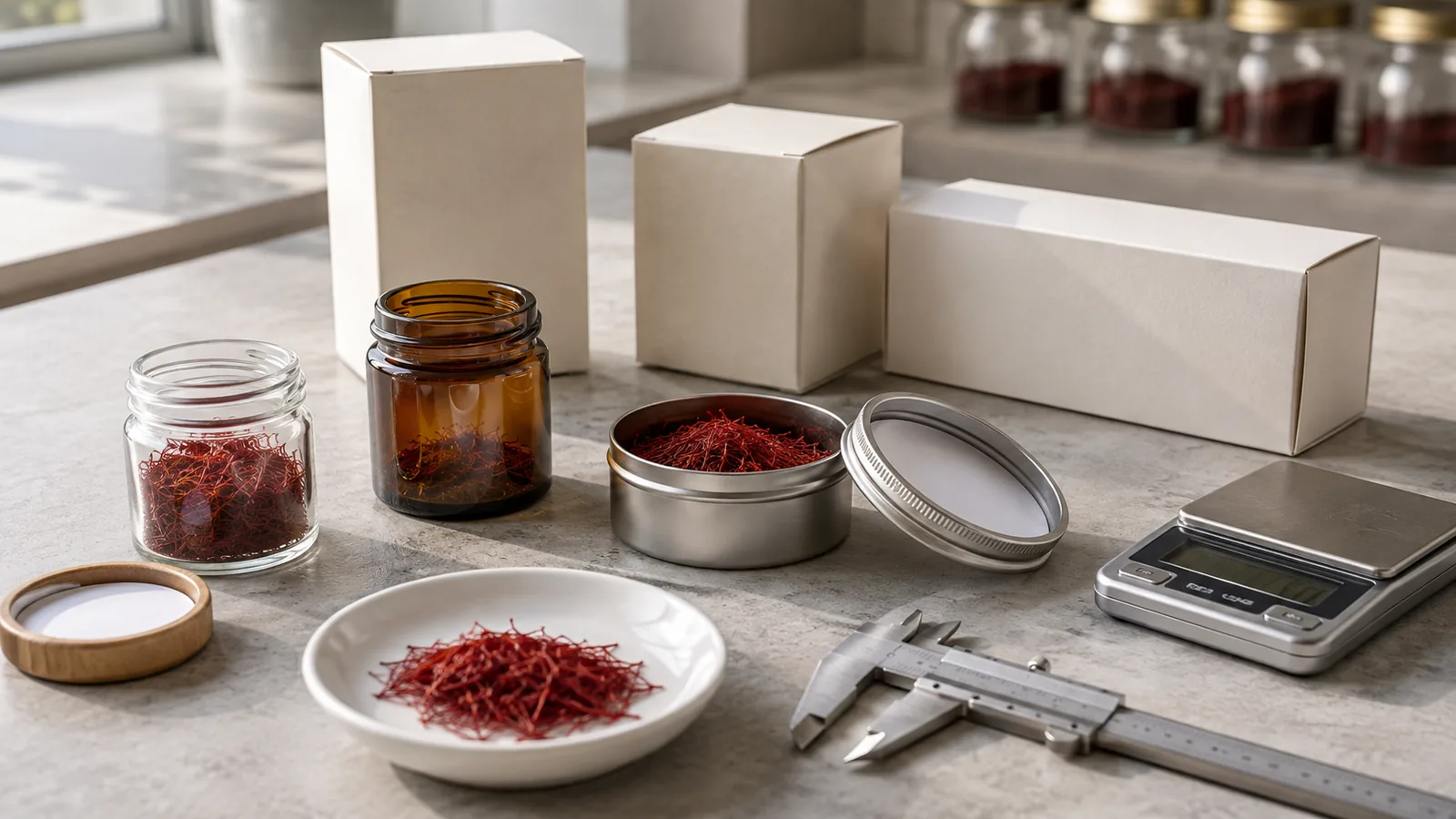
Start with the saffron and the route to market
A one-gram retail pack displayed in a bright shop has different needs from a sealed container moving several kilograms between businesses. Before asking a supplier for samples, write down the pack size, expected shelf time, climate, transport method and whether the container will be opened repeatedly.
Whole threads also make appearance important. Buyers may want to see their colour and condition, yet a completely clear pack gives light more opportunity to reach the product. A carton, sleeve or dark storage case can provide protection while allowing the retail container to remain attractive.
For bulk trade, handling usually matters more than decoration. The container should be easy to inspect, seal, label and stack without crushing the saffron. If several people will measure from it, smaller working containers can reduce how often the main lot is exposed to humid air.
What a saffron container needs to protect against
Saffron is dry, light and aromatic. Its packaging should limit four practical risks: moisture, light, air exchange and contamination from the container or its surroundings. No decorative finish compensates for a poor seal or an unsuitable food-contact surface.
Moisture and repeated opening
Humidity can encourage clumping and make careful weighing difficult. Check the complete closure system rather than judging the container body alone. A well-made jar with a loose cap is still a weak package. Ask how the closure performs after repeated opening, especially when the same pack will be used in a restaurant or shop.
Light and heat
A clear jar helps customers inspect the threads, but it should not spend months in direct sunlight or beside a hot display light. An opaque tin, amber glass, fitted carton or protective sleeve can reduce exposure. Warehousing still matters: packaging does not make a hot or damp storeroom suitable.
Odours, dust and contact materials
The inside surface should be clean, food-safe and free from a noticeable smell. Saffron can pick up surrounding aromas, so do not store filled containers beside perfumes, cleaning products or strongly scented foods. The European Commission’s food-contact materials guidance explains the broad principle that packaging must not transfer substances to food in amounts that could endanger health or unacceptably change its composition, taste or smell.
Compare container materials by performance
Glass, metal and food-grade polymers can all be appropriate when they are designed for the intended food contact and paired with a dependable closure. The material name by itself does not establish quality.
Glass is easy to inspect and does not retain odours, but it is heavier and can break. Metal tins provide good light protection and are convenient for many retail formats; their internal coating, seams and closure need scrutiny. Polymer containers are light and less prone to breakage, but traders should confirm the exact material, food-contact declaration and suitability for the expected temperature and shelf life.
Decorative wooden boxes and fabric pouches can work as secondary presentation packaging. They should not normally be the only barrier around loose threads because their seal, cleanliness and moisture protection are difficult to control. Keep the saffron in a suitable primary container inside them.
Match the pack size to how it will be sold
Choose a container close to the intended fill quantity. A very large jar holding a small pinch of saffron wastes storage space, raises freight costs and can make the product look sparse. A container that is too tight makes clean filling difficult and may trap threads in the closure.
Ask the supplier for the internal volume, empty weight and dimensional tolerances, then test them with the saffron you actually sell. Thread length and density differ between lots, so a nominal gram capacity from a catalogue is only a starting point. Fill several samples on the real packing line and check the final presentation at the minimum and maximum expected net quantity.
Request evidence, not broad assurances
A professional supplier should be able to identify the container material and the intended conditions of use. Depending on the market, useful records may include a declaration of compliance, migration or material test reports, batch details and documentation for inks, coatings, liners and adhesives that could affect the food-contact system.
Read what the documents actually cover. A certificate for a manufacturer’s quality-management system does not automatically certify every jar as suitable for saffron, and an attractive “food grade” statement without a material specification is not enough for a commercial purchase. Claims about meeting international standards must name the applicable standard and product scope. Requirements differ by destination, so confirm them with the competent authority, importer or qualified compliance adviser for that market.
Inspect samples before placing a large order
Obtain production samples rather than relying only on catalogue photographs. Inspect them under ordinary light and handle them as a packer and customer would. A simple sample review should include:
- consistent dimensions, finish and colour across several units;
- smooth food-contact surfaces without chips, sharp edges, residue or strong odour;
- caps and liners that seat evenly and do not cross-thread;
- a tamper-evident feature that is visible and practical where the sales channel requires one;
- enough flat space for a legible label, lot code and date marking;
- resistance to ordinary packing, stacking, vibration and delivery handling;
- cartons and dividers that prevent movement without damaging the retail finish.
Conduct a small filling trial and retain sealed samples from it. Weigh them over time in the intended storage conditions, inspect closure integrity and note any change in odour, clumping, label adhesion or appearance. Formal testing may be needed for regulated claims or high-value contracts; a desk check is not a substitute.
Plan the label and traceability before approving the shape
A beautiful container can become unusable when there is nowhere to place mandatory information clearly. Prepare the full label copy first, including the product name, net quantity, responsible business, origin or provenance statement where required, lot identification, date information, storage instructions and any market-specific language or importer details.
Do not make the label imply a grade, origin, harvest year, laboratory result or certification that the lot records cannot support. Packaging should reinforce the product’s identity, not compensate for uncertain sourcing. Buyers who want a practical quality review can use the site’s guide to identifying pure saffron, while traders should retain the supplier documents and test results for each commercial lot.
Check compatibility with filling and sealing equipment
Confirm whether containers arrive ready to fill or need cleaning under the supplier’s instructions. Measure the neck opening against scoops, funnels and automated dispensers. Then test the cap torque or sealing method on the actual line, not by hand on a single sample.
Labels should remain straight and readable on the chosen surface. If the pack uses a liner, shrink band or induction seal, make sure the components are designed to work together. A closure assembled from unmatched parts may appear secure while giving inconsistent results from one unit to the next.
Compare the full landed cost
The lowest unit price may not be the least expensive option. Include mould or artwork charges, minimum order quantity, inserts, labels, freight, customs costs, storage space, filling speed, breakage and rejected units. Also establish who pays when a shipment falls outside the agreed specification.
For a new supplier, a smaller first order can reveal variation that samples did not show. Record the approved sample, drawing, colour, material, closure, packaging method and acceptable tolerances in the purchase order. An item code alone may not protect the details that matter.
Use invoices and lot records to protect the transaction
Ask whether the supplier can provide the official invoice required in your jurisdiction. An itemised commercial invoice should identify the buyer and seller, container description, quantity, price and transaction date. Keep it with the purchase order, supplier specification, test documents, delivery record and the internal batch in which the containers were used. This creates a traceable record if a defect or customer question appears later.
Tax and invoice rules vary by country. Traders should use the form required in their jurisdiction rather than assuming one supplier’s invoice practice is universally sufficient. The practical goal is a record that connects each delivery of containers with the saffron lots packed in them.
Storage continues after the container is chosen
Keep empty containers covered, clean and protected from pests, dust, chemicals and strong odours. Rotate stock so older packaging is used first, and quarantine damaged cartons. Once filled, store the packs away from heat, sunlight and humidity according to the needs described in the guide to brewing and storing saffron.
Inspect packed samples during their intended shelf period. Look for loose closures, fading labels, corrosion, cracking, liner changes, trapped moisture or a change in aroma. If the package is redesigned, treat the new combination as a new system and repeat the relevant checks.
A practical purchasing decision
Good saffron packaging for traders balances protection, compliance, usability, presentation and total cost. Define the market first, compare complete container-and-closure systems, review meaningful documentation, trial the pack with the real product and record the approved specification. That process is more reliable than choosing by appearance, supplier history or the number of designs in a catalogue.

![Exporting Saffron to Turkey + Price Guide [Complete 0 to 100]](https://img.rowhanisaffron.com/20260827003933/saffron-export-turkey-quality-inspection.webp)



