


“One ton of dry saffron equals 17,000 barrels of oil” was the headline comparison made at a Khorasan Razavi Water Council meeting during discussion of an Oman Sea water-transfer proposal. It was intended to show how much economic value a small mass of saffron could carry. It was not a permanent conversion rate, and it should not be read as one today.
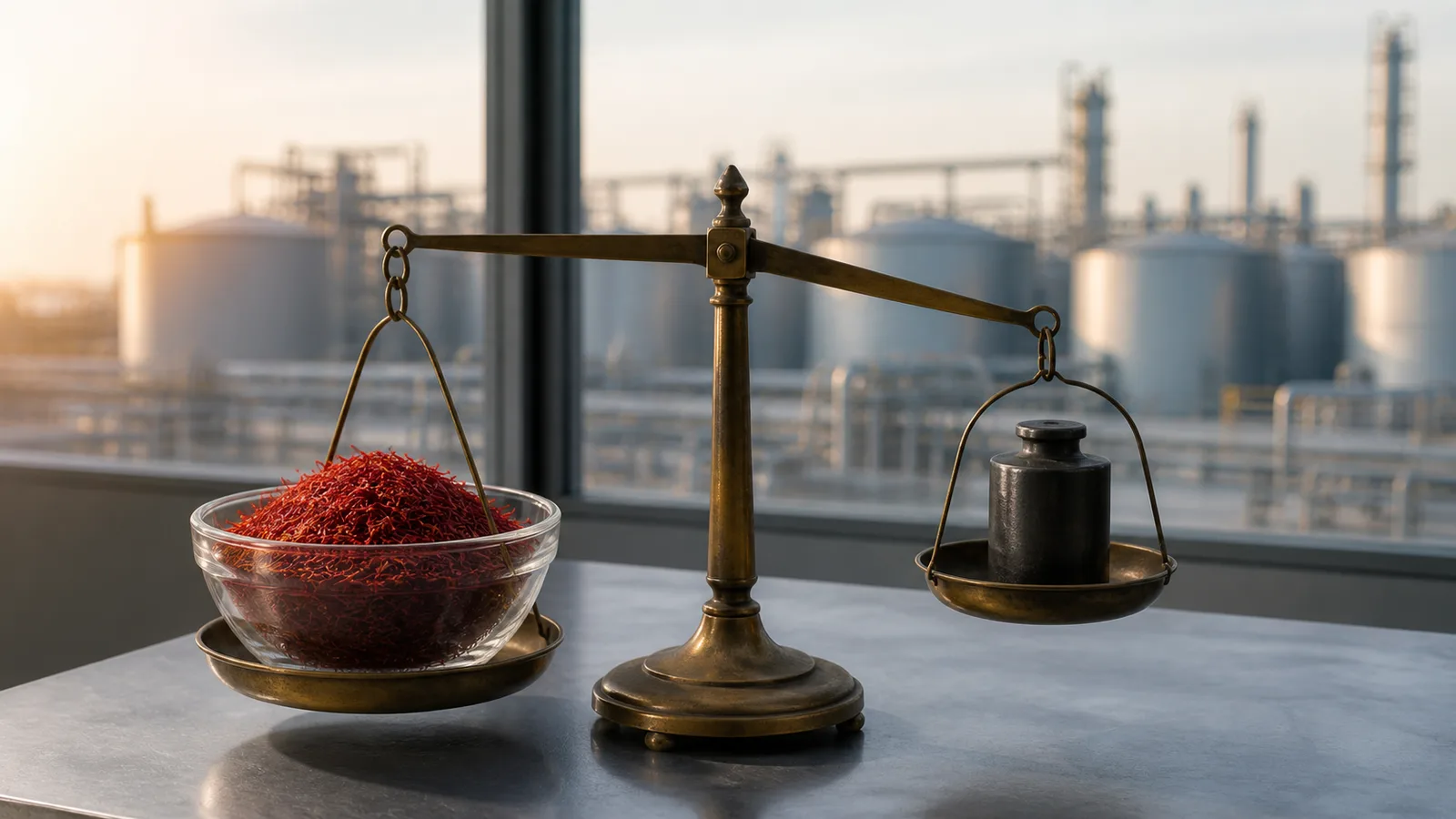
How the 17,000-barrel comparison works
The arithmetic is straightforward. Multiply the price of one barrel of crude oil by 17,000, then compare the result with the bulk value of 1,000 kilograms of dry saffron. At an illustrative oil price of $60 per barrel, 17,000 barrels would be worth about $1.02 million. For one tonne of saffron to match that total, its average value would need to be about $1,020 per kilogram.
Change either market price and the equivalence changes immediately. Crude grades do not all command the same price, and saffron varies by grade, moisture, testing, packaging, contract size, origin and point in the supply chain. The US Energy Information Administration publishes historical crude-oil spot prices, making clear that oil prices are reported by date and benchmark rather than as one fixed figure.
The claim is therefore best understood as a snapshot from an economic argument, not a scientific equivalence and not a current price quote for either product.
The meeting behind the headline
The original report quoted Ali Abdollahi, identified as the executive of the Oman Sea water-transfer project, speaking at a Khorasan Razavi Water Council meeting. His wider point was that eastern Iran needed two connected approaches: development of new supply and better management of existing water resources.
He referred to Mashhad as an example of demand management combined with supply infrastructure, including the Doosti—“Friendship”—Dam line. He also connected water policy with concern about rural depopulation and growth on the outskirts of large cities.
Desalinated-water figures in the old account
A confusing line in the earlier English text said that “53% of fresh water is produced in the Middle East.” In context, the speaker was discussing desalinated water, not all freshwater. The account attributed the principal regional share to Saudi Arabia and the United Arab Emirates, described Iran’s share as roughly 0.5%, and compared about six litres per person per day in Iran with 500 litres in those two countries.
Those numbers are preserved as claims from that meeting. The post did not provide their dataset, year or definition, so they should not be reused as current regional statistics without a new primary source.
What the Oman Sea project was meant to achieve
Abdollahi described several goals for the proposed transfer system:
- provide more reliable drinking and industrial water in eastern Iran;
- support settlements and economic activity near the eastern border;
- reduce pressure associated with migration to the margins of major cities;
- assist development around the Makran coast and industrial activity in Chabahar;
- create employment, with 200,000 jobs stated as a project goal; and
- establish a planned national use of water from the Oman Sea and Persian Gulf.
These were projected benefits, not completed outcomes. Environmental effects, energy demand, brine management, construction cost, water affordability and the condition of receiving aquifers and farms all matter when judging a transfer project.
The route, scale and dates that were proposed
The report said studies began in the Iranian year 1395 and moved through budget planning in 1397 and 1398. The old machine translation rendered those as 1995, 1997 and 1998, which is impossible in the chronology of this 2020 report. The route under study ran from Chabahar to Iranshahr, then Zahedan, Birjand, Gonabad and Mashhad.
At the time of the quoted meeting, study progress was given as 82%, with completion expected within a month. The estimated project cost was $4 billion. A financial model was described with an 11-year payback period, a 20-year operating period and a 16% investment return.
The same account referred to an initial 35-million-cubic-metre stage, a target for the line to reach its endpoint in Iranian year 1403, and a horizon in 1420 of 750 million cubic metres through three 250-million-cubic-metre lines. It assigned 330 million cubic metres to the province. These are historical planning figures. They do not establish the project’s present route, allocation, cost or completion status.
Why saffron entered the water proposal
The speaker said transferred water could cost roughly $3 per cubic metre at some inland destinations. That led to an economic question: what activity could justify expensive water while making use of spare transfer capacity outside the period of highest urban demand?
Saffron was proposed because its irrigation calendar is concentrated in cooler months and its dry product carries high value in a small volume. The presentation described a first-line capacity of 250 million cubic metres and suggested that winter capacity might support up to 150,000 hectares of saffron. It also referred to about three million hectares of potentially suitable land in the broader region.
“Low water use” must still be handled carefully. Saffron is not a crop with zero water demand, and a regional planting decision needs soil, salinity, climate, corm health, labour, yield, ecosystem and groundwater analysis. A proposal’s headline area is not the same thing as land proven suitable at farm level.
Production and trade claims in the presentation
The meeting account included several saffron figures. Abdollahi referred to a harvest of 42 kilograms per hectare in the preceding year, 270 tonnes of production in Iranian year 1397, purchases by Spain and the UAE, 88% of world production, and an economic share of only 3.5%.
The 42-kilogram yield would be exceptional rather than a safe planning average, and the original report did not explain the field, area or measurement behind it. The global production and value shares also need a defined year and methodology. They are retained here as statements made in the presentation, not upgraded into current verified statistics.
Production value is not the whole value chain
The strongest durable point in the old article is that producing a high-value crop does not guarantee that growers or the producing country capture the final retail value. Sorting, laboratory control, packaging, product development, branding, distribution and access to end markets can shift where income is earned.
A UNIDO diagnostic study of Iran’s saffron value chain likewise identified substantial value added after bulk export and argued for stronger processing, packaging and direct market connections. That evidence supports the need to look beyond raw production; it does not validate every percentage or revenue forecast in the water-council presentation.
The large economic scenario
The proposal linked 150,000 hectares, about 90 million cubic metres of water after 30% recycling, projected annual revenue of $5.1 billion and as many as one million jobs. It also argued that land arrangements could reduce the drinking-water component’s cost and listed compact storage and transport as advantages of saffron.
Another sentence in the translation claimed “$7 billion per kilo,” which is plainly corrupted and cannot be used. More broadly, the $5.1-billion and one-million-job figures are scenario outputs. A credible investment decision would need the underlying assumptions: realistic yield by year, corm and labour cost, grade distribution, farm-gate and export prices, processing capacity, water and energy price, market absorption, exchange rate and environmental constraints.
What the comparison can—and cannot—tell us
One ton of dry saffron with 17,000 barrels of oil is a memorable comparison because it makes saffron’s value density visible. It also highlights why packaging and direct market access matter. But the ratio cannot prove that a water-transfer project is viable, that 150,000 hectares should be planted, or that exports are immune to sanctions and trade barriers.
The responsible way to use the old claim is to preserve its date and speaker, show the arithmetic, and test every input again. Water planning and agricultural investment require current primary data. The headline is the beginning of the analysis, not the conclusion.

![Exporting Saffron to Turkey + Price Guide [Complete 0 to 100]](https://img.rowhanisaffron.com/20260827003933/saffron-export-turkey-quality-inspection.webp)



