


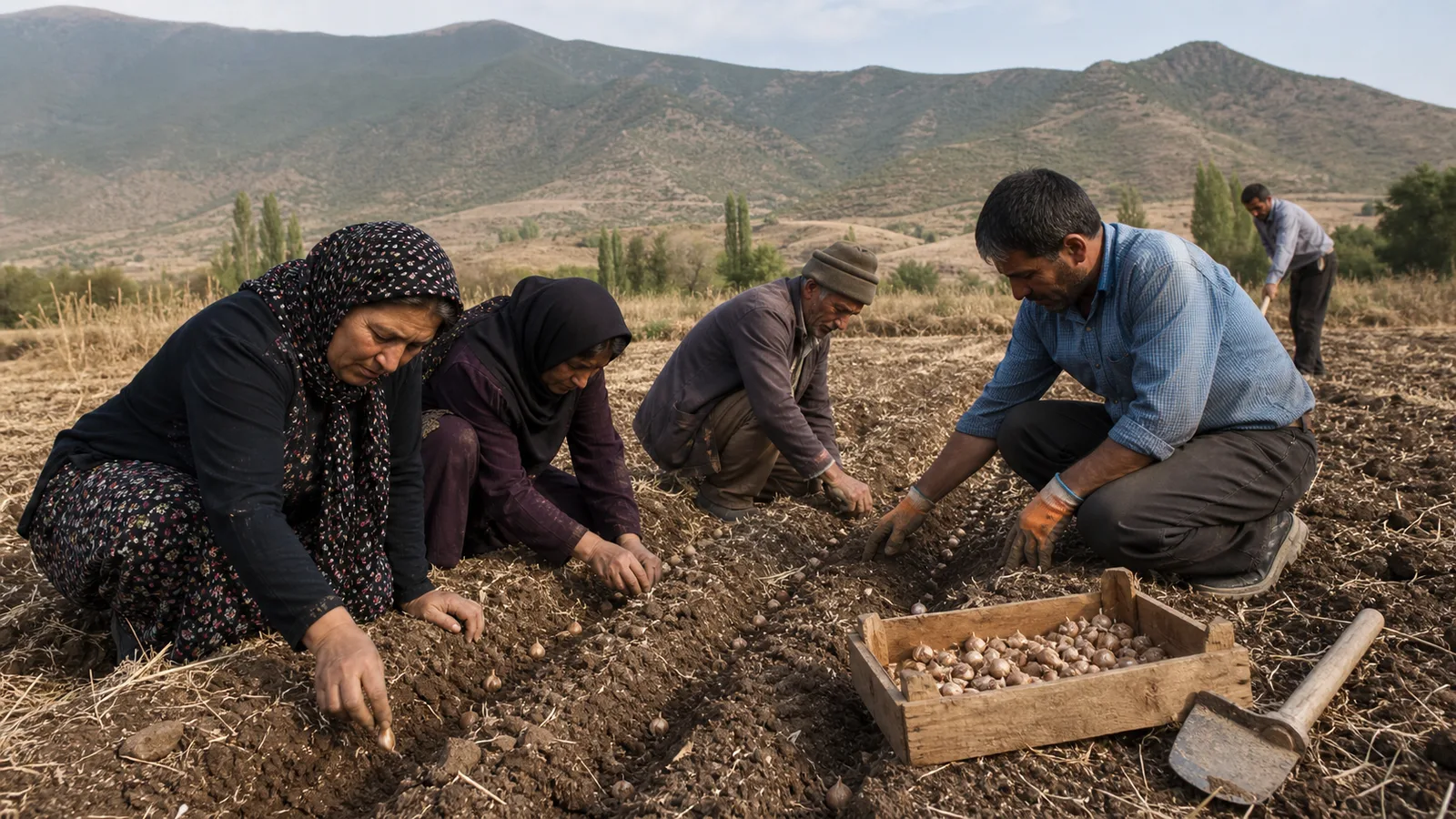
Employment of one thousand people by planting saffron was the ambition behind a rural cooperative proposal announced in Ardabil Province in May 2016. The plan covered 240 households in Germi County, representing about 1,000 family members, and paired local participation with a proposed 130 billion rials in financing.
The figure in the headline needs that context. The report did not document 1,000 permanent payroll positions already created. It described the number of people expected to benefit through the participating households if the cultivation project went ahead as planned.
A cooperative plan for Germi’s rural communities
Akbar Touba, then director-general of Rural Affairs and Councils at the Ardabil Governorate, presented the saffron project as one part of a broader rural-development programme. In the original IRNA report, he said the participating households were expected to contribute 13 billion rials toward the scheme.
Officials were also pursuing 130 billion rials in facilities under a memorandum connected with Iran’s rural development and deprived-areas programme. The proposed financing carried a zero-percent commission and was expected to be released in stages rather than as a single payment.
That distinction matters. The 13 billion rials referred to the applicants’ share, while the much larger figure described the financing being sought for the project. Treating the two numbers as interchangeable would give a misleading picture of how the plan was meant to be funded.
Why saffron was selected
Touba said an executive committee had examined about 30 public-participation proposals for rural production units. At the time of the interview, the saffron cultivation scheme was the project that had reached approval.
Ardabil had already begun establishing saffron as a local crop. In January 2015, the Iranian Agricultural News Agency reported that 72 tonnes of saffron corms had been distributed across eight counties and planted on about 50 hectares. The provincial agriculture authority highlighted the crop’s relatively modest water needs, its value per unit of land and the work associated with cultivation and processing.
For readers interested in the regional background, our report on planting saffron in Ardabil fields follows the province’s early cultivation programme. A separate guide explains the practical growing conditions for premium saffron.
What the employment estimate included
Saffron can spread work across several stages: preparing land, selecting and planting corms, field care, picking flowers, separating the stigmas, drying, grading and packing. The busiest work is seasonal, especially during the short flowering and harvest period. A household-based cooperative can share those tasks, but the number of participating people should not be read as a promise of year-round employment for every individual.
The 2016 proposal used a cooperative structure to organise that participation. Touba said qualifying groups could be formed with 25 members drawn from heads of households who held subsidy cards. The zero-commission terms were aimed particularly at rural and border communities. Knowledge-based companies and other cooperatives could also seek support under a separate four-percent commission arrangement.
These were financing terms reported at the time, not current loan offers. Anyone evaluating a similar project today would need to confirm eligibility, rates and programme rules with the responsible authorities.
Saffron was part of a wider development programme
The committee was not considering saffron in isolation. Other proposals under review included tourism camps, fish and ostrich farming, mushroom production, cattle and lamb finishing, dairy production, concrete manufacturing and small textile or spinning activities. The common idea was to build locally managed production around resources and skills already present in rural communities.
Saffron stood out because a small area can carry a relatively high-value crop and because much of the work can be organised at household or cooperative level. It still requires careful planning. Suitable corms, soil preparation, labour at harvest, drying standards and a dependable route to market all affect whether cultivation turns into lasting income.
What happened as cultivation expanded
The Ardabil programme continued to develop after the 2016 announcement. In 2017, the provincial Agricultural Jihad organisation reported that saffron and medicinal plants had been developed on 110 hectares, with 50 jobs recorded, and that technical work was under way for five saffron processing and packing units in Namin, Khalkhal and Germi.
Those later figures should not be used as proof that every target in the earlier cooperative proposal was achieved. They do show why processing mattered alongside planting. Selling dried, graded and properly packed saffron offers a stronger rural value chain than growing flowers without local capacity to handle the harvest.
How to judge a rural saffron project
A headline employment number is only the beginning. A sound project needs to state how many households are enrolled, how much land is ready, whether financing has actually been released, and which jobs are seasonal or permanent. It should also track the volume and quality of dried saffron, the share processed locally, sales channels and the income that remains with growers.
For the Germi proposal, the most useful facts are therefore the ones the original report separated: 240 participating families, around 1,000 potential beneficiaries, a 13 billion-rial applicant contribution and a proposed 130 billion-rial finance package. Keeping those measures distinct makes the scale of the plan much easier to understand.
Sources and date context
- The project figures and comments from Akbar Touba come from the IRNA report on which this article was originally based, published in May 2016.
- Iranian Agricultural News Agency: saffron cultivation and processing established in Ardabil, published January 6, 2015.
- Iranian Agricultural News Agency: Ardabil agricultural production and employment programme, published April 18, 2017.

![Exporting Saffron to Turkey + Price Guide [Complete 0 to 100]](https://img.rowhanisaffron.com/20260827003933/saffron-export-turkey-quality-inspection.webp)



