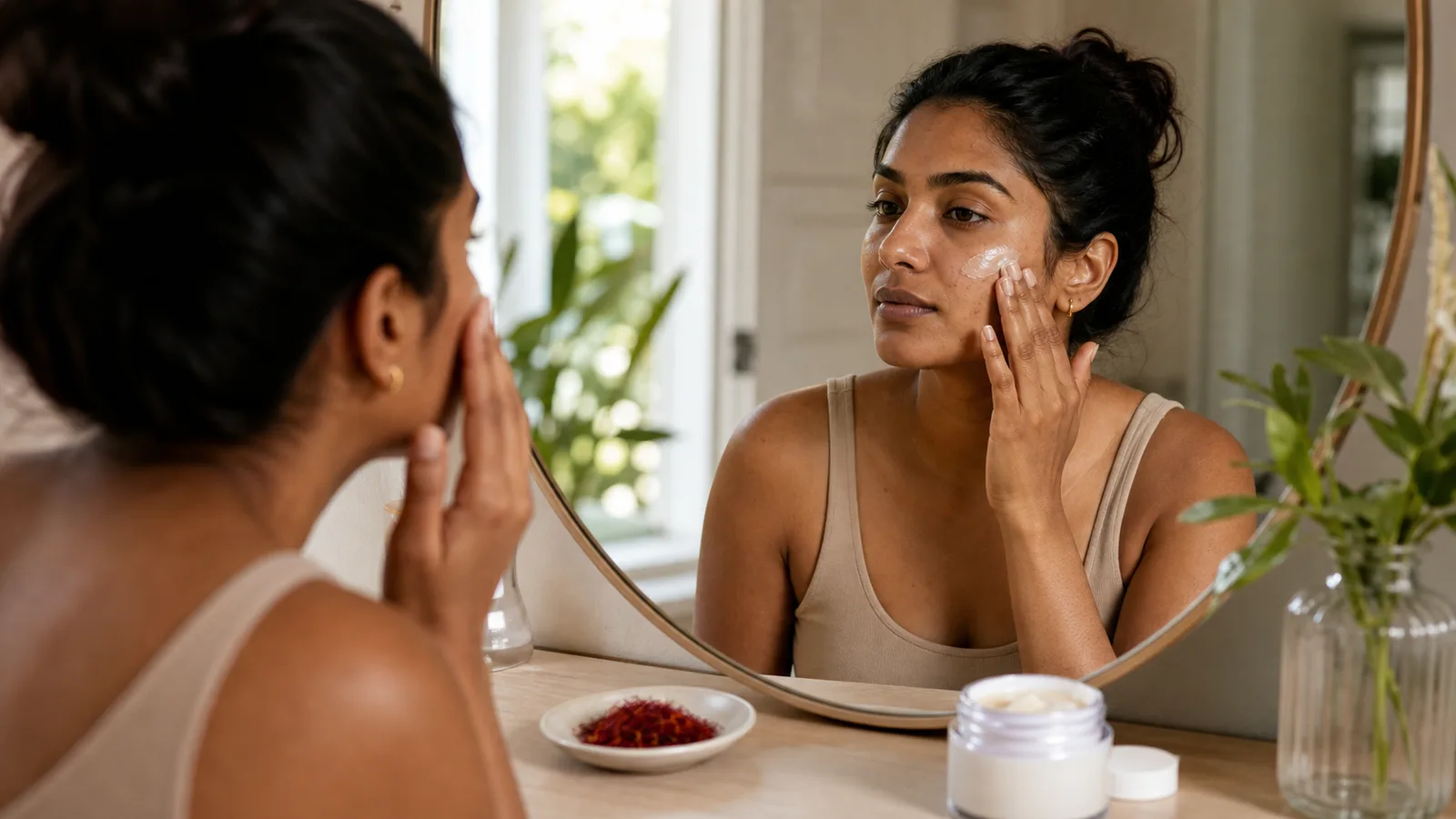
No human clinical evidence shows that culinary saffron threads reduce melanin in the skin or safely lighten a person’s natural skin colour. Laboratory work has found that particular saffron-derived compounds or extracts can affect tyrosinase under experimental conditions, but that is an early research finding, not proof that a homemade mask fades pigmentation.
This is the central limit behind claims about saffron for melanin reduction. The ingredient, the concentration, the test system, and the way it reaches the skin all matter. A compound tested against an isolated enzyme or melanoma cells cannot be assumed to work when three threads are soaked in milk and placed on a face.
What melanin does in the skin
Melanin is the pigment that contributes to the natural colour of skin, hair, and eyes. It is made by cells called melanocytes and helps absorb ultraviolet radiation. Genetic factors have a major influence on baseline skin colour; sun exposure and hormones can also change pigment production.
More pigment in one area is described as hyperpigmentation and can appear as dark spots or uneven skin tone. It can follow acne, eczema, a burn, another injury, sun exposure, or a condition such as melasma. Sunburn itself is an injury from ultraviolet radiation, not simply “excess melanin.” The cause matters because the appropriate treatment for a post-acne mark may not be the right treatment for melasma or a changing mole.
Does saffron reduce melanin production?
The strongest accurate answer is: not demonstrated in people. Saffron contains crocin, crocetin, picrocrocin, and safranal. Research often describes antioxidant or anti-inflammatory activity, yet those broad properties do not establish skin lightening.
A 1999 paper isolated kaempferol from saffron flower petals and tested it against mushroom tyrosinase. It did not test saffron threads on human faces. A 2023 laboratory paper also found tyrosinase inhibition by a measured saffron extract and studied several endpoints in cells. Again, it was not a clinical trial of dark spots, melasma, or natural skin tone.
That distinction corrects a common claim that crocin and safranal simply inhibit the tyrosinase enzyme responsible for melanin synthesis. The experimental literature is more specific and less conclusive than that sentence suggests. It does not tell us that a DIY infusion reaches human melanocytes at an effective, safe concentration.
Can saffron lighten skin or fade dark spots?
Saffron has a long traditional association with complexion care and appears in modern cosmetic formulas. Tradition can explain why an ingredient is popular; it cannot supply missing clinical evidence. There is no reliable basis for promising that saffron alone lightens skin, removes blemishes, or evens pigmentation gradually if it is used often enough.
Freshly irritated skin can actually develop or deepen post-inflammatory hyperpigmentation, especially in darker skin tones. If a mask burns, stings, or causes redness, continuing it in pursuit of a brighter complexion can work against the goal.
How to use saffron for skin whitening: assess the recipe first
The phrase how to use saffron for skin whitening often leads to two kitchen recipes. They deserve a clear evidence and safety check before anyone tries them.
Saffron, milk, or rose-water face mask
A common method says to soak three or four saffron threads in a tablespoon of milk or rose water for 10 to 15 minutes, spread the liquid on the face for about 20 minutes, rinse with lukewarm water, and repeat two or three times a week. Those timings are not a clinically tested treatment schedule. Household milk is not a standardized lactic-acid product, rose water may contain fragrance, and the saffron concentration varies.
Because a water- or dairy-based kitchen mixture has no validated preservation system, make-and-store advice creates an additional contamination concern. A labelled facial product has a defined ingredient list, use directions, and intended shelf life; a spoonful mixed at home does not.
Saffron and honey mask
The second recipe mixes a few threads with honey and leaves the paste on dark spots for 15 to 20 minutes. Honey can feel moisturizing, but that does not prove the combination reduces melanin or pigmentation. It is also sticky near hair and eyes, and either ingredient may trigger a reaction.
Patch testing lowers some risk but does not turn an untested recipe into an effective lightening treatment. The American Academy of Dermatology recommends testing a new skincare product on a small area twice daily for seven to ten days and stopping if redness, itching, or swelling develops.
If you want a saffron cosmetic
Choose a finished product manufactured for facial skin rather than treating culinary threads as a serum. Read the complete label, follow the stated frequency, and patch-test it. A formula that contains saffron extract must still be judged as a whole product; the extract’s name alone does not tell you its strength, stability, pH, or clinical effect.
Stop if it burns or stings. “Pure,” “natural,” and “premium” do not guarantee that a botanical suits sensitive skin. Our all-red saffron collection contains food saffron for culinary use; it should not be mistaken for a tested depigmenting cosmetic.
What actually helps uneven pigmentation?
First identify the likely cause. Treating acne or eczema can help prevent new post-inflammatory marks. Gentle care matters because irritation can worsen dark spots. The American Academy of Dermatology recommends that hyperpigmentation care begin with sun protection.
- Use broad-spectrum, water-resistant SPF 30 or higher on exposed skin.
- For pigmentation, consider a tinted sunscreen containing iron oxide, which also helps protect against visible light.
- Avoid scrubbing, burning, or repeatedly irritating the area.
- Choose labelled products suited to your skin, or ask a dermatologist about targeted treatment.
Some dark spots fade slowly after their cause is controlled, while deeper pigment can take much longer. Melasma may recur and often needs an individual plan. See a dermatologist promptly for a new or changing pigmented lesion rather than trying to lighten it at home.
Be cautious with products sold as skin lighteners
The U.S. Food and Drug Administration warns that some skin-lightening products have contained mercury or unapproved hydroquinone. These products can cause serious harm, including rashes, swelling, nervous-system or kidney injury, and permanent discoloration. An unlabeled or poorly labeled “natural” cream is not safer by default.
Read the ingredient list and avoid products with no proper label. In the United States, hydroquinone skin-lightening products are not approved for over-the-counter sale; prescription treatment should be supervised by a licensed professional. Never apply household bleach to skin.
The practical conclusion
Saffron is scientifically interesting, and laboratory tyrosinase findings justify further study. They do not yet justify the claim that saffron reduces human melanin or that milk, rose-water, or honey masks lighten skin. Protecting the skin from sun and irritation, treating the cause of dark marks, and choosing properly formulated care are safer ways to work toward a more even tone.
Sources
- Laboratory study of a saffron-flower flavonol and mushroom tyrosinase
- Laboratory evaluation of saffron-extract activities relevant to skin
- American Academy of Dermatology: how to fade dark spots safely
- American Academy of Dermatology: melasma self-care
- American Academy of Dermatology: how to patch-test skincare products
- U.S. Food and Drug Administration: skin-lightening product warning