


Iran saffron still carries extraordinary weight in the world spice trade, but production leadership does not protect an industry from weak policy, informal exports, water stress or loss of identity after the crop leaves the farm. Those were the threats behind Gholamreza Miri’s warning about Iran’s “red gold.” Some of the figures in that warning belong specifically to 2018, so they need dates and context rather than being presented as current facts.
Why Iran’s saffron leadership can still be vulnerable
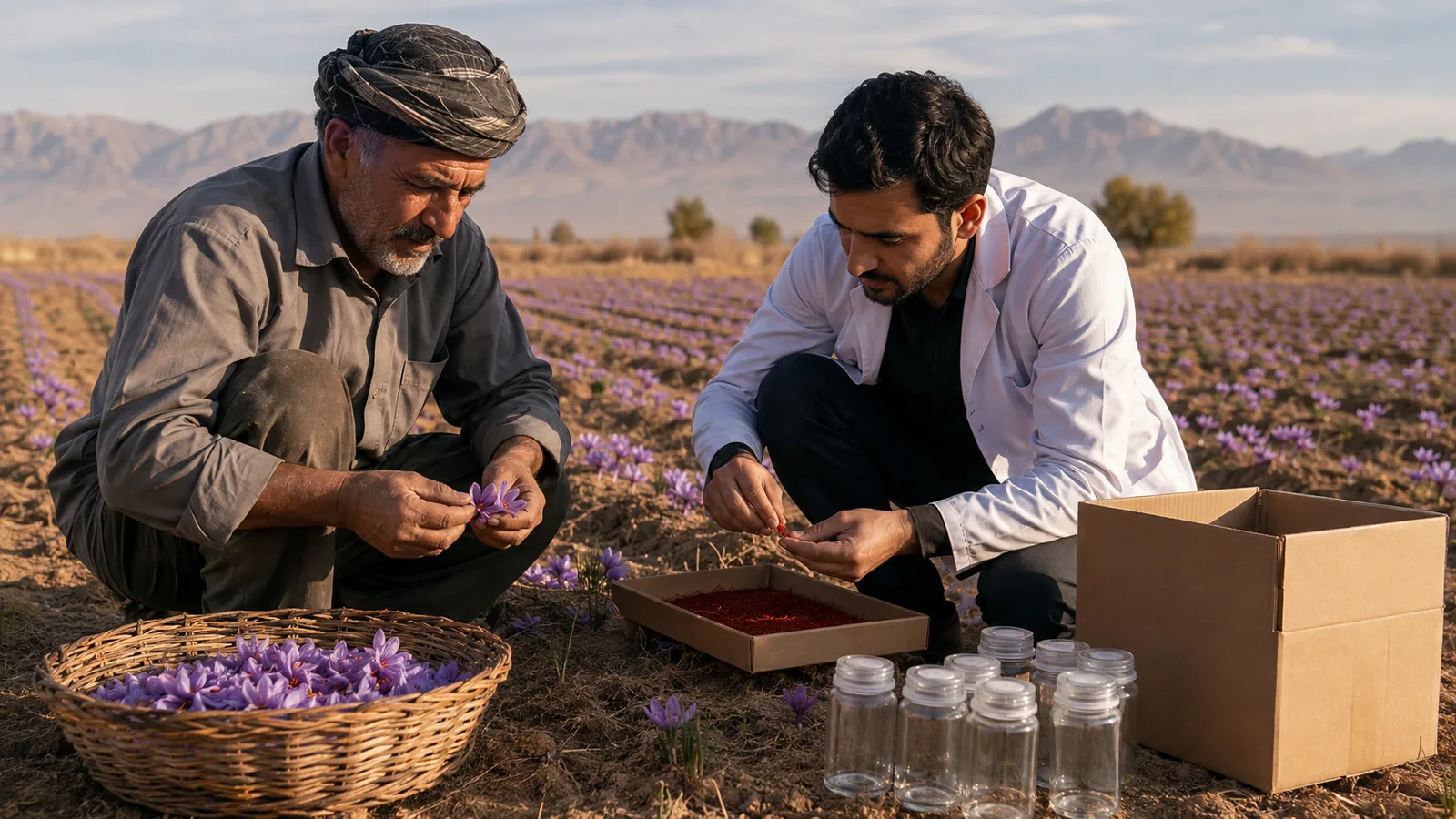
The starting point is not in doubt. The Food and Agriculture Organization says Iran produces more than 90% of the world’s saffron. That makes Iran the dominant origin by production, not a minor supplier on the edge of the market.
Yet production share, export value and control of the final brand are different things. A country can grow most of a crop while importers, packers and distributors elsewhere build the customer relationship. Iranian saffron may reach another market in bulk, be sorted or packaged there, and appear on a retail shelf under a brand that says little about the farmer or original region.
Miri, then a senior representative of Iran’s saffron trade, framed the danger in direct terms: poor export rules, smuggling and drought could weaken Iran’s position. His broader point remains useful. A large harvest is only one part of a healthy saffron industry; quality assurance, traceable origin and reliable access to buyers determine how much of the final value stays with producers and legitimate exporters.
The 2018 warning and what it actually said
The original discussion came during a turbulent currency period. Miri said exporters were selling saffron for roughly $500 to $1,000 per kilogram in different markets while customs valued it at $1,450 per kilogram for foreign-currency return purposes. A contemporary Persian-language report records his objection to that valuation and his request for it to reflect the real sale price.
That $1,450 figure is a historical policy figure, not today’s Iranian saffron price per kilogram. It should not be used to value a current crop or retail purchase. The amount a shipment realizes depends on its grade, quality evidence, packaging, order size, delivery terms, destination and date. Exchange rates and transfer costs matter as well.
Anyone looking for the Iran saffron price per kilogram in 2025 should be especially careful not to reuse that 2018 customs figure. A dated reference value and a verified sale price answer different questions.
The concern was practical. If an exporter had to return more foreign currency than a legitimate sale produced, the formal route became difficult to use. Miri argued that the mismatch could encourage one-time export cards and movement outside normal customs channels. A sensible policy test is therefore simple: does the declared customs value bear a defensible relationship to the invoice, product grade and destination market?
Informal trade can erase origin as well as revenue
Saffron is unusually easy to move because a valuable shipment occupies little space. That physical feature does not prove smuggling, but it makes weak enforcement and distorted incentives more consequential than they would be for a bulky, low-value crop.
In October 2018, Miri told Trend that Iran expected a crop of about 350 tonnes and that restrictions on direct access to markets such as the United States, Saudi Arabia, India and China were contributing to saffron moving through Afghanistan. He warned that some product could then be exported under another origin. The report also records his estimate that cultivation had expanded by 10% to 15% while drought was still expected to reduce production in some regions.
Claims about a particular route should be read as attributed industry testimony, not as a measurement of every shipment. Formal Iranian exporters, Afghan growers and lawful re-exporters should not be treated as interchangeable. The genuine risk is that undocumented movement makes it harder to verify where the crop was grown, how it was handled and whether the name on the package represents its origin.
This is why anti-fraud work belongs beside export policy. FAO’s current work with Mashhad University focuses on authenticity testing, post-harvest guidance and methods that laboratories can use consistently. Better testing cannot solve banking or customs problems, but it can make an origin claim easier to defend and a false claim harder to maintain.
Did the export increase prove money laundering?
No. An increase in reported exports, by itself, cannot establish money laundering. Contemporary coverage said Iranian saffron exports rose by about 40% in both weight and value during the first six months of the relevant Iranian year. The reported total was 105 tonnes worth approximately $145 million.
The old version of this article described money laundering as the cause of that increase and suggested that most exporters were using saffron to move currency. The sources available do not support such a sweeping conclusion. Iran’s currency-return system allowed export proceeds to be supplied through approved mechanisms, including import-against-export arrangements. Using an authorized mechanism is not evidence of a crime.
There were legitimate reasons to investigate unusual declarations, unrealistic customs values or exporters created only for a single transaction. Those indicators call for shipment-level evidence and regulatory review. They do not justify accusing an entire trade. The safer conclusion is narrower: a policy gap can create opportunities for abuse while also burdening established exporters who are following the rules.
Drought is a production threat, even for a relatively frugal crop
Saffron needs less water than many agricultural alternatives, but “less” does not mean none. Corm health, autumn flowering and the next season’s yield still depend on suitable soil moisture, temperature and farm management. Expanding the cultivated area can keep national output steady for a time while yields fall in particular districts.
The contrast in the 2018 forecast captures that tension: more land was planted, yet drought was expected to reduce output in some places. Later industry testimony reported a much sharper climate effect. In an interview republished by the Khorasan Razavi Saffron Exporters Union, Miri estimated that a crop once expected to approach 400 tonnes had fallen to roughly 170 tonnes following poor conditions and drought. That is an industry estimate rather than a final national production series, but it shows why water and weather cannot be treated as background issues.
A durable response starts below the national headline number. Yield by district, corm condition, irrigation reliability, harvest labour and drying losses reveal problems that a single tonnage estimate can hide. Growers also need incentives for quality. Increasing hectares alone is a weak strategy if the additional crop is sold anonymously at a discount.
How much saffron does Iran produce?
The answer changes from harvest to harvest. The original article said that Iran had produced 326 tonnes in the previous year and associated the industry with about $400 million in annual revenue. Those were period-specific estimates, not permanent production and income figures. They should also not be mixed with customs exports: a country can produce saffron that is sold later, held in stock or used domestically.
For comparison, WITS recorded 235.9 tonnes of Iranian saffron exports worth $325.65 million in 2017. That does not contradict a larger production estimate; it measures a different part of the chain. A current answer therefore needs a named crop year and must say whether the number means production or exports.
Competition is broader than another country growing more flowers
The 2018 warning named Uzbekistan, Greece, Kashmir in India, Italy and Morocco as potential competitors. Afghanistan and Spain also appeared prominently in discussions of trade routes and branding. Several of these places have genuine saffron production traditions; others play an important role in packing, distribution or re-export.
That does not mean any one of them was about to replace Iran’s output. It means buyers have alternatives, and countries with a smaller crop can still compete in a valuable segment through protected origin, consistent grading, attractive packaging or easier commercial access.
World Bank WITS data provide a useful check on the old market-share claims. In 2017, Iran reported $325.65 million and 235.9 tonnes of saffron exports. Spain was an important destination for Iranian shipments, alongside Hong Kong, the United Arab Emirates and Afghanistan. A separate WITS exporter table placed Iran far ahead of Spain by reported export value that year.
Those data do not support the old article’s statement that Iran held only one-seventeenth of global saffron trade or its uncited 2016 percentage split. Trade databases can differ by reporter, year and whether a figure measures value or quantity, so historical shares should always identify the dataset and period. What the evidence does show is a gap between growing the spice and retaining its identity through the full route to the consumer.
The earlier version also listed Portugal, France, the Netherlands, Germany and Switzerland among saffron-exporting countries, together with Iran, Spain, Afghanistan, Hong Kong, Greece and China. The broad point is fair—trade is not limited to producing countries—but the list does not establish that every participant grows the saffron it exports. Country, year, trade direction and product code must be checked before drawing that conclusion.
What would protect Iranian red gold?
No single intervention fixes production, trade and branding at once. The practical priorities are connected:
- Use realistic customs values. Valuation should reflect verified contracts, grade and destination rather than forcing every shipment into an outdated reference price.
- Make formal exporting workable. Clear currency-return rules and lawful payment channels reduce the incentive to move through opaque routes.
- Prove origin and quality. Consistent sampling, laboratory methods, batch records and careful post-harvest handling help an Iranian name carry measurable meaning.
- Follow the crop at district level. Water stress and yield loss require local evidence, not reassurance based only on a larger planted area.
- Sell closer to the final customer. Stronger packaging, direct buyer relationships and dependable delivery allow producers and exporters to retain more value.
The comparison with pistachios and caviar in the original speech was a warning from Miri, not a forecast that saffron would inevitably follow the same path. Its value is as a reminder that an origin’s reputation can weaken when production problems and market access are ignored. It should not be read as proof that Iran has already lost leadership in saffron.
How to read Iran saffron export news
Export headlines are easier to interpret when the date and measure come first. Check whether the number describes a harvest forecast, customs exports, world production or retail sales. Note whether value is quoted in dollars or local currency, whether tonnage refers to a full year or a partial period, and whether the comparison is year on year.
Price headlines need the same care. A bulk customs value is not a retail jar price, and an average per kilogram says nothing about grade without the shipment record. Sanctions can influence banking, freight and buyer access without changing the biological quality of the threads. For a broader current framework, read our overview of saffron export challenges in Iran.
Iran’s scale remains a formidable advantage. Protecting it requires more than growing the most saffron: the formal route must make commercial sense, the origin must remain visible, and the product arriving overseas must justify the confidence attached to Iranian red gold.

![Exporting Saffron to Turkey + Price Guide [Complete 0 to 100]](https://img.rowhanisaffron.com/20260827003933/saffron-export-turkey-quality-inspection.webp)



