


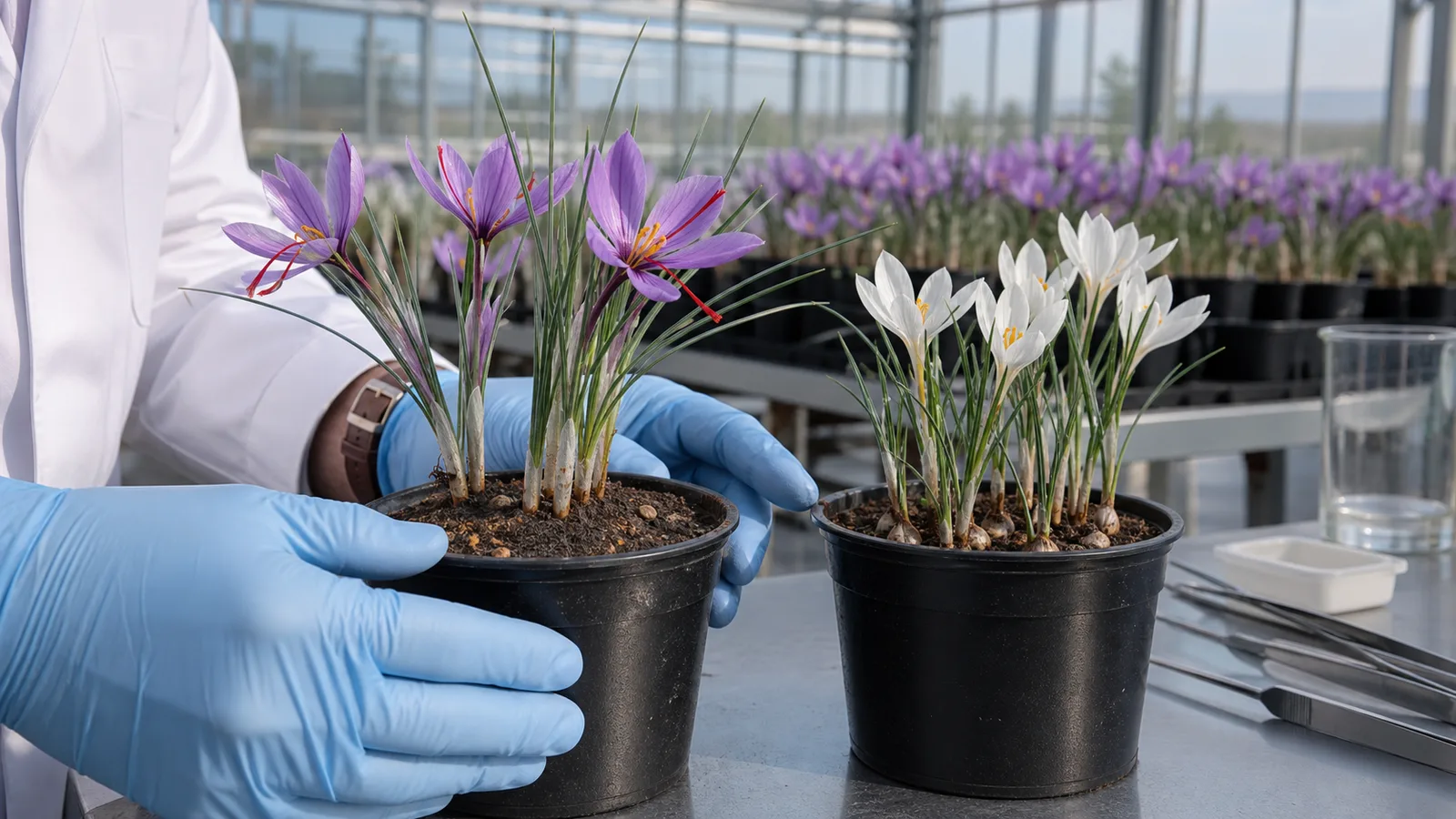
“White saffron” is an ambiguous name, and that matters before anyone plants, sells or consumes it. A 2020 report from West Azerbaijan used the phrase for local white or pale crocus-like flowers while also discussing ordinary cultivated saffron. Some wild plants called autumn crocus, meadow saffron or “flower of regret” are not culinary saffron at all and can be highly poisonous.
First: what “white saffron” can mean
The culinary spice saffron comes from the dried stigmas of Crocus sativus. The US Department of Agriculture identifies the dark-red stigmas of Crocus sativus as saffron. A pale flower may still need expert identification, but appearance alone does not turn another species into the food crop.
The phrase may also be used commercially for the pale yellow or white style attached below a saffron stigma. That plant material is not a separate white-saffron crop and has less colouring strength than the red stigma. Finally, local names may be applied to unrelated wild flowers that resemble crocuses. These meanings must not be mixed.
For readers who reached this page through the Spanish query cultivo de azafrán: it means saffron cultivation. The same identification rule applies—verify Crocus sativus corms before treating a crop as culinary saffron.
The West Azerbaijan entrepreneur’s account
The original article quoted Ziba Habibi, described at the time as a 35-year-old plant-science graduate and entrepreneur. It said she began work to promote saffron in Iranian year 1390—not Western calendar year 1990, as the earlier English translation implied—with 10 million tomans of credit and a 1,500-square-metre plot in Takab.
Habibi’s stated aim was to expand a crop with a lower irrigation requirement and create more attention for saffron cultivation in West Azerbaijan. She argued that the province needed branding, innovation, marketing and farmer education if it wanted local production to reach larger markets.
The greenhouse and employment claim
The interview said a 1,000-square-metre greenhouse had been established in Urmia during the preceding year and connected it with direct and indirect work for 500 people. The old report does not define the jobs, period or supply-chain activities included in that number. It is retained as Habibi’s statement, not presented as independently verified employment created inside one greenhouse.
Greenhouse saffron also needs an economic reason. A protected structure can support controlled trials, corm work or research, but the building, climate control and labour add costs. A grower should compare those costs with open-field production and confirm that the intended method has a buyer and a tested yield model.
Harvest and yield figures in the interview
Habibi placed the local saffron harvest in October and November. She gave an average of 0.5–1 kilogram of dry saffron per 1,000 square metres, equivalent to roughly 5–10 kilograms per hectare if the same performance continued across the larger area.
That is a planning range from the interview, not a guarantee. Actual yield changes with corm size and health, planting density, field age, soil and drainage, irrigation timing, nutrition, weeds, disease, harvest labour and drying losses. A farm budget should use measured local trial results rather than the highest end of a quoted range.
The 78% water-saving statement needs a baseline
The article attributed a 78% water saving to saffron. A percentage cannot be evaluated without knowing the comparison crop, irrigation method, soil, rainfall, growing season and whether the figure measures water applied or water consumed. It should therefore remain a reported claim, not a universal property of saffron.
Habibi contrasted saffron with water-demanding crops then grown in the province, naming sugar beet and grapes. A sound replacement decision still requires local water accounting and economics. Saffron’s irrigation calendar can be attractive, but it does not make every field or water source suitable.
Nowruz Goli and other local white flowers
The interview referred to a native flower on the Urmia plain as Nowruz Goli or Soghan Goli and described it as a white-and-purple wild mountain plant. The old text mentioned a corm-like underground structure, needle-like leaves, six petals and more than ten yellow “flags,” probably a mistranslation of stamens.
Those details do not establish that the plant is Crocus sativus. In fact, a flower with more than ten stamens would not match the simple botanical distinction used for either true Crocus or Colchicum. A pressed specimen, clear photographs of all plant parts and expert taxonomic identification are required before drawing conclusions about its relationship to saffron.
Gol-e Hasrat and Colchicum are a safety issue
The article also mentioned an autumn-flowering plant called Gol-e Hasrat around the Marmisho and Qasmalvi areas of Urmia. Kew’s medicinal plant database records gol-e-hasrat as a non-scientific name associated with Colchicum autumnale. Kew also explains that plants in the Colchicum genus are misleadingly called autumn crocus even though they are unrelated to the Crocus genus: Crocus has three stamens, while Colchicum has six.
This is not a minor naming detail. Poison Control describes Colchicum autumnale as extremely poisonous and warns that even a taste can cause severe symptoms. No wild plant sold or described as white saffron, meadow saffron or autumn crocus should be eaten unless its identity and food use are established by a qualified local expert.
Colchicine is medicine—not a home remedy
The previous version said tinctures from the “flower of regret” had long been used for gout and that industrial drugs were now sold. The relevant compound is colchicine, but that does not make the plant safe to prepare. The European Medicines Agency notes that colchicine can be toxic at doses close to those used for treatment.
Prescription colchicine is manufactured and dosed as a regulated medicine. Eating a plant, brewing it as tea or making a home tincture cannot control the dose and may cause fatal poisoning. This page gives no instruction for medicinal use.
What must be verified before cultivation
- Botanical identity: obtain certified Crocus sativus planting stock with traceable provenance.
- Food purpose: confirm that the harvested part will be the red stigmas of culinary saffron, not a look-alike flower.
- Trial performance: measure flowering, dry-stigma yield, disease, irrigation and labour on a small local plot before scaling.
- Quality: use controlled drying, clean handling and appropriate testing rather than relying on soil or province as proof of quality.
- Economics: record corm, labour, water, drying, packaging and sales costs; a high retail price does not equal farm profit.
- Market route: identify buyers, grades and traceability requirements before expanding acreage.
Branding ordinary saffron from West Azerbaijan
Habibi wanted West Azerbaijan saffron to develop recognition beyond the dominant production and trading centres around Khorasan and Mashhad. She named Turkey and Iraq as nearby export opportunities and Europe as a wider market for Iranian saffron.
Regional branding can help only when it rests on a defined product. For ordinary culinary saffron, that means verified Crocus sativus, documented origin, consistent grade, clean processing, laboratory evidence where required, and packaging that preserves the threads. Soil quality alone cannot establish superiority.
The responsible conclusion
The entrepreneur’s larger argument—test lower-water crops, train growers and build a market—is worth preserving. The botanical language in the old report is not. “White saffron plant” is not a precise species name, and Gol-e Hasrat should never be folded casually into a culinary saffron story.
West Azerbaijan may cultivate genuine saffron and may also host interesting native crocus-like flora. Those are separate propositions. Identify first, test second, and only then decide what can be grown, branded or eaten.

![Exporting Saffron to Turkey + Price Guide [Complete 0 to 100]](https://img.rowhanisaffron.com/20260827003933/saffron-export-turkey-quality-inspection.webp)



