


Cultivation of saffron in Eshtehard, in the Karaj area, was reported at 15 hectares in 2020 as local farmers adapted to declining rainfall and tighter water supplies.
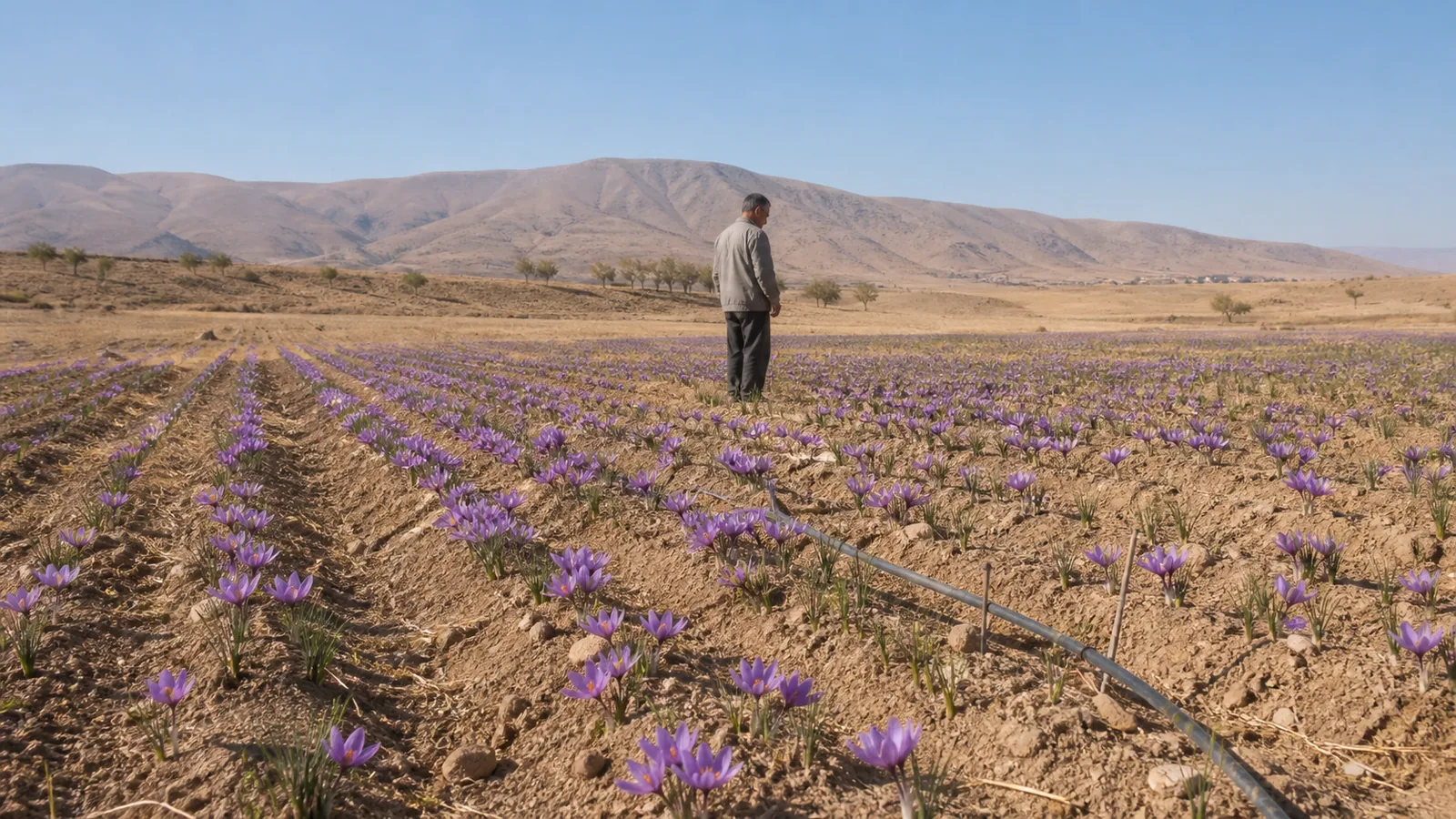
This article preserves that historical report and the statements attributed to Mohammad Reza Mirzaei, then director of Eshtehard’s Agricultural Jihad office. The figures describe the situation reported in 2020; they should not be read as a current acreage survey.
The 2020 report on saffron cultivation in Eshtehard
Mirzaei said that 15 hectares of agricultural land in Eshtehard had been allocated to saffron. He connected the crop’s expansion with the pressure that lower rainfall was placing on the city’s farmers.
According to his account, rainfall had decreased over the preceding years. Farmers were consequently facing greater difficulty with crops that depended on more abundant water, prompting some to consider crops with lower irrigation demand.
Why saffron was being considered
In the report, Mirzaei described saffron as hardy, adaptable and less water-demanding than many other agricultural products. His point was specific to crop planning under Eshtehard’s water constraints, not a claim that saffron can be grown without water.
The distinction matters. “Low-water” in this context means choosing a crop whose seasonal water requirements may be more manageable than those of some alternatives. It does not remove the need for suitable soil, healthy corms, timely irrigation and careful field management.
Seven years of local expansion
Mirzaei said saffron cultivation had begun in the central parts of Eshtehard seven years before the report. By 2020, he put the cultivated area at 15 hectares.
He also said that the area could soon reach 20 hectares if the same trend continued. That was a forward-looking estimate made at the time, rather than confirmation that the additional five hectares were ultimately planted.
Water scarcity and farm decisions
The report placed saffron within a broader change in local agriculture. As water resources declined from year to year, farmers had to weigh crop demand, available irrigation and the long-term viability of their land more carefully.
Mirzaei’s recommendation had two parts: consider crops suited to limited water conditions, and improve how available water is delivered. He argued that crop choice alone would not be enough to protect farming livelihoods.
The role of modern irrigation
Alongside saffron and other lower-water crops, Mirzaei encouraged the use of modern irrigation systems. In his account, better irrigation was part of maintaining sustainable employment and farm income as local water resources tightened.
That recommendation did not identify one universal system for every field. The appropriate method depends on the water source, field layout, soil and the stage of crop growth. The report’s central point was the need to reduce avoidable water loss rather than rely on crop selection by itself.
What the figures do and do not show
- 15 hectares: the saffron area Mirzaei reported for Eshtehard in 2020.
- Seven years: the period he said had passed since cultivation began in the city’s central areas.
- 20 hectares: his projected area if expansion continued, not a verified later total.
- Declining rainfall: the local pressure he cited as farmers reconsidered crop and irrigation choices.
- Modern irrigation: the accompanying measure he recommended for more sustainable use of water.
A historical snapshot, not a current total
The value of the report is that it records an early stage in the cultivation of saffron in Eshtehard city of Karaj and explains the local reasoning behind it. It shows how water availability, crop resilience and rural income were being considered together.
Because cultivated area can change from one season to another, a present-day figure would require a newer survey from the relevant agricultural authority. Until such data are available, 15 hectares and the proposed 20-hectare expansion should remain clearly dated to the 2020 statement.

![Exporting Saffron to Turkey + Price Guide [Complete 0 to 100]](https://img.rowhanisaffron.com/20260827003933/saffron-export-turkey-quality-inspection.webp)



