


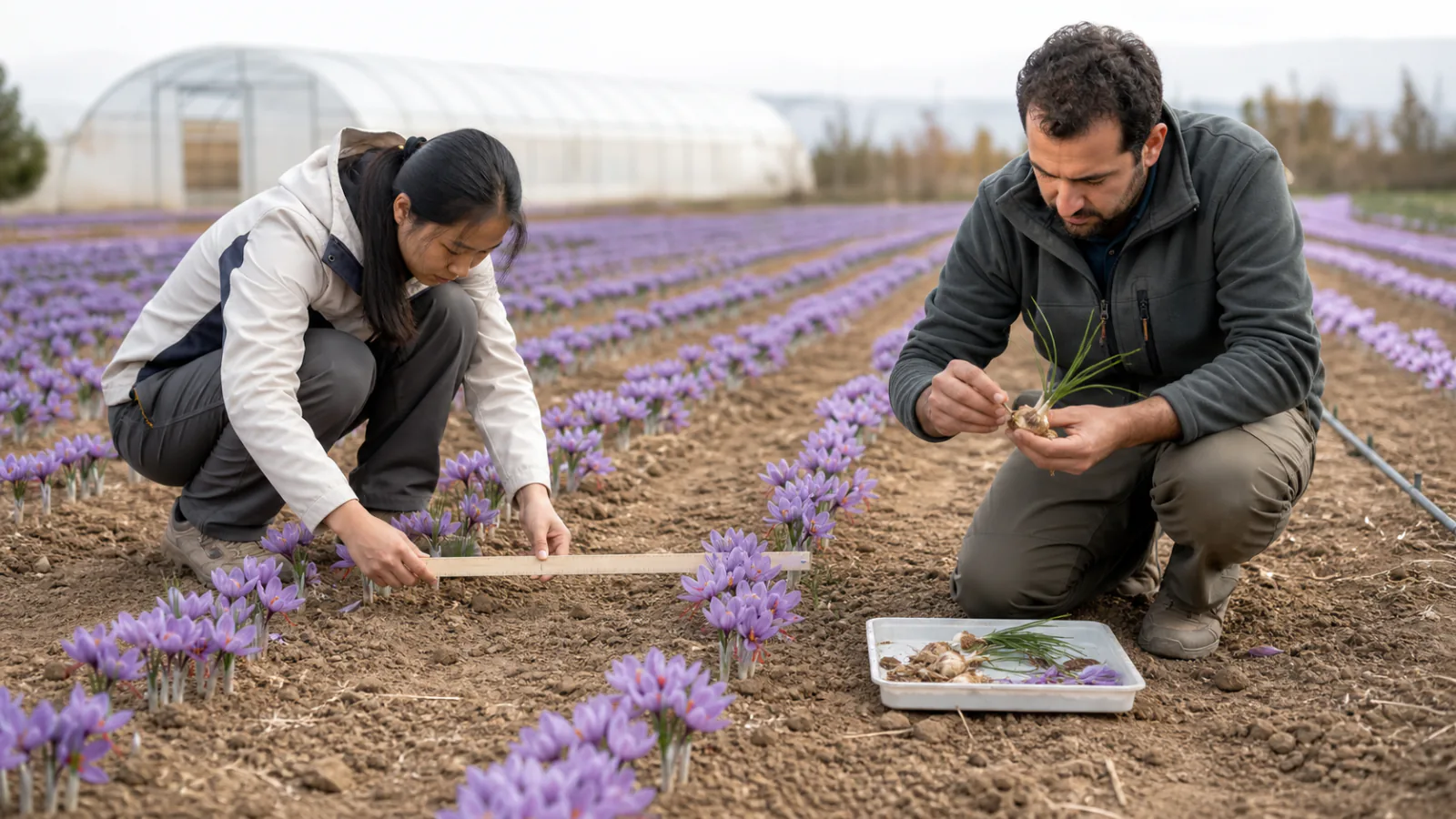
China grows saffron and has developed notable regional production, but current evidence does not show it matching Iran’s scale. FAO reported in 2025 that Iran still produced about 85–90% of the world’s saffron. The useful question is therefore not whether China has already displaced Iran, but what rising producers reveal about productivity, quality, research and market development.
A serious comparison of China and Iran saffron production needs dated, comparable data. A national figure should not be set against one township, and an old policy target should not be reported as a result.
Is China a Rival to Iran in Saffron Production?
Iran leads by production scale and accumulated knowledge
Saffron cultivation is deeply established in Khorasan Razavi and South Khorasan. The crop supports many smallholder families and draws on local knowledge of corm selection, irrigation, seasonal labour, harvest and drying. In its 2025 report on Iran’s saffron value chain, FAO described Iran as the global leader and highlighted quality integrity, post-harvest handling, traceability, modern marketing and digital branding as priorities.
Scale is a strength, but it also creates a coordination challenge. Thousands of growers and many collectors, processors and exporters must preserve lot identity and quality across a dispersed chain. More production is valuable only when the market can absorb it and the product reaches buyers in a form that retains value.
China has real production, but regional figures need context
Saffron is cultivated in parts of China for herbal, culinary and economic uses. One concrete example comes from Sandu township in Zhejiang. A 2021 regional report said the township had about 140 hectares of saffron crocus and annual dried-filament output of 2,900 kilograms. The Zhejiang account of saffron cultivation also described investment in mechanisation, breeding research and a flower–rice farming model.
That is meaningful local production, not a current national total. It cannot be used alone to rank China against Iran. It does show that technical support, infrastructure and regional specialisation can build a viable saffron cluster.
Yield targets are not the same as achieved yield
The old article quoted a proposal to raise Iranian yield from about 3 kilograms per hectare toward 10 kilograms. It also gave an old national output estimate and a future policy target. The date and source definitions are unclear, so those figures should not be presented as current performance.
Yield depends on corm size and health, planting density, field age, soil, irrigation, nutrition, climate, pests, disease and harvest management. A high figure from a trial plot may not transfer to every commercial field. Useful reporting states the location, season, planted area, measurement method and whether the number is fresh flowers or dried stigmas.
Competition is about quality as well as kilograms
Saffron earns value through colour, aroma, bitterness, purity, moisture control and consistent handling. The current ISO 3632-1:2025 specification applies to dried saffron in filament, cut-filament and powder forms and provides a common quality context for trade.
Country of origin does not replace batch evidence. A strong lot from any country should be properly sampled, identified, stored and tested. Iran’s production leadership gives it a powerful reputation, but traceability and repeatable specifications are what let an individual exporter defend that reputation.
Harvest and drying can decide the outcome
Saffron flowers open during a short season and deteriorate after picking. Early collection can limit heat exposure and gives workers time to separate the stigmas. The threads then need prompt, controlled drying. Direct sun, excessive heat, long delay or damp storage can reduce quality.
The old article recommended early-morning harvest and rapid drying away from ultraviolet sunlight. The principle is sound: time, temperature, cleanliness and moisture must be controlled. It is better to document the process than repeat one universal drying technique for every facility.
Field care cannot be reduced to one fertiliser recipe
The earlier text also prescribed aged cattle manure and warned against entering the field while leaves were yellowing. Such advice needs local agronomic context. Organic amendments can affect soil structure and nutrients, but poorly composted manure may carry weed seeds or pathogens, and excessive application can create other problems.
Saffron leaves continue supporting the corm after flowering. Removing or damaging them too early can interfere with the plant’s seasonal cycle. Growers should base nutrition, traffic and leaf management on soil tests, field condition, local extension advice and the growth stage rather than a translated rule with no location or rate.
New products create demand only when claims are responsible
The old workshop report argued that processors should develop a wider range of saffron products. That remains a plausible market strategy: culinary ingredients, beverages, food-service formats and carefully standardised extracts serve different buyers. Each product also introduces new requirements for stability, labelling and evidence.
The article claimed saffron was being consumed as an “anti-Alzheimer’s drug” in Europe. That wording is not supported. A systematic review of randomised trials on saffron and cognition described promising results but warned that evidence came from few studies with potentially high risk of bias and called for larger, lower-bias trials. Saffron is not an approved replacement for dementia diagnosis or treatment.
Regional brands need traceability, not only a place name
The old article referred to Bahabad seeking a distinctive regional brand. Place identity can help customers understand climate, tradition and production methods, but a name alone does not ensure quality. A credible regional claim needs defined boundaries, product specifications, producer controls and a way to verify origin.
That lesson applies in Iran, China and every other producing country. Branding works best when it makes the chain more accountable rather than simply adding prestige.
What Iran can protect and improve
- Raise farm productivity through local evidence, not headline targets alone.
- Protect healthy corms, soil and scarce water.
- Reduce delays between flower harvest, stigma separation and drying.
- Record lots and test quality with recognised methods.
- Develop products that have clear specifications and responsible claims.
- Build regional and national brands on traceable origin.
- Publish current, comparable data so market decisions are evidence-based.
China is a participant in saffron production and may become a stronger competitor in selected markets. Iran’s immediate advantage remains its scale, experience and cultural depth. Keeping that advantage depends on quality integrity, efficient production and credible market information—not on assuming that past dominance will preserve itself.

![Exporting Saffron to Turkey + Price Guide [Complete 0 to 100]](https://img.rowhanisaffron.com/20260827003933/saffron-export-turkey-quality-inspection.webp)



