


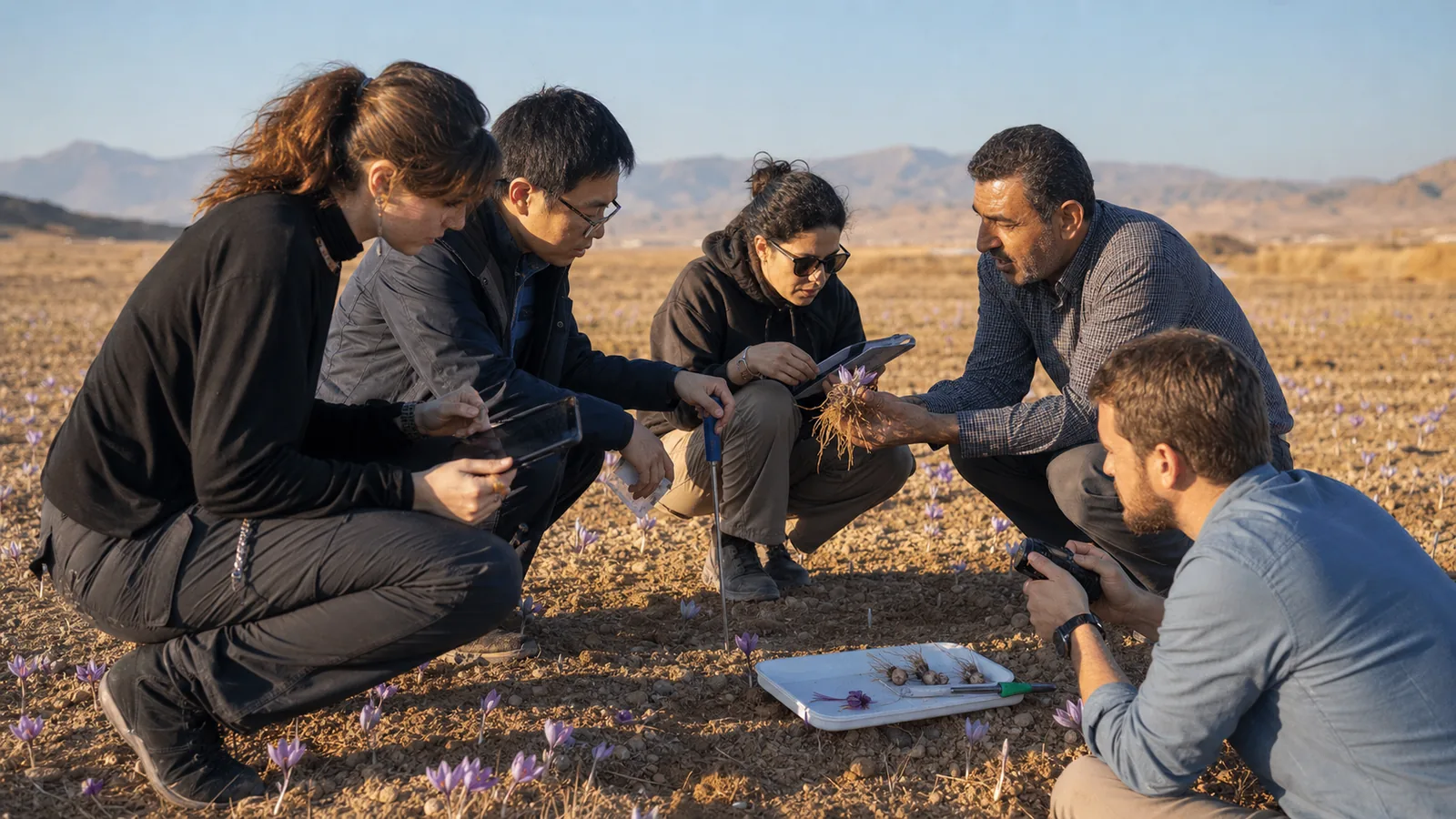
A 2016 academic visit to the saffron fields of Torbat Heydarieh produced an expression of interest in joint research involving the University of Tokyo, Ferdowsi University of Mashhad and the University of Torbat Heydarieh. The visitors discussed saffron chemistry, corms, field longevity and the unusually large concentration of cultivation around Torbat Heydarieh and neighbouring Zaveh. The report records an intention to collaborate; it does not establish that a formal project or agreement was later completed.
The proposed three-university research
A visiting professor associated in the translated report with Tokyo described plans for trilateral work on saffron properties with researchers at Ferdowsi University and the University of Torbat Heydarieh. After visiting farms, the professor said the scale of the local saffron fields made future joint projects attractive.
The source text renders the professor’s name inconsistently as “Yelena,” “Fauji” and “Harrow Fuji.” None can be verified confidently from the surviving English copy, so this article does not invent a corrected identity. The University of Tokyo connection and the three named universities are retained as attributed claims from the event report.
What the researchers wanted to study
The visiting academic referred to roughly 30 years of work on plants and biological competition. Plants produce secondary metabolites that can influence their relationships with herbivores, microbes and neighbouring plants. Some compounds are also investigated for useful biological activity. That scientific idea was compressed in the old translation into a claim that plant “juices” could provide practical treatment.
No compound, experiment, dose or disease was identified. It would therefore be wrong to turn the statement into a health claim. A credible saffron study would specify the plant material, extraction method, comparison group, measured outcome and statistical plan before drawing any conclusion.
The professor also reportedly observed that saffron field performance can decline after several years and called for wider study. Field age is only one possible influence. Corm crowding, disease, soil fertility, irrigation, weeds, weather and planting density can all affect yield. Research should separate those variables rather than assume one universal replacement year.
A Russian botanist’s interest in saffron corms
The group included a doctoral researcher described as a botanist from a Moscow university. Her first name was recorded as Elena. She told IRNA that she had studied plant tissues from the Caucasus Mountains and wanted to continue research on saffron corms after seeing a saffron field at close range for the first time.
The report said Moscow’s climate did not allow the same form of saffron cultivation and that she wanted to take a few corms for focused study. Any movement of live corms between countries would need formal institutional permission, plant-health certification and compliance with export, import and research rules. An expression of interest at a field visit is not evidence that material was transferred.
The wider study group
The two foreign researchers travelled as part of a group that included about 20 graduate students and specialists connected with medicinal-plant study at Ferdowsi University of Mashhad. They visited saffron fields around Torbat Heydarieh during the harvest period.
A field visit can help researchers frame useful questions, but observation alone does not prove a scientific result. The next steps would normally include an agreed protocol, documented samples, ethics or phytosanitary approvals where required, identified laboratories, data ownership and a publication plan.
Why Torbat Heydarieh is a natural research site
The 2016 report placed about 70,000 hectares of Razavi Khorasan land under saffron. It attributed around 11,000 hectares to Zaveh and 8,400 hectares to Torbat Heydarieh. It also cited an average dry-saffron yield of four kilograms per hectare across the province and about 4.2 kilograms in the Torbat Heydarieh area.
These are dated regional estimates. The boundaries and figures in later reporting are not identical: a 2017 remote-sensing study estimated roughly 19,503 hectares for the wider Torbat Heydarieh study area, while more recent regional accounts combine Torbat Heydarieh and Zaveh in different ways. A research paper should define the mapped boundary and harvest year before comparing acreage or yield.
The University of Torbat Heydarieh is particularly relevant because it publishes the peer-reviewed journal Saffron Agronomy and Technology, established in 2013, and has local access to growers and fields. That combination supports research grounded in actual production conditions.
The families and jobs behind the acreage
The original article said 117,000 families in Razavi Khorasan were involved in saffron cultivation, including 14,000 to 15,000 in Torbat Heydarieh. It also referred to about 70,000 direct jobs and two to three times as many indirect jobs.
Another phrase claimed “220 people per hectare.” This almost certainly lost its unit in translation and is more plausibly a measure of labour-days or person-days, not 220 permanent workers assigned to every hectare. The figure is retained here only as an unresolved historical labour estimate. Harvest employment is intensive but short, and job totals depend on whether a source counts people, workdays or seasonal positions.
Geographic details in the report
Torbat Heydarieh was described as a centre of roughly 250,000 people about 150 kilometres south of Mashhad. A separate figure of 72,000 and a distance of 176 kilometres appear to refer to neighbouring Zaveh, but the place name dropped out of the translation. These numbers help explain the regional setting; they are not current census data.
What matters for the research story is the proximity of universities, farms and a substantial grower population. Researchers can observe flowering and harvest, compare management practices, collect properly authorized samples and return results to the people whose fields generated the data.
What a meaningful collaboration could examine
A well-designed international programme could address practical questions such as:
- how field age, corm size and planting density affect yield;
- methods for detecting corm disease before planting;
- water, soil and nutrient management under local conditions;
- drying and storage practices that preserve colour, aroma and flavour;
- chemical profiling and authenticity testing;
- the genetics and sterile triploid biology of Crocus sativus; and
- farm economics, labour demand and adoption of new practices.
Results would be most valuable if protocols and datasets were transparent, local researchers and growers were full partners, and any claims were published for independent review.
Reading the 2016 announcement accurately
The visit demonstrated genuine international interest in Torbat Heydarieh saffron and identified sensible areas for research. It should not be described as a completed University of Tokyo partnership without a signed agreement, project record or publication.
The durable value of the report is the research opportunity it documents: a globally important crop, a concentrated production region, local university expertise and questions that matter directly to growers. Confirming what happened after the visit would require records from the three universities, not a stronger reading of the original press story.
Sources reviewed: the 2016 visit report preserved on this page; the ISSN record for the University of Torbat Heydarieh’s Saffron Agronomy and Technology journal; and the 2017 peer-reviewed remote-sensing study of Torbat Heydarieh saffron acreage. The visitors’ identities and completion of a formal Tokyo collaboration remain unverified.

![Exporting Saffron to Turkey + Price Guide [Complete 0 to 100]](https://img.rowhanisaffron.com/20260827003933/saffron-export-turkey-quality-inspection.webp)



