


Iranian saffron export growth depends on more than producing a larger crop. Overseas buyers need consistent grades, reliable documents, lawful payment routes and delivery they can plan around. Iran’s production experience gives exporters a strong foundation, but long-term presence is earned shipment by shipment.
The original news report behind this article quoted saffron-industry representatives predicting that exports could rise two or three times from the previous month and that production might increase by 20–30 percent. Those were short-term expectations from an earlier season, not current forecasts. The more useful question is what turns harvest volume into repeat international business.
Start with a market, not a general export target
“Increase global presence” is too broad to guide a shipment. A practical plan names the destination, customer type and product. A food manufacturer buying kilograms of tested saffron has different requirements from a distributor ordering private-label jars or a chef buying small premium packs.
Before quoting, an exporter should know the buyer’s preferred grade, annual volume, packaging format, laboratory requirements, delivery terms and target price basis. That information determines whether the opportunity suits the exporter’s supply and processing capacity.
Market selection should consider more than apparent demand. Import rules, sanctions compliance, payment feasibility, freight options, local competition and the cost of customer acquisition can change the result. A smaller market with a dependable partner may be more valuable than a larger market reached only through occasional spot sales.
Make quality repeatable from lot to lot
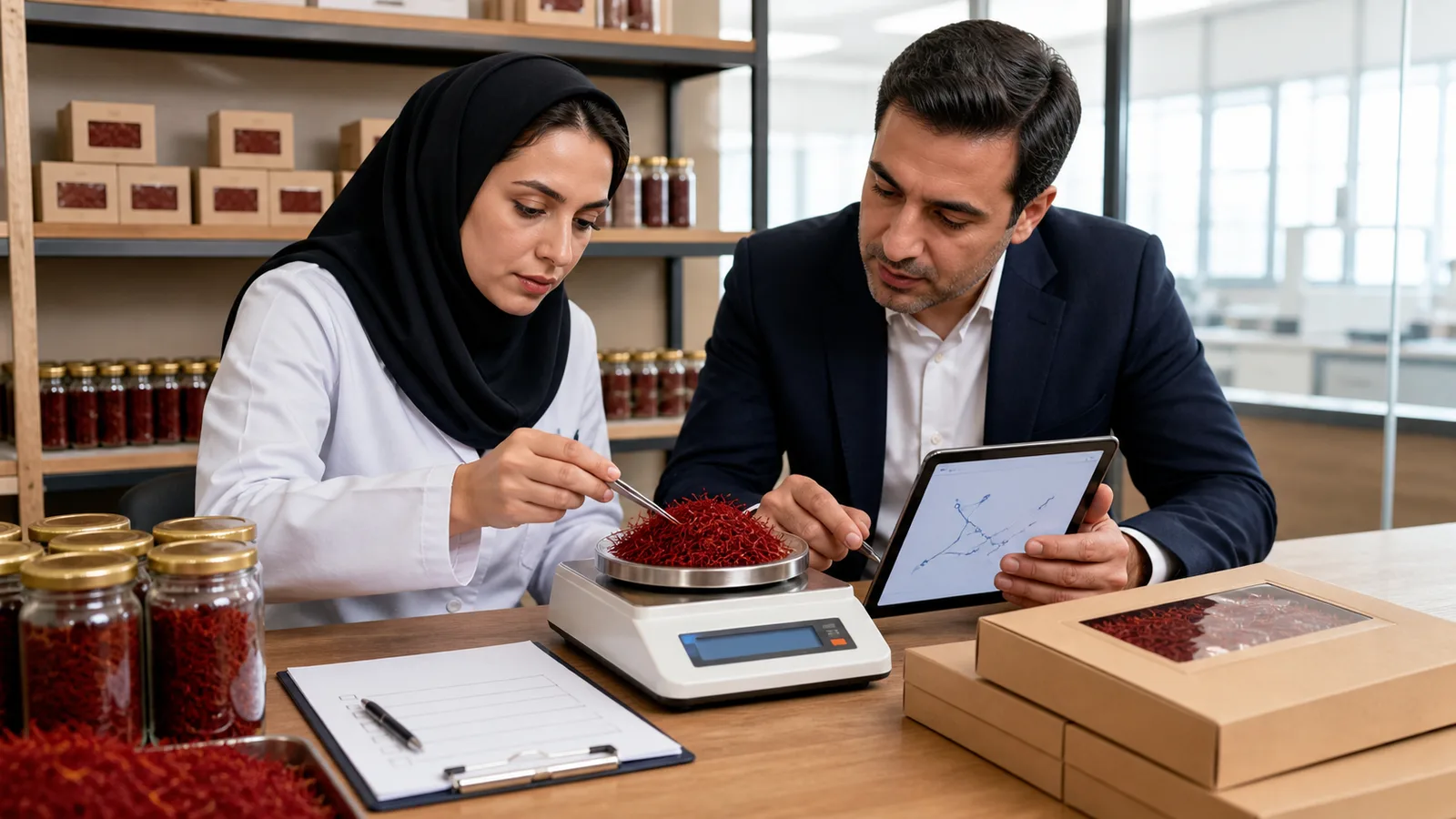
A strong sample can win an order; consistency wins the next one. Exporters need written specifications for the saffron form, moisture, foreign matter, colour-related test results, packing and storage. The sampling method and laboratory report must connect to the same lot that is shipped.
Visual grade names such as Negin, Sargol and Pushal help describe the product, but they do not replace analysis. Buyers should be able to trace each pack back to a batch and understand which test methods were used. Clear acceptance tolerances also reduce arguments when natural variation occurs.
Quality control begins before the laboratory. Clean separation, controlled drying, food-safe handling and protection from moisture, heat and light all affect the delivered product. If several farms contribute to one lot, records should preserve the chain rather than erase it.
Use packaging that suits the buyer and journey
Export packaging has two jobs: protect the saffron and carry accurate information. Bulk food-service containers, manufacturing packs and consumer jars have different cost and barrier requirements. An attractive retail box is useful only if the inner pack limits moisture and contamination and survives transport.
Labels must meet the destination’s rules for language, net quantity, responsible business, lot identification, origin and any required food information. Health or medicinal promises create additional legal and reputational risk and should not be used to decorate a pack.
Private-label work can open a route into established distribution, while an Iranian-owned brand can retain more visible value. Neither model is automatically superior. The contract should make origin, trademark ownership, specifications and responsibility for compliant labels explicit.
Treat compliance as part of the product
Import requirements vary by country and can change. The European Commission’s EU importing guidance, for example, directs businesses to current information on tariffs, rules of origin, procedures and product requirements. Other destinations have their own food-safety, customs and facility-registration systems.
An exporter should confirm the current rules for the exact destination and product code before dispatch. Documentation may involve a commercial invoice, packing list, transport document, certificate of origin, laboratory evidence and destination-specific declarations. A buyer or customs broker can clarify responsibilities, but the exporter should keep its own complete record.
Banking and sanctions restrictions also require formal compliance advice. The old article referred to removing currency-conversion barriers and ensuring the return of export earnings. Those policy issues affect trade, but informal circumvention is not an export strategy.
Quote prices that can be compared
An export price needs a grade, quantity, currency, validity period, packing specification and delivery term. Without them, a low headline quote may simply exclude testing, freight, insurance or destination charges included elsewhere.
Exchange rates and harvest conditions can move during negotiations. A clear validity window protects both sides from assuming that an old quote remains open. For repeat customers, a documented price-review method is usually better than unexplained changes.
Published exchange prices can provide context, but they do not automatically match an export lot. Our explanation of a global saffron price reference shows why grade, volume and delivery basis must travel with the number.
Build a dependable route to the customer
Reliable export infrastructure means more than access to an airport. The exporter needs suitable storage, predictable pickup, correct temperature and moisture protection, customs coordination and a plan for delays. Small, high-value saffron shipments face different economics and security concerns from ordinary bulk agricultural cargo.
Trial orders can test the whole route before either party commits to a larger programme. Record transit time, packaging condition, customs questions, received weight and customer feedback. A problem log becomes useful only when the next shipment is changed in response.
Give Iranian origin verifiable meaning
A national reputation is strongest when buyers can confirm what it stands for. Origin records, grower or processor identity, lot-linked testing and honest product photography give the phrase “Iranian saffron” substance. Repeating that Iran is a leading producer is not a branding plan by itself.
Exporters can explain the growing region, harvest method and commercial grade without making every pack sound identical. A clear story should support the evidence on the label, not compete with it. The discussion of Iranian saffron sold through Spanish brands illustrates why brand ownership, packing location and agricultural origin must remain distinct.
A measurable Iranian saffron export strategy
Progress should be tracked through repeat-order rate, rejected or disputed lots, delivery reliability, average realised value for a comparable grade and the share of shipments with complete traceability. Total export weight alone can rise while margins, quality or customer retention weaken.
A sensible sequence is to choose a reachable market, agree a written specification, validate compliance, test the logistics with a controlled order and review the result with the buyer. Production planning should follow evidence of durable demand rather than optimistic month-to-month forecasts.
That approach makes Iranian saffron export growth less dependent on a single season or announcement. Consistent quality, transparent terms and reliable relationships are slower to build than a headline percentage, but they are what create a lasting global presence.

![Exporting Saffron to Turkey + Price Guide [Complete 0 to 100]](https://img.rowhanisaffron.com/20260827003933/saffron-export-turkey-quality-inspection.webp)



