


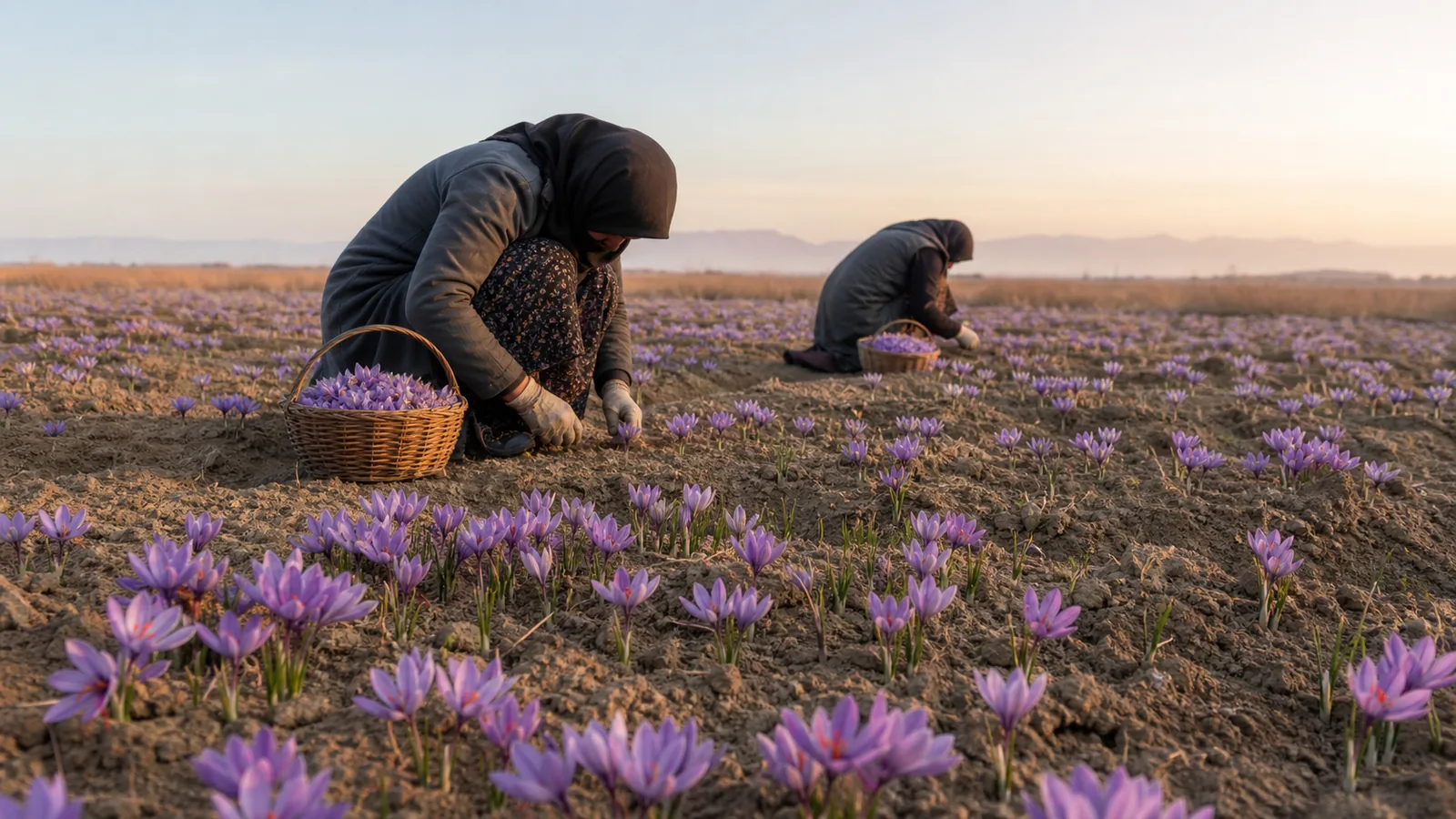
Saffron harvest began across 35 hectares in Shahinshahr and Maymeh in late 2011, with local agricultural officials forecasting as much as 250 kg.
This is a dated account of that season, not a current production forecast. The report captures an early stage in the area’s saffron development and places the harvest alongside the wider farm economy of Shahinshahr and Maymeh County in Isfahan Province.
The 2011 Shahinshahr and Maymeh saffron harvest
The original story quotes Mohammad Karimian, then director of the local Agricultural Jihad office, announcing that picking had started on 35 hectares of saffron farms in Shahinshahr and Maymeh. Maymeh is also transliterated as Meymeh or Meimeh in English-language versions of the report.
A contemporary archive reproducing the ISNA report dates the announcement to 22 Azar 1390, in December 2011. That date matters: every area, output and activity figure below describes the county at that time and should not be read as the present state of local agriculture.
Why officials expected a larger saffron crop
Karimian said growers had followed expert recommendations and fed the saffron crop by foliar application during the season. He linked that practice to a noticeable increase in the expected harvest and forecast that the county’s farms could produce more than 250 kg of saffron.
The announcement did not provide measured final output, a control field or details about the foliar treatment. The 250 kg figure was therefore a forecast, and the claimed increase was the official’s observation rather than the result of a published field trial. Weather, corm condition, field age, irrigation and picking conditions can all affect the crop eventually collected.
Even so, the report is useful as a local record. It identifies the cultivated saffron area, the start of picking and the production expectation for the Shahinshahr and Maymeh farms in one named season.
What harvest beginning means on a saffron farm
Saffron is picked when the purple flowers emerge, usually early in the day before heat and handling weaken them. The flowers then need prompt separation so the three red stigmas can be dried under controlled conditions. The harvested flower weight and the final dry-saffron weight are very different, which is why production reports should make clear which one they mean.
The 2011 announcement refers to the forecast weight of saffron, not the number or weight of flowers. It does not describe picking labour, drying equipment, quality grade or the date on which the season finished, so those details cannot be reconstructed from the archived statement.
Aloe vera and rural women’s employment
The same agricultural briefing moved beyond saffron. Karimian reported 2,000 square metres of greenhouse aloe vera cultivation in the Maymeh district, with rural women involved in the work. He described the project as successful in creating employment.
The original English version also made broad claims about aloe vera having “useful and unique properties,” but it supplied no study, product, dose or defined use. That health-like wording is too vague to repeat as fact. The supported point in this local economic report is the existence and scale of the greenhouse project and its stated employment role.
Poultry production reported in the same briefing
For the first six months of that reporting year, the director said more than 4.1 million chicks had been placed or hatched for the county’s meat-poultry units. He referred to 100 active broiler farms and forecast more than 8,000 tonnes of chicken meat from that activity.
These were separate poultry-sector figures, not inputs into the saffron forecast. Keeping them in the dated record preserves the scope of the original briefing while making the distinction clear.
Mechanisation, fuel and horticultural output
Karimian also reported distribution of 1.2 million litres of subsidised fuel for farm machinery and tools. According to his statement, more than 80% of agricultural operations in Shahinshahr and Maymeh were mechanised at the time.
Annual horticultural production was put at more than 12,000 tonnes. The briefing further credited facilities for higher-yield businesses and entrepreneurs with creating up to 140 horticultural jobs in the county.
Like the saffron estimate, these are historical administrative figures. The archive does not supply the underlying tables or define whether “jobs” means permanent, seasonal or project-supported positions, so the wording remains attributed rather than converted into a present-day claim.
How to read this harvest report today
The central event is straightforward: in December 2011, officials announced the beginning of saffron harvest on 35 hectares in Shahinshahr and Maymeh and expected the crop to exceed 250 kg. They associated a stronger forecast with expert-guided foliar feeding, although the article records a statement rather than experimental evidence.
The rest of the briefing shows why the saffron story was part of a wider agricultural update. Greenhouse crops, rural employment, poultry, mechanisation, fuel support and horticultural output were all being discussed together as measures of the county’s farm activity.
For current planning or purchasing decisions, newer official acreage, final harvest and quality data would be needed. This page preserves the 2011 Shahinshahr and Maymeh harvest record with its original people, places and figures, while keeping the date and evidence limits visible.

![Exporting Saffron to Turkey + Price Guide [Complete 0 to 100]](https://img.rowhanisaffron.com/20260827003933/saffron-export-turkey-quality-inspection.webp)



