


An archived local report records the beginning of saffron harvest across 100 hectares in Torqroud, Natanz, and nearby villages, with an 800 kg forecast.
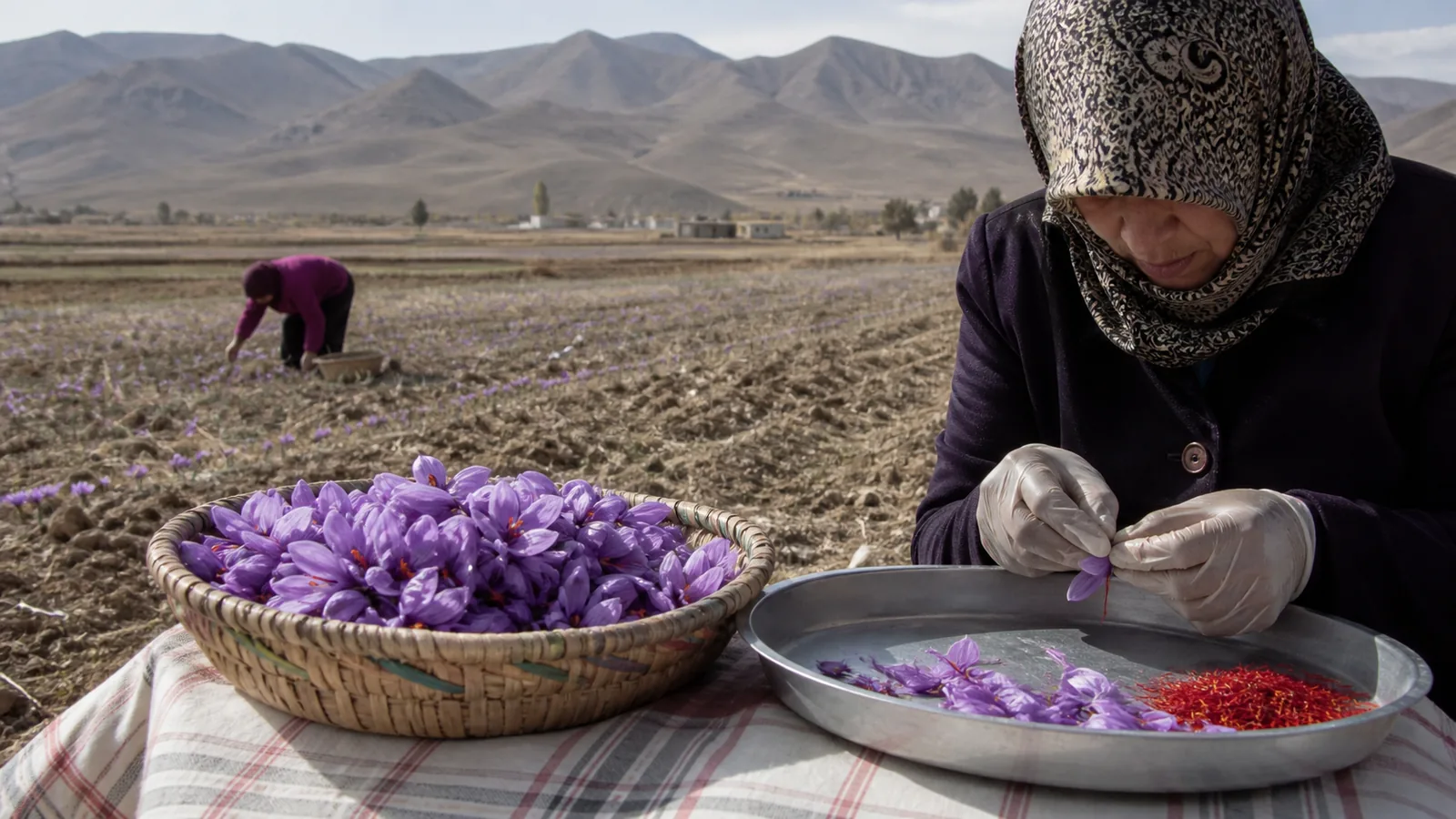
Torqroud is also written as Torqrood, Tarq Rud or Targhrood in English. The report does not identify its season by year, so its acreage, yield, price and packaging statements are preserved here as a historical snapshot rather than current Natanz statistics.
The reported saffron harvest in Torqroud
Abdolreza Mehdibadi, identified in the original story as director of Natanz Agricultural Jihad, announced that harvesting had begun on 100 hectares of land in Torqroud and adjacent villages.
He forecast 800 kg of dried saffron from those farms. The report also gives an expected yield of 8 kg per hectare, which is consistent with the total forecast across 100 hectares. Both numbers were predictions made at the beginning of harvest, not a final post-season measurement.
The stored English version says harvesting generally started “from the end of November.” Without the original publication date or a Persian calendar reference, that phrase is best read as late-autumn context rather than a permanent start date. Flowering shifts with elevation, temperature and the season’s first irrigation.
Why harvesting involves families and nearby communities
The Torqroud account describes whole families and residents from neighbouring towns joining the harvest. That labour is needed in a short window: flowers should be collected promptly and the red stigmas separated before the blossoms deteriorate.
Picking is only the first step. Whole flowers are brought from the field, the stigmas are separated on clean surfaces and the saffron is dried. Handling and drying affect the final product, so speed must be balanced with hygiene and careful temperature control.
The report does not quantify the number of workers, hours, flower weight or drying method. Those details cannot be inferred from its 800 kg forecast.
The three problems farmers raised
Mehdibadi highlighted three pressures on Natanz saffron growers at the time: water shortage, falling world saffron prices and the lack of appropriate standard packaging.
Water shortage
Saffron’s seasonal water pattern can suit dry areas, but it is not independent of water. Establishment, flowering and corm development still depend on irrigation timing, soil and local rainfall. A shortage can affect both the current flower crop and the corms that support later seasons.
Price uncertainty
A forecast made at the beginning of harvest cannot fix the income growers will receive. Quality grade, supply, buyer demand, exchange conditions and the point at which a farmer sells all affect the realised price. The statement about declining world prices therefore belongs to that reporting period, not every later season.
Packaging and market identity
The director argued that weak packaging capacity and bulk exports allowed businesses in European markets to repackage Iranian saffron and capture more of its retail value. The original wording went further by saying it could be sold under another country’s name; that is preserved as the official’s concern rather than asserted about every shipment.
The broader value-chain problem is independently documented. A 2014 UNIDO diagnostic report on Iran’s saffron industry found that much Iranian saffron was exported in bulk and then packaged, marketed and distributed by companies in destination countries. It identified better processing, packaging and direct participation in global markets as areas for upgrading.
Later records show why the date matters
The 100-hectare, 800 kg statement should not be mistaken for an evergreen description of Natanz. A later archive reproducing a 2016 IRNA report quoted the same agricultural director discussing 200 hectares in Torqroud and Badroud, an average forecast of 7 kg of dry saffron per hectare and a total above 1,400 kg.
That later report is not a correction to the earlier one; it concerns a different harvest and a broader named area. It demonstrates that acreage and expected yield changed over time, which is why attaching a year and geography to agricultural figures is essential.
What the original 100-hectare forecast tells us
Read on its own terms, the report records four useful facts about its season: harvest had started in Torqroud and neighbouring villages; 100 hectares were involved; officials expected 8 kg per hectare and 800 kg in total; and family and neighbouring-community labour took part in picking and stigma drying.
It also records the commercial worries growers and officials were discussing—water, prices, packaging and the loss of value through bulk trade. These concerns explain why producing a high-value spice does not automatically mean that all of the final market value stays with the farm or the region.
Current buyers or planners would need a newer official harvest report for today’s acreage, production, quality and prices. This page keeps the original Torqroud of Natanz harvest record intact while separating its forecast from later evidence.

![Exporting Saffron to Turkey + Price Guide [Complete 0 to 100]](https://img.rowhanisaffron.com/20260827003933/saffron-export-turkey-quality-inspection.webp)



