


Bahabad saffron has long faced a problem that begins after harvest: much of it leaves the area as an unbranded raw product, then reaches the market under another place name or private label. The saffron itself may be local, but the identity and added value are easily lost.
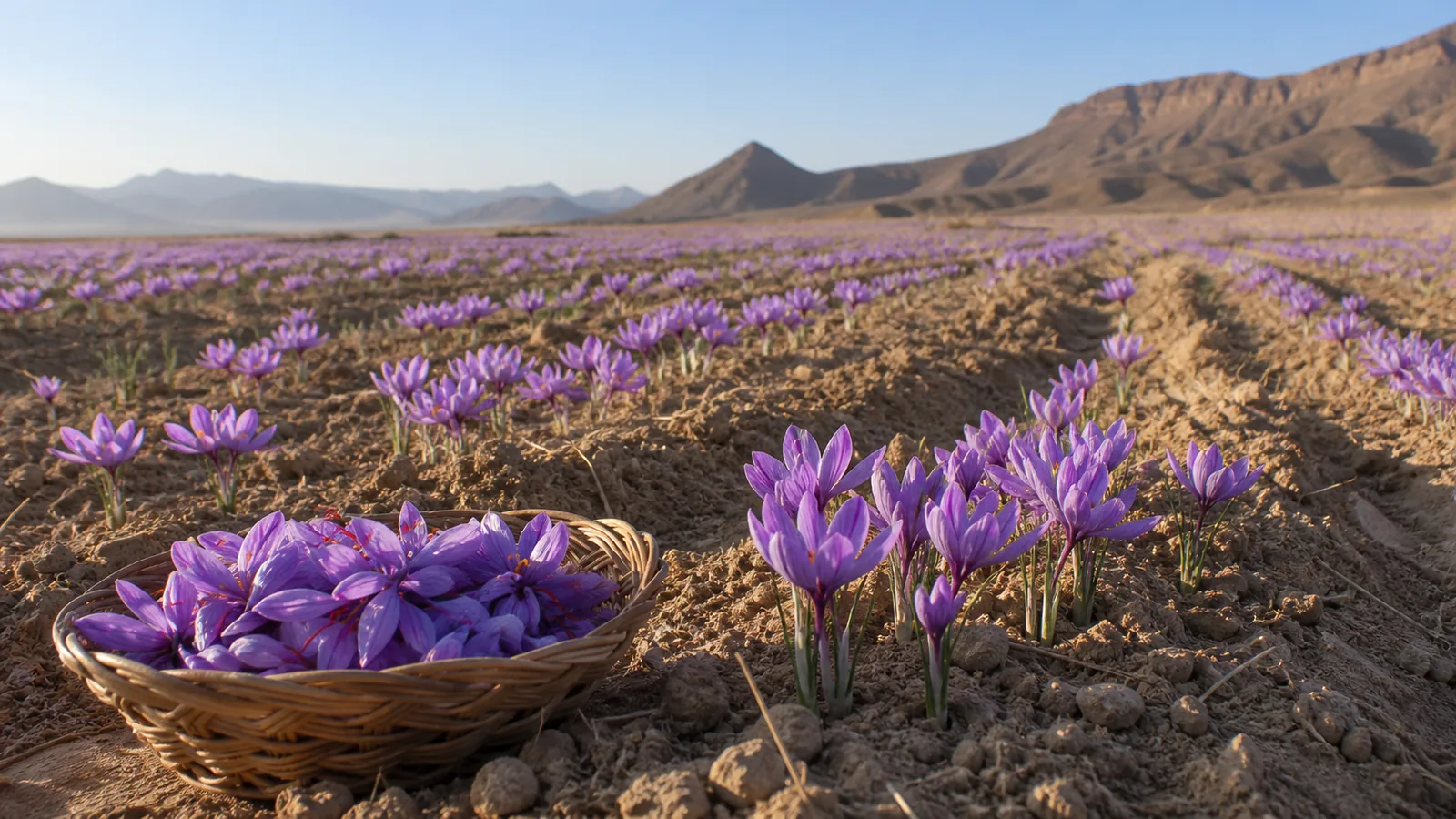
This article revisits a 2020 report about Bahabad in Yazd Province. Its acreage, loan rates and business counts describe that period; they are not presented as current statistics. The broader question remains useful: how can a producing region keep its name attached to the saffron it grows?
Why Bahabad saffron was losing its name
Growers and local tourism advocates told the original reporter that high-quality saffron was being sold cheaply in bulk, taken to other cities or countries, and offered again in polished packaging under different brands. Their concern was not that Bahabad lacked a product. It lacked a strong route from farm to recognised origin.
The awkward repetition in the published headline came from the earlier translation, but the issue behind it is clear: Bahabad saffron was not consistently being marketed in the name of Bahabad, or even as a product of Yazd.
A crop suited to a water-scarce province
Yazd lies on Iran’s central plateau and has severe water constraints. In the 2020 report, local officials said agriculture accounted for about 80% of the province’s water use. That was a period claim rather than a timeless measurement, but it explains why policymakers were encouraging crops that do not require summer irrigation.
Saffron was already established in Bahabad before those programmes. Its seasonal water pattern made it relevant to the debate, although “low water” should never be read as “no water” or as proof that every field is suitable. Corm quality, soil drainage, irrigation timing, labour and post-harvest handling still determine whether cultivation is viable.
The Bahabad Saffron Festival linked farming and tourism
The Cultural Heritage and Agricultural Jihad authorities had supported a Bahabad Saffron Festival for several years. The event was intended to introduce the crop while giving visitors a reason to experience the county’s landscape, crafts and local products.
Mahmoud Ghanei, identified in the report as a Bahabad tourism activist, argued that the festival could develop into an attraction on the scale of Kashan’s rose festival. He described visits by student groups, religious minorities, disabled artists from Isfahan, Chadormalu mining specialists and travellers from outside Iran.
The programme also brought medicinal plants and local food into view. Craft demonstrations included kilim and wicker weaving; one craft name in the translated source is unclear, so it should not be treated as a reliable English identification.
A proposal inspired by Consuegra
Ghanei wanted the event entered on Iran’s national calendar and proposed exchanges with the Spanish town of Consuegra. The older article rendered that name as “Consovagra,” but Spain’s official tourism site identifies Consuegra’s Saffron Rose Festival as a celebration of saffron, food, handicrafts and regional tradition held since 1963.
Sending Bahabad producers to that festival and pursuing a sister-city agreement were ideas under discussion in the 2020 account, not completed agreements. Their value lay in the model: a harvest event can connect a crop to a place when it is supported by traceable products and credible local participation.
What the 2020 agricultural figures showed
Seyed Jamal Sajjadipour, then head of the Yazd Agricultural Jihad Organization, put saffron cultivation across the province at 830 hectares, concentrated mainly in Bahabad and other mountainous areas. He said Yazd did not have the guaranteed-purchase arrangement used in parts of Khorasan.
At that time, the organisation offered loans at 8% interest for expanding cultivation and 15% for processing. Sajjadipour said the private-sector response remained limited. He counted about five home businesses working in processing, alongside several small operations making syrup or jam from saffron petals, and called for larger companies capable of developing export trade.
Those exact rates, areas and business counts belong to the report’s date. Anyone considering an investment now should obtain current terms from the relevant provincial authorities rather than relying on a 2020 article.
What origin-based branding actually requires
A festival can introduce Bahabad saffron, but it cannot protect the name on its own. Growers, processors and sellers need a shared definition of the product and a way to show where each batch came from.
- A documented product specification: agreed production area, harvesting practices, drying standards and measurable quality requirements.
- Lot-level traceability: records connecting packaged saffron to a grower, field, harvest and processor.
- Independent testing: checks for identity, moisture, contamination and declared grade.
- Suitable local processing: hygienic drying, storage and packaging that keep more value in the producing area.
- Collective governance: clear rules about who may use the Bahabad name and how misuse is handled.
The World Intellectual Property Organization explains that a geographical indication links a product’s qualities or reputation to its place of origin. Whether that route is appropriate for Bahabad would require legal and technical work, but the principle helps explain why evidence of origin matters more than attractive packaging alone.
A practical path for Bahabad producers
The strongest plan would join agricultural quality, local processing and tourism rather than treating them as separate projects. A visitor may first encounter Bahabad saffron at a harvest festival, but confidence grows when the package carries a traceable lot, an honest grade and the name of a real producer.
Small home businesses can test products such as saffron-petal jam or syrup, while shared processing and testing facilities can reduce costs that are difficult for one grower to bear. Larger firms may help with distribution, but contracts should keep the source visible instead of turning Bahabad saffron into anonymous bulk stock again.
The unfinished point in the 2020 discussion was not whether Bahabad could grow saffron. It was whether growers, public bodies and private processors could build a system that lets buyers recognise it. Festivals create attention; consistent quality and verifiable origin allow that attention to become lasting value.

![Exporting Saffron to Turkey + Price Guide [Complete 0 to 100]](https://img.rowhanisaffron.com/20260827003933/saffron-export-turkey-quality-inspection.webp)



