


Which country offers the cheapest saffron? Iran usually offers the lowest prices close to production, especially for wholesale quantities, because it grows most of the world’s crop. That does not mean every Iranian listing is the cheapest delivered option—or that the lowest-priced packet is genuine, fresh or the same grade as a higher-priced one.
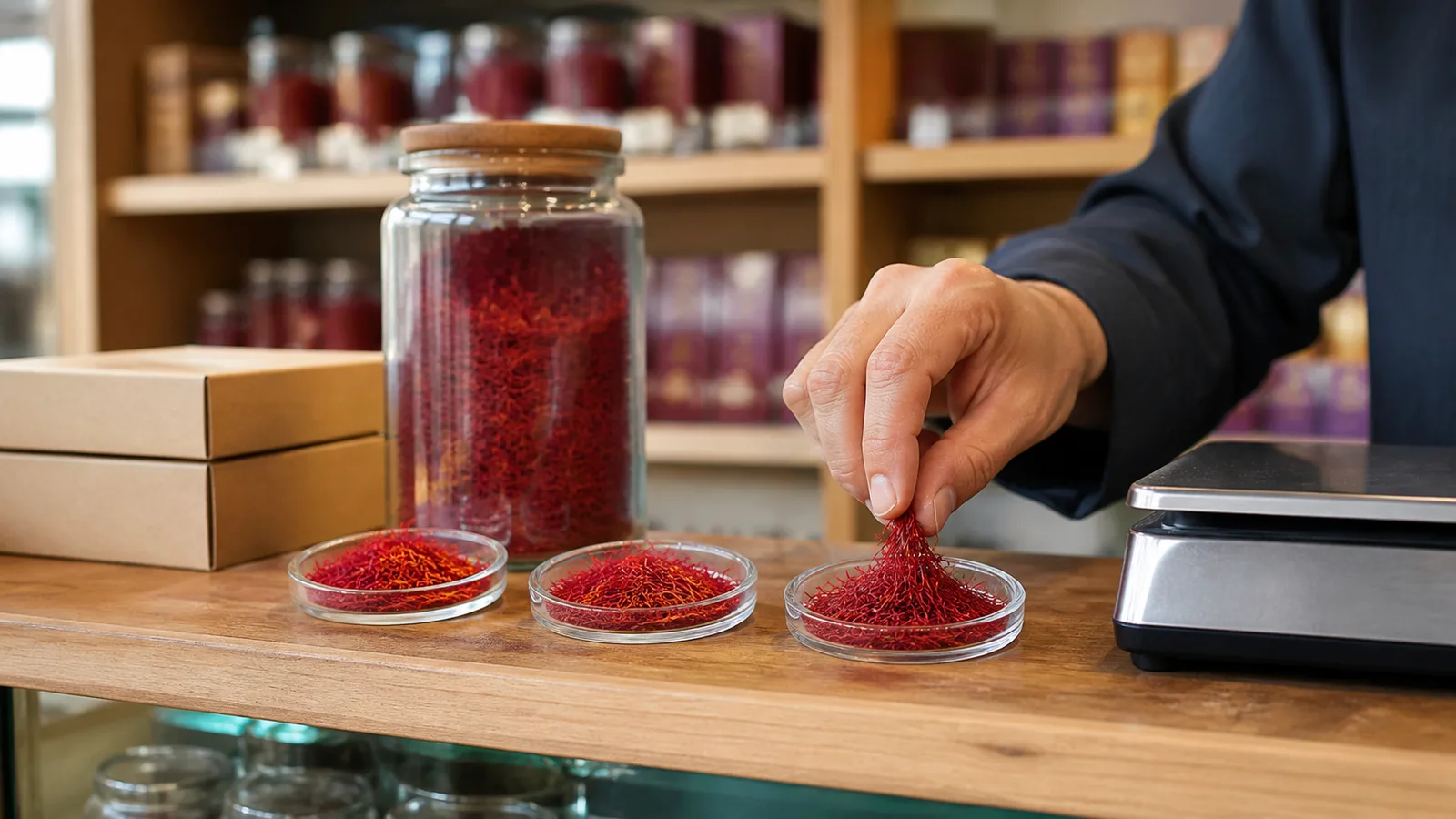
For a fair comparison, match the form, quality, quantity and route to your door. A wholesale saffron price in Iran, a one-gram retail jar in Spain and a delivered order in the USA are three different prices. Currency conversion, shipping, duties, testing, packaging and the seller’s margin can outweigh the apparent country-level difference.
Is saffron cheap in Iran?
At source, often yes. The Food and Agriculture Organization reported in 2025 that Iran produces more than 90% of the world’s saffron. Large production volumes, experienced growers and processors, and proximity to farms in Khorasan can make Iranian saffron cost-effective before international distribution expenses are added.
For readers asking “in which country saffron is cheapest?”, Iran is therefore the usual source-level answer, with the delivered-cost qualifications below.
“Cheapest saffron in the world” still has no permanent answer. Harvest size, exchange rates, export rules and freight change. Retailers sell different grades in different pack sizes. A traveller buying locally may see one result; a customer importing a certified kilogram may see another after insurance, customs clearance and taxes.
Why affordable Iranian saffron can still be high quality
Affordable Iranian saffron is not automatically inferior. Iran’s scale and long saffron-growing tradition can support efficient cultivation, drying, sorting and trade. Khorasan has a suitable dry climate and established production knowledge. More supply near the harvest area can reduce some upstream costs.
Price and quality are separate questions, however. Saffron from any country can be excellent, average, stale or adulterated. Iranian origin does not guarantee high crocin content, a rich aroma or ethical production. Those qualities depend on the cultivar, growing conditions, harvest timing, how much style is included, drying, storage, testing and the honesty of each seller.
How other saffron-producing countries compare
Afghanistan
Afghan saffron can be competitively priced and has developed a strong export identity. Availability and shipping routes vary by market. Compare it with Iranian saffron on the same grade, test documentation and delivered weight instead of assuming either country is always cheaper.
India and Kashmir
Kashmir saffron has a distinct protected regional identity and limited production. India’s Agricultural and Processed Food Products Export Development Authority lists Kashmir Saffron as a registered geographical indication. Genuine GI-linked origin and smaller supply can command a premium. “Kesar price” listings elsewhere may refer to saffron, but the word kesar does not by itself verify Kashmiri origin.
Spain
Spanish saffron, including protected-origin Azafrán de La Mancha, often carries costs associated with regional production, certification, labour and retail presentation. It may therefore cost more than bulk product near an Iranian farm. Spanish packaging is not proof that the saffron was grown in Spain, so check the declared country of origin as well as the packer’s address.
Greece, Italy and other smaller origins
Greece has the Krokos Kozanis protected designation, while parts of Italy and other countries produce smaller regional crops. Limited output, manual labour and protected-origin systems can raise prices. These products can offer traceability and a particular regional character; they are not designed to win a contest for the lowest global price.
Dubai, the UAE and international retail hubs
Dubai is a trading centre, not a single saffron grade or origin. Shops may carry Iranian, Afghan, Kashmiri, Spanish and re-exported saffron at widely different prices. The same applies in the USA, Saudi Arabia, Singapore and other import markets. A low local tax or competitive market can help, but packaging, rent, brand and tourist pricing can move the final amount in either direction.
Why saffron prices differ so much
Saffron is costly because each Crocus sativus flower supplies only three stigmas. Flowers are picked and the stigmas separated largely by hand, then dried carefully. That labour-intensive process explains why genuine saffron remains expensive even in a producing country.
When comparing offers, account for:
- Grade and cut: long red filaments, shorter broken threads and material containing more yellow style are not equivalent.
- Form: whole threads are easier to inspect than powder; powder may also have different processing and testing costs.
- Harvest and freshness: storage time and conditions affect aroma and colouring strength.
- Quantity: a saffron price per kilogram is normally wholesale, while a one-gram jar includes much more packaging and handling per gram.
- Origin and certification: geographical indications, laboratory reports and traceability add value and verification costs.
- Trade route: freight, insurance, duties, taxes, payment costs and distributor margins affect delivered price.
- Crop conditions: weather, water, labour availability and harvest size change supply from season to season.
How to compare saffron price per gram and per kilogram
Convert every quote to the same unit before deciding. One kilogram equals 1,000 grams. Divide the total product price by the net grams of saffron, then add shipping, duties and taxes. Exclude the jar or gift box weight. This gives a delivered price per gram that can be compared across sellers.
Do not assume that multiplying a one-gram retail price by 1,000 reveals a realistic saffron price per kg. Wholesale orders use different packaging, contracts, quality controls and margins. Conversely, a very low bulk quote may omit export documents, insurance, lab testing or delivery.
Exact figures age quickly, so a reliable comparison should show its currency, date, quantity, grade, origin and delivery terms. A page that announces one permanent “Iran price” or “Spain price” without those details is giving false precision.
Cheapest country is not the same as best saffron
Searches for the cheapest saffron often overlap with “best saffron in the world.” There is no country label that settles both questions. The best purchase is the one that delivers the flavour, aroma, colour, purity and traceability required for its use at a fair total price.
For a home cook, a fresh half-gram or one-gram packet from a trusted shop can be better value than a cheap large packet that fades in storage. A restaurant may need consistent batches and laboratory specifications. A wholesaler also needs lawful export documents, repeatable supply and clear commercial terms.
How to check whether cheap saffron is genuine
Prefer whole, dry threads in sealed, lot-coded packaging from a seller who identifies the origin and net weight. Ask for recent batch-specific certificates or laboratory analysis when the order is large. A generic certificate copied across every product is less useful than documentation tied to the lot you will receive.
The current ISO 3632-1:2025 specification applies to dried saffron in filament, cut-filament and powder forms. ISO explains that saffron purity and strength require defined laboratory methods; colour alone or a home water test cannot certify a sample. Our guide to recognizing genuine saffron covers the practical warning signs.
Be cautious when an offer is dramatically below comparable products. Powder is easier to dilute with other material, and threads can be mixed with dyed plant fibres or extra style. An unusually low price may also reflect old stock, excess moisture, missing documentation or a misleading net weight.
Does low price mean unethical or unsustainable production?
Price alone cannot answer that. The former version of this article said many Iranian farmers use sustainable practices with minimal environmental impact; that broad claim needs farm-level evidence. Saffron can suit dry regions and has deep cultural importance, but water, soil, labour conditions and post-harvest practices vary among farms.
Ask a supplier how growers are paid, how the crop is traced, which inputs are used and how drying and testing are controlled. Direct trade can reduce intermediaries, but “direct” is not proof of a fair return to farmers. Useful evidence is specific and verifiable.
Iranian saffron’s economic and culinary importance
Saffron production supports growers, seasonal harvest workers, processors, laboratories, packers and exporters. It is important to rural livelihoods and Iran’s agricultural trade. Claims about a precise contribution to national GDP should be dated and sourced; they should not be inferred simply from Iran’s leading production share.
In the kitchen, genuine saffron provides a distinctive aroma, golden colour and subtle bitter note to rice, stews, sauces, breads, desserts and drinks. Saffron also has a history in traditional medicine and contains compounds with antioxidant activity in laboratory testing. Those facts do not turn a low-priced culinary packet into a medical treatment or guarantee “numerous health benefits.”
How to buy affordable Iranian saffron without buying blind
- Decide whether you need a small culinary pack or a commercial quantity.
- Request the grade, form, harvest or packing date, origin and net weight.
- For significant orders, ask for batch-specific laboratory results and verify the laboratory.
- Calculate the delivered price per gram in one currency.
- Compare equivalent products, including certification, shipping and import costs.
- Place a sample order before committing to a large lot.
Saffron may also appear as azafrán, safran or kesar in different markets. These are names used for the spice, not grades. The product details and evidence still need to be checked.
The practical answer
Iran is normally the first country to investigate for affordable saffron because of its dominant production scale and mature supply chain. It may offer the cheapest source-level or wholesale price for a comparable grade. For an individual buyer, the cheapest place can instead be a reputable seller in the buyer’s own country once freight, duty, taxes and risk are included.
Keep the question precise: cheapest for which grade, quantity, date and destination? That comparison protects you from paying a premium for packaging—and from wasting money on a bargain that is weak, stale or not genuine saffron at all.

![Exporting Saffron to Turkey + Price Guide [Complete 0 to 100]](https://img.rowhanisaffron.com/20260827003933/saffron-export-turkey-quality-inspection.webp)



