


Iranian saffron can create more value per cultivated hectare than wheat, but that comparison depends on prices, yields, labour, water and the year measured.
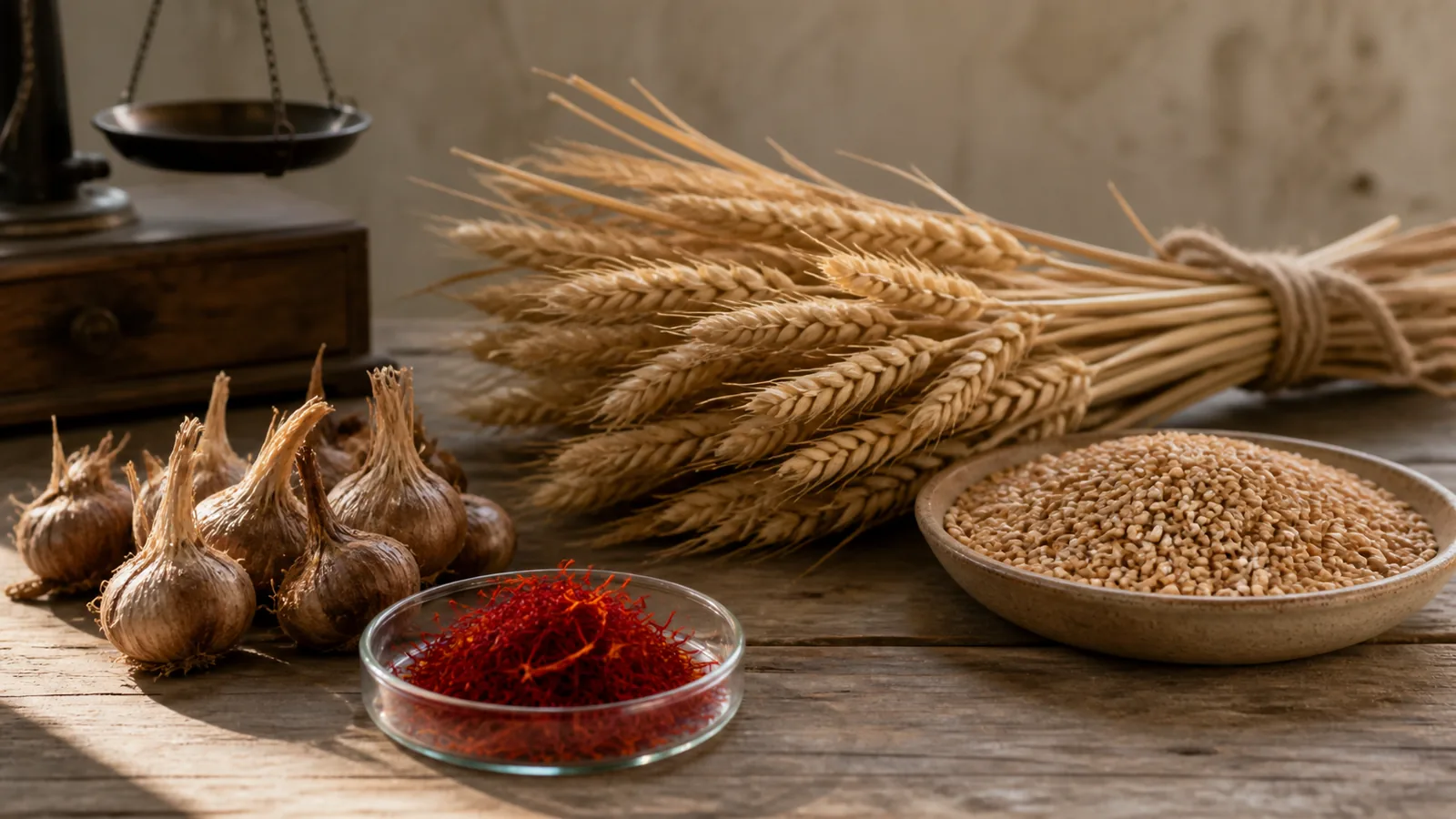
The original report behind this article recorded a Khorasan Razavi official arguing that saffron’s added value exceeded wheat’s despite occupying less land. That central point has economic support, but the old figures need dates and context rather than being repeated as current statistics.
What the original saffron-and-wheat comparison said
The archived report attributes the remarks to Reza Jamshidi, then described as Khorasan Razavi’s deputy governor for planning, during a National Saffron Council election meeting held on May 10. It quotes him as saying that wheat was a strategic crop with a larger cultivated area, while saffron generated much greater added value.
It also recorded several numerical claims: Iran produced 96% of the world’s saffron; more than 90% of Iranian production came from Khorasan Razavi and South Khorasan; Khorasan Razavi produced about 200 tonnes annually; and the quoted yield was 1.3 kg per hectare. On that basis, the speaker called the province the world’s leading saffron-producing province.
Those numbers belong to the historical statement. The stored article does not identify the year of the meeting, link to a transcript or name the statistical dataset, so they should not be treated as a current production bulletin. Preserving them as attributed archive material is different from endorsing them as today’s figures.
What research found when saffron and wheat were compared
A peer-reviewed farm study offers a more precise comparison. Researchers surveyed saffron and wheat growers in Torbat Heydarieh, Khorasan Razavi, in 2013 and examined both energy use and economic performance. Their saffron-versus-wheat study in Sustainable Production and Consumption reported benefit-to-cost ratios of 2.78 for saffron and 2.17 for wheat in the production systems studied.
That result supports the idea that saffron can be economically more attractive than wheat in this part of northeast Iran. It does not prove that every saffron farm, season or province produces the same return. The calculation came from a particular region, survey year, price environment and set of farming practices.
The energy results were also more nuanced than a simple “saffron is better” headline. Total energy use per hectare was lower for saffron than wheat in the study, and saffron used a larger renewable-energy share. However, the crops differed sharply in output and production cycle, so economic return, energy efficiency and added value should not be treated as interchangeable measures.
Why saffron can create high value on limited land
Saffron is sold in small quantities as a high-value spice, while wheat is a bulk staple. The saffron flower contributes only three stigmas, and harvesting, separating and drying them requires careful work. Much of the product’s market value is therefore concentrated in very little final weight.
A saffron field is also perennial for several years after planting, whereas wheat is normally established for each crop. Those differences affect land preparation, labour, planting material and annual costs. In the 2013 farm study, saffron corms were the largest single energy input for the saffron system; in wheat, nitrogen fertiliser and electricity were major inputs.
None of this makes wheat unimportant. Wheat and saffron serve different agricultural and food-system purposes. The useful question for a grower is not which crop has the higher selling price alone, but which rotation and allocation of land, water, labour and capital is viable under local conditions.
Iran’s production share has to be dated
Production shares change as harvests and competing origins change. A November 2025 update from the Food and Agriculture Organization of the United Nations described Iran as producing about 85–90% of the world’s saffron, rather than the 96% quoted in the undated meeting report.
The same FAO update identifies Khorasan Razavi and South Khorasan as the heart of Iranian saffron cultivation and notes the crop’s importance to large numbers of smallholder farmers. This supports the original article’s geographic emphasis while showing why a percentage without a year should not be frozen into evergreen copy.
Where saffron value can be lost
Jamshidi’s remarks did not focus only on headline production. The report lists traditional cultivation, low yield per hectare, fragmented small holdings, crop-insurance problems, weak transfer of research into practice, limited use of modern packaging technology and the absence of a shared national brand among the sector’s weaknesses.
Several of those concerns still map to practical parts of the value chain. Poor harvesting or drying can reduce colour, aroma and grade. Weak traceability and inconsistent testing can make authenticity harder for buyers to judge. Commodity-style bulk exports can also leave processing, packaging and branding value to businesses closer to the final customer.
The 2025 FAO programme responds to these issues through work on post-harvest handling, quality assurance, authenticity, traceability, modern marketing and digital branding. That does not guarantee a higher return, but it identifies the points where better practice can protect quality and improve access to trusted markets.
A more careful meaning of “added value”
Added value is the value created after subtracting purchased inputs from the value of output. It is related to profitability, but it is not identical to sale price, yield, export revenue or a benefit-to-cost ratio. A fair saffron-and-wheat comparison needs the same geography, season, accounting boundary and currency basis for both crops.
The strongest conclusion is therefore bounded: evidence from Khorasan Razavi shows that saffron has produced a higher benefit-to-cost ratio than wheat under studied conditions, and its high value per unit of weight gives it unusual economic importance on limited land. The exact advantage is not permanent. It must be recalculated with current farm costs, yields, water conditions, labour availability and market prices.

![Exporting Saffron to Turkey + Price Guide [Complete 0 to 100]](https://img.rowhanisaffron.com/20260827003933/saffron-export-turkey-quality-inspection.webp)



