


The Iranian saffron industry is built on farmers’ work, yet harvest-time pressure often leaves growers with the least freedom to choose when and how they sell. Mehdi Jahanshiri, a saffron exporter and local economic representative in Torbat-e Heydarieh, made that imbalance the centre of a 2024 interview: the market should give producers a meaningful voice instead of asking them to accept whatever price appears when their bills are due.
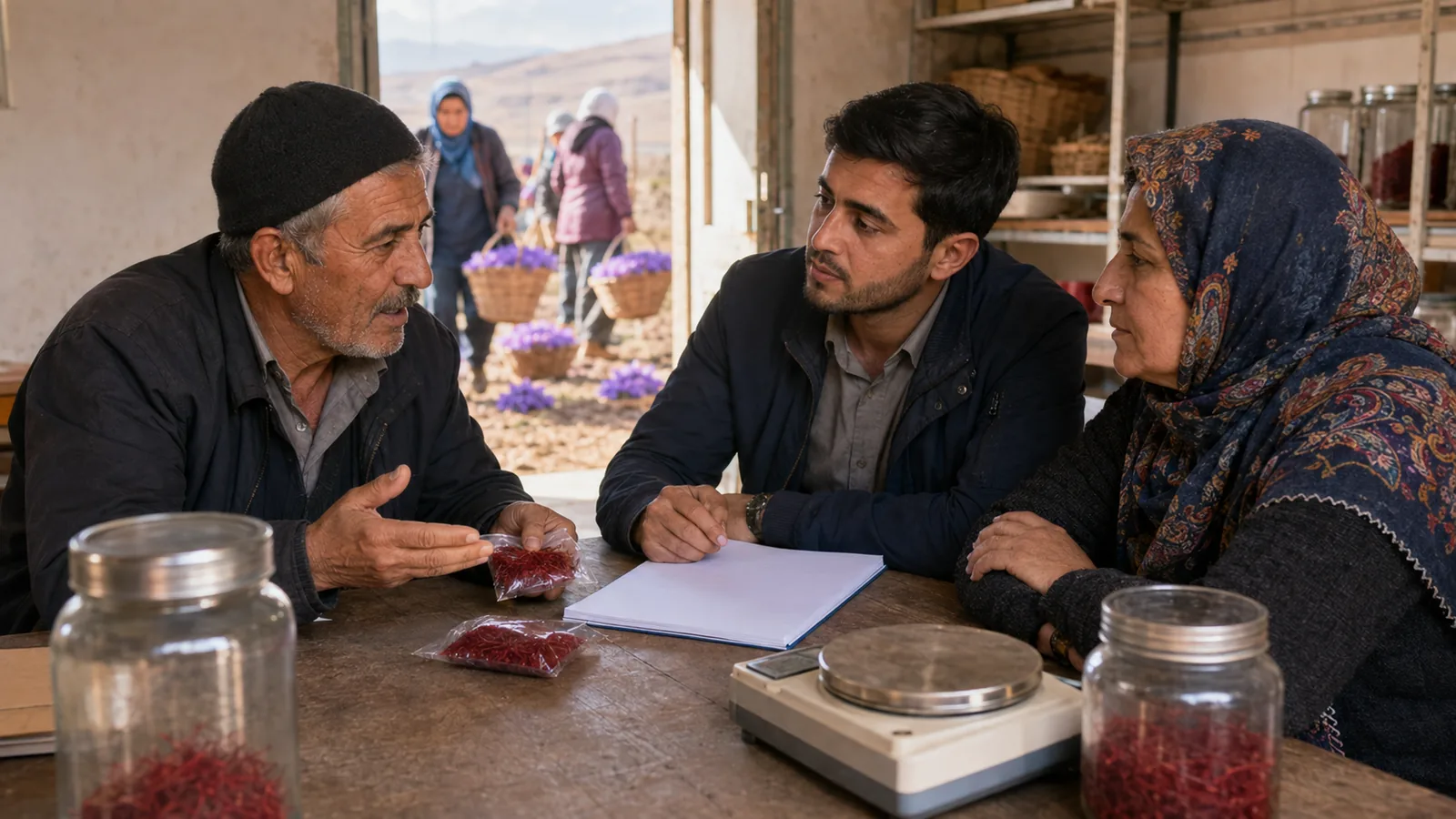
Why Jahanshiri wanted the market returned to farmers
Jahanshiri described a familiar harvest-season problem. Picking and separating saffron flowers creates an immediate need for cash. A grower may have to take a loan, sell the crop in advance, write a cheque or accept a buyer’s early offer simply to pay labour and other initial costs.
The spice may later sell for more, but a farmer who had to sell quickly does not share in that increase. This is what Jahanshiri meant when he said politicians and other market actors had too much influence while the rightful owners of the crop had too little.
His suggested response was for farmers, where possible, to sell only enough saffron to cover immediate expenses and avoid reacting to rumours of an imminent price fall. That is a viewpoint from the interview, not one-size-fits-all financial advice. Storage has costs and risks, households have different debts, and no farmer can know a future market price with certainty.
The harvest forecast behind the warning
The interview took place on 28 Mehr 1403, corresponding to 19 October 2024, as a new harvest approached. Jahanshiri said good saffron corm condition and suitable rainfall suggested a bountiful crop. More supply arriving over a short period could, in his view, cause a temporary reduction in price.
That forecast must remain attached to its season. It is not a current harvest prediction. Corm health and rainfall are useful observations, but final dried output also depends on temperature, flowering, labour, harvest timing and post-harvest losses.
The practical lesson lasts longer than the prediction: when many growers need cash at the same moment, even a high-quality harvest can weaken their bargaining position. Better production does not automatically produce better farm income.
What went wrong in the support-purchase dispute?
Jahanshiri criticized the Rural Cooperative Organization’s previous support-purchase programme. According to his account, the organization announced 420 million rials per kilogram when saffron was delivered but paid farmers 370 million rials per kilogram at settlement. He further alleged that growers later learned the same saffron had been sold for 1 billion rials per kilogram.
Those figures are an attributed dispute, not an audited finding about every purchase. A fair comparison would need the grade, storage period, sale date, handling cost and contract terms. Even with that limitation, changing the settlement amount after delivery would damage confidence unless the contract clearly allowed it and the adjustment was explained.
A separate 2022 report records Jahanshiri criticizing an earlier cooperative purchase after a promised amount was reduced. The recurrence explains why he placed transparency and farmer participation ahead of another headline price.
What useful government support would look like
Jahanshiri proposed identifying smallholder farmers first, then using advance purchases or low-interest facilities to reduce the need for a distress sale. If a direct-buying plan were repeated, he argued, its gains should not bypass the people who produced the crop.
That design needs safeguards. Eligibility should be clear before harvest. Grade and sampling rules should be published. Growers need to know the payment schedule, storage charges and what happens if the market rises or falls after delivery. A support price that is announced but not paid on the agreed terms can be worse than no promise at all.
Credit also has to reach the intended farmer in time. A low nominal interest rate is not useful if approval comes after the flowers have been picked and the crop has already been sold. Small farms may need a cooperative or local service to help with records, warehousing and applications.
The National Saffron Council and producer representation
Jahanshiri praised the experience of individual members of the National Saffron Council, saying they each had at least 30 years in the field and defensible professional records. His praise came with a clear criticism: producers and people engaged in saffron processing should have a larger role.
Experience gives a council valuable institutional memory, but it does not automatically represent every point in the supply chain. A small grower, seasonal worker, processor, exporter and laboratory may see a policy differently. The council is stronger when those differences are heard before a price or support plan is announced.
Representation also improves accountability. If a public programme fails to pay the declared amount, producer delegates can ask what changed and how the decision was made. If it succeeds, the same delegates can help explain the rules to growers rather than leaving the market to rumour.
Why a higher rial price may not make farmers richer
Jahanshiri called a saffron price increase a misfortune disguised as a blessing. His argument was about currency. He recalled dollar prices of roughly $1,300 to $1,400 per kilogram—and at times as high as $1,700—about 15 years earlier, then said the underlying dollar value in 2024 remained in a similar range.
In that view, a larger figure in rials did not necessarily show better crop management or stronger export performance; it could simply reflect depreciation of the local currency. At the same time, growers were paying more for labour, food, farm inputs and household needs. He pointed to rising prices for cardamom, lentils, beans and even animal manure to show why a nominal saffron increase could not be treated as pure gain.
His dollar range was a market observation, not a verified annual average for every grade. To measure a farmer’s position properly, compare the farm-gate price with the cost of producing a kilogram, the yield from the field and the purchasing power of the proceeds. Quoting only the final retail or export figure hides that calculation.
A government plan was promised, not yet proven
The original report also included a response from Hamidreza Rezaei, acting head of the Rural Cooperative office in Torbat-e Heydarieh. He said the Ministry of Agriculture-Jihad in Iran’s fourteenth government was developing a new plan with members of parliament and representatives from saffron-producing provinces, centred on the constituencies of Torbat-e Heydarieh, Zaveh and Mahvelat.
Rezaei predicted that the plan would limit speculation and intermediaries while supporting stable or higher prices. At the time, however, it had not been unveiled. A proposal that was still to be announced cannot be described as if it subsequently delivered those results.
The right tests are measurable: Did eligible farmers participate? Was payment made on time? What share of the crop passed through the mechanism? Did the spread between farm-gate and later sale prices narrow after storage and handling costs? Without published outcomes, “stability” remains an intention.
Why Torbat-e Heydarieh matters to the saffron supply chain
The 2024 report placed this policy debate in Iran’s main growing region. It cited 120,000 hectares of saffron nationwide and 91,000 hectares in Khorasan Razavi—about 76% of the stated area. Torbat-e Heydarieh and Zaveh together were credited with more than 20,000 hectares.
Across the wider 50-kilometre area around Torbat-e Heydarieh, including Zaveh, Mahvelat, Khaf and Rashtkhar, the report gave more than 30,000 hectares, or over 34% of Khorasan Razavi’s saffron area. Using an average yield of four kilograms per hectare, it estimated annual production at about 120 tonnes.
These are dated regional figures and an arithmetic estimate, not a promise that every year produces 120 tonnes. They do explain why local voices matter. The same report counted 117,000 saffron-growing households across Khorasan Razavi, including 14,000 to 15,000 in the Torbat-e Heydarieh area.
Torbat-e Heydarieh itself was described as a city of about 225,000 people, roughly 150 kilometres south of Mashhad. Jahanshiri served as head of the economic commission of its Islamic City Council. He said the council had raised its objections with members of parliament and used tourism exhibitions to promote Iranian saffron with the region at the centre.
How farmers can gain more influence without fixing prices
A farmer-led market does not require every grower to set the same price or hold the crop indefinitely. It means producers have access to information and practical choices before they sell.
- Publish grade-specific transactions. A number per kilogram means little unless the grade, date and quantity are visible.
- Offer independent sampling. Growers should be able to challenge a grade with evidence rather than accept an unexplained deduction.
- Provide secure storage. A farmer who can store a documented lot safely has more freedom than one forced to sell during the harvest rush.
- Make finance timely and transparent. Loan cost, eligibility and repayment terms should be known before harvest.
- Track support-purchase outcomes. The public should see how much was bought, paid, stored and sold, with costs separated from gains.
Commodity-deposit receipts can support some of those choices by connecting a standardized warehouse lot with a tradeable record. They also have fees and access requirements. Our explanation of the Iranian saffron market and its exchange vision sets out what those instruments can and cannot do.
A key figure is useful when the evidence stays visible
Jahanshiri’s contribution was not a claim that one person could control the saffron market. It was a demand to judge policy from the farmer’s side of the transaction. Harvest forecasts, rising prices and government plans can all sound positive while a grower is still forced to sell too soon or receives less than the announced amount.
The Food and Agriculture Organization’s current work in Iran similarly connects saffron quality with farmer returns and a stronger, more transparent value chain. Quality evidence protects the buyer; transparent commercial terms protect the producer.
A fairer Iranian saffron industry therefore needs both. Farmers should know what their crop is worth and have enough time, finance and storage to choose a route to market. Buyers should receive traceable quality. Government and industry bodies can provide the framework, but their success is measured by what reaches the farm—not by the price announced at a press conference.

![Exporting Saffron to Turkey + Price Guide [Complete 0 to 100]](https://img.rowhanisaffron.com/20260827003933/saffron-export-turkey-quality-inspection.webp)



