


“A few percent of the world’s saffron is produced in Iran” is not what the historical figures in this article actually show. The headline survived from a poor translation of a speech at the launch of saffron trading on the Iran Commodity Exchange. The speaker’s central point was the opposite: Iran produced roughly nine-tenths of the world’s saffron. Current Food and Agriculture Organization reporting places the share at about 85–90 percent, so Iran remains the clear global leader.
That distinction matters. Iran’s strength is not simply the volume of dried red threads that leaves its farms. It rests on knowledge, rural livelihoods, quality control and a market that can connect a traceable lot of saffron with a fair price. The original speech raised each of those issues, although its English translation damaged several names and numbers.
What the original Iranian saffron figures meant
Ali-Akbar Mehrfard, then a senior official in Iran’s Ministry of Agriculture-Jahad, spoke at the opening of a formal saffron-trading initiative in Mashhad. His surname appears in several distorted forms in the old translation. Contemporary coverage of the event identifies him as Mehrfard and describes the launch of saffron warehouse-receipt trading on the Iran Commodity Exchange.
The translated post records annual production as 336 tonnes, then says “236 tonnes were produced” without naming the country or region attached to the second figure. It immediately adds that Iran supplied 90 percent of world output. Because a word or number has plainly been lost, the 236-tonne fragment should not be treated as a reliable statistic. The defensible meaning is that the official was describing Iran as the dominant producer, not as the source of only a few percent.
The same caution applies to the stated cultivation area of “105 hectares.” An industry producing hundreds of tonnes could not have come from such a small area at the quoted average yield of 3.3 kilograms per hectare. The translation almost certainly dropped “thousand,” but the exact original figure cannot be recovered from this English text alone. It is better to identify the error than to turn a likely correction into a new unsupported claim.
How much of the world’s saffron comes from Iran today?
FAO reported in November 2025 that Iran produces 85–90 percent of the world’s saffron. An earlier FAO profile of the qanat-based saffron system in Gonabad described the national share as more than 90 percent. The figures come from different dates and methods, so they should be read as a range rather than as a permanent, exact percentage.
Khorasan Razavi and South Khorasan remain at the centre of that production. The old speech put their combined share at about 90 percent of Iran’s saffron area. The concentration is understandable: saffron is adapted to arid and semi-arid conditions, and its seasonal cycle suits areas where water is scarce. It still needs planned irrigation. Calling it a crop for “shallow water,” as the old translation did, confuses low water demand with no water requirement.
The speech also mentioned an average yield of 3.3 kilograms per hectare and an ambition to reach 8 kilograms. Yield is not a simple measure of success, however. Corm health, soil, irrigation timing, flowering weather, picking speed and drying practice all affect the usable crop. Chasing a high field yield while weakening aroma, colour, cleanliness or traceability would not create more value for the farmer.
Domestic use, exports and the value that reaches farmers
According to Mehrfard’s historical estimate, Iran consumed roughly 20–25 percent of its saffron domestically and exported 75–80 percent. Those proportions describe the market at the time of the speech, not a current trade forecast. They nevertheless explain why export conditions have such a strong effect on rural income.
A farmer may produce excellent saffron and still be forced to sell quickly if cash is needed after harvest. Many growers offering small quantities at the same time can strengthen the position of intermediaries. The original report called this a shortage of liquidity and weak organization among farmers. It also referred to a rural-cooperative support purchase of close to 67 tonnes; “67 people bought saffron” was another machine-translation error.
Cooperatives, transparent grading and access to short-term finance can give growers more choice over when and how they sell. They cannot guarantee a particular price. A credible system instead gives participants clearer information about the grade, quantity, ownership and current demand for each lot.
What warehouse receipts and exchange trading change
In warehouse-receipt trading, a grower or owner deposits saffron in an approved warehouse. The lot is weighed and assessed against the warehouse standard. If accepted, a receipt represents the stored product and can be traded without moving the physical saffron every time ownership changes.
Contemporary coverage of the Mashhad launch says the model was intended to support continuous offers, daily price discovery, faster settlement and participation by both small and large sellers. It also introduced a practical quality threshold: a non-compliant lot was returned rather than receiving a tradable receipt.
These mechanisms can reduce some transaction costs and make prices easier to observe, but they do not remove every intermediary or protect a seller from a falling market. The strength of a receipt depends on the warehouse, sampling method, grading rules and confidence that the stored saffron matches the document. For a fuller explanation of the market mechanism, see our guide to how saffron is traded on the commodity exchange.
Why exporters can weaken their own market
Mehrfard also criticised what the translation called “negative competition” among Iranian exporters. This happens when sellers compete mainly by undercutting one another, especially when buyers know that stock must be sold quickly. A lower offer may win one order while reducing the reference price used in later negotiations.
The answer is not an artificial promise that every lot deserves the same high price. Different grades, harvests and contracts carry different values. A healthier export market makes those differences visible: origin and batch records, consistent grading, documented test results, careful packaging and reliable delivery give a buyer reasons to compare more than the lowest price per kilogram.
Quality, traceability and product development
The original speech listed technology, diversification, genetic registration and standardization as priorities. In practical terms, that agenda reaches from the field to the sealed pack:
- healthy planting material and field records that identify where a crop was grown;
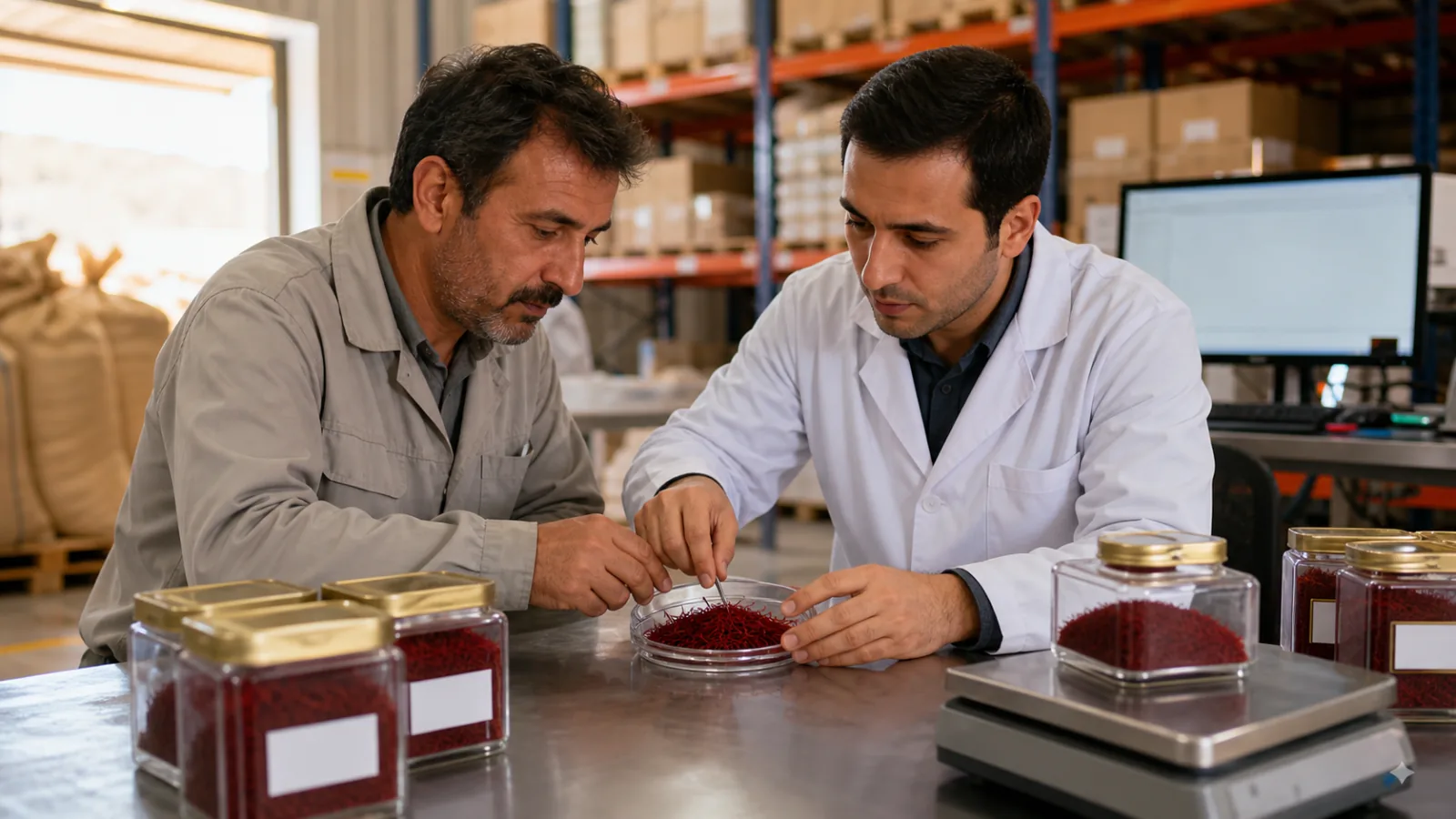
- fast, hygienic separation and controlled drying after the flowers are picked;
- lot-based sampling and tests tied to the saffron actually being sold;
- consistent descriptions for thread style, grade, net weight and origin;
- packaging that protects aroma and colour while retaining batch identity;
- products designed for a real use, without disguising weak raw material.
“Genetic registration” should not be read as a claim that genetics alone determines quality. Botanical identity and provenance can support traceability, while farming, harvesting, drying and storage still shape the finished saffron. FAO’s current work with Iran likewise emphasizes authenticity, testing, transparent supply chains and quality integrity.
The more useful measure of Iran’s saffron leadership
Production share explains Iran’s scale, but it does not tell a buyer whether one packet is fresh, authentic or fairly priced. The stronger measure is how much of the crop can be traced from grower to lot, graded consistently and sold without losing its identity along the way.
That was the durable idea beneath the damaged numbers in the original report. Better market infrastructure can help farmers avoid distressed sales. Better standards can help buyers understand what they are paying for. Neither works without accurate records, credible inspection and a product whose quality survives the journey from a Khorasan field to the customer.

![Exporting Saffron to Turkey + Price Guide [Complete 0 to 100]](https://img.rowhanisaffron.com/20260827003933/saffron-export-turkey-quality-inspection.webp)



