


Iranian saffron exports were discussed at a national export meeting under the headline claim that Iran supplied 95% of world saffron markets. The report documents policy proposals for packaging, price management, foreign-buyer access, and producer support. It does not provide the trade dataset needed to verify 95% as a current export-market share.
The distinction between production and markets matters. Producing 95% of a crop, supplying 95% of traded volume, and earning 95% of retail value are three different claims. The meeting account uses them loosely and gives no year, country table, volume, value, or definition of “world markets.”
What the 95% saffron-market claim means
Hamid Zadboom told the National Saffron Export Desk that Iran’s saffron position should be strengthened as a symbol of the country’s non-oil exports. The article says Iran supplied 95% of saffron in world markets and describes the National Saffron Council and private sector as central to improving that position.
The percentage is best preserved as a historical statement made at the meeting. It should not be converted into a current, audited export share because the source does not identify whether it measures production, export volume, sales value, or market presence.
The site’s separate review of why more than 90% of world saffron was reported produced in Iran explains the historical production series. This page covers export policy and value capture, not another independent production count.
The National Saffron Export Desk’s role
Zadboom traced an export-desk effort to the Iranian 1370s and referred to Trade Promotion Organization support beginning in Iranian year 1381, approximately 2002–03. The translation later uses “2008” for another set of proposals, but it mixes calendar notation and does not provide the original resolution dates. A current timeline should verify those records before assigning a Gregorian year.
The report says the Trade Promotion Organization, the National Saffron Council, government bodies, growers, and exporters had worked on approvals intended to remove export barriers and add value. It does not list the approvals, budgets, disbursements, performance indicators, or completed outcomes.
Representatives from Khorasan Razavi and South Khorasan, executive agencies, the National Saffron Council, and sample producers/exporters attended the national meeting. Their participation shows consultation, but it does not by itself prove that the proposed measures were implemented.
Price management and foreign-buyer access were proposals
Participants discussed managing domestic prices while giving Iran a more active role in the global saffron price. They also proposed attracting foreign buyers during harvest, when visitors could see production areas and saffron-related tourism.
These ideas were presented as strategies. The article gives no purchase mechanism, price band, buyer program, visitor count, contract volume, or evidence that domestic price management improved farm returns. They should not be rewritten as completed policy.
Exporters also asked the National Saffron Council to announce and implement a support statement protecting producer interests “in all circumstances.” The report does not quote a final statement or establish legal or financial protection, so the request remains a request.
Khorasan Razavi made saffron trade a provincial priority
A separate meeting at the Khorasan Razavi governor’s office adds the provincial layer. Then-governor Mohammad Sadegh Motamedian met members of the National Saffron Council and said organizing problems in saffron development and trade was a management priority.
Motamedian described saffron as a strategic product within the policy language of Iran’s “resistance economy” and provincial export development. He called on responsible agencies to build export infrastructure, introduce the product in more countries, identify obstacles clearly, and work on solutions with the sector.
Growers, processors, and exporters presented their views on Khorasan Razavi’s capacity and trade problems. The source does not name those problems, record decisions, assign deadlines, or report later results. The strongest accurate conclusion is that the issues reached the governorate’s agenda, not that they were solved.
What export infrastructure needs to accomplish
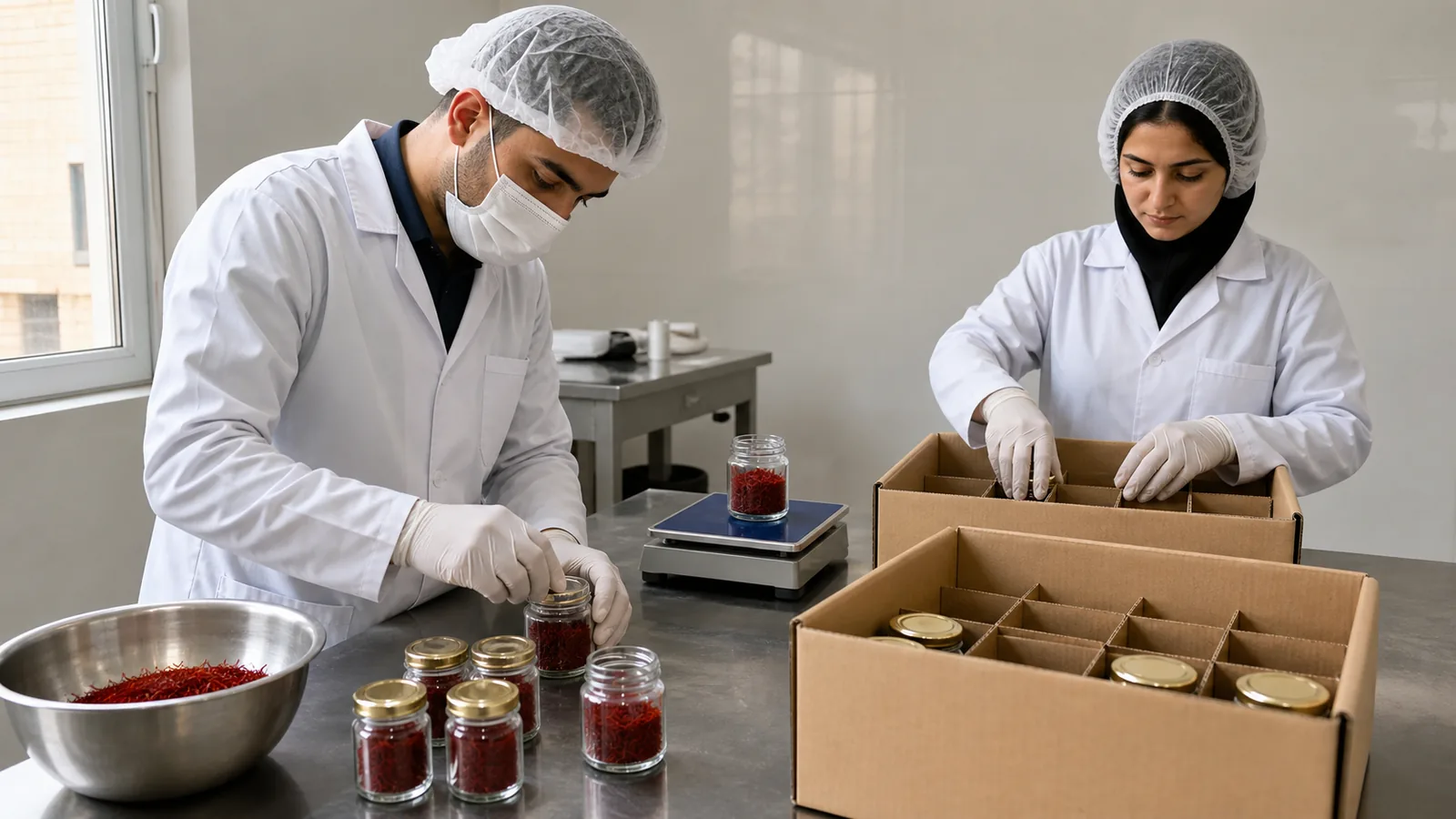
The two meetings point to the same chain of work: production has to become a consistent export product and then reach buyers under terms that return value to the producing region. Depending on the market and transaction, that can involve:
- documented origin and lot traceability;
- consistent grading and agreed quality specifications;
- food-safe separation, drying, storage, and packing;
- laboratory or regulatory documentation where the buyer requires it;
- commercial contracts, logistics, payment, and buyer communication; and
- clear evidence of how producer and exporter returns change.
This list explains the functions implied by the meetings; it does not claim that a specific national program supplied each one.
What would verify the strategy today
A current assessment would need year-specific export volume and value, destination-country data, re-export information, grade and packaging mix, realized prices, producer share, named infrastructure projects, and measured results. It would also need to define whether any claimed percentage refers to production or trade.
Until those records are available, the 95% figure and the government initiatives belong to their historical meeting context. The durable message is that production dominance does not automatically create export value; quality systems, market access, and transparent commercial outcomes determine whether the value reaches growers and exporters.

![Exporting Saffron to Turkey + Price Guide [Complete 0 to 100]](https://img.rowhanisaffron.com/20260827003933/saffron-export-turkey-quality-inspection.webp)



