


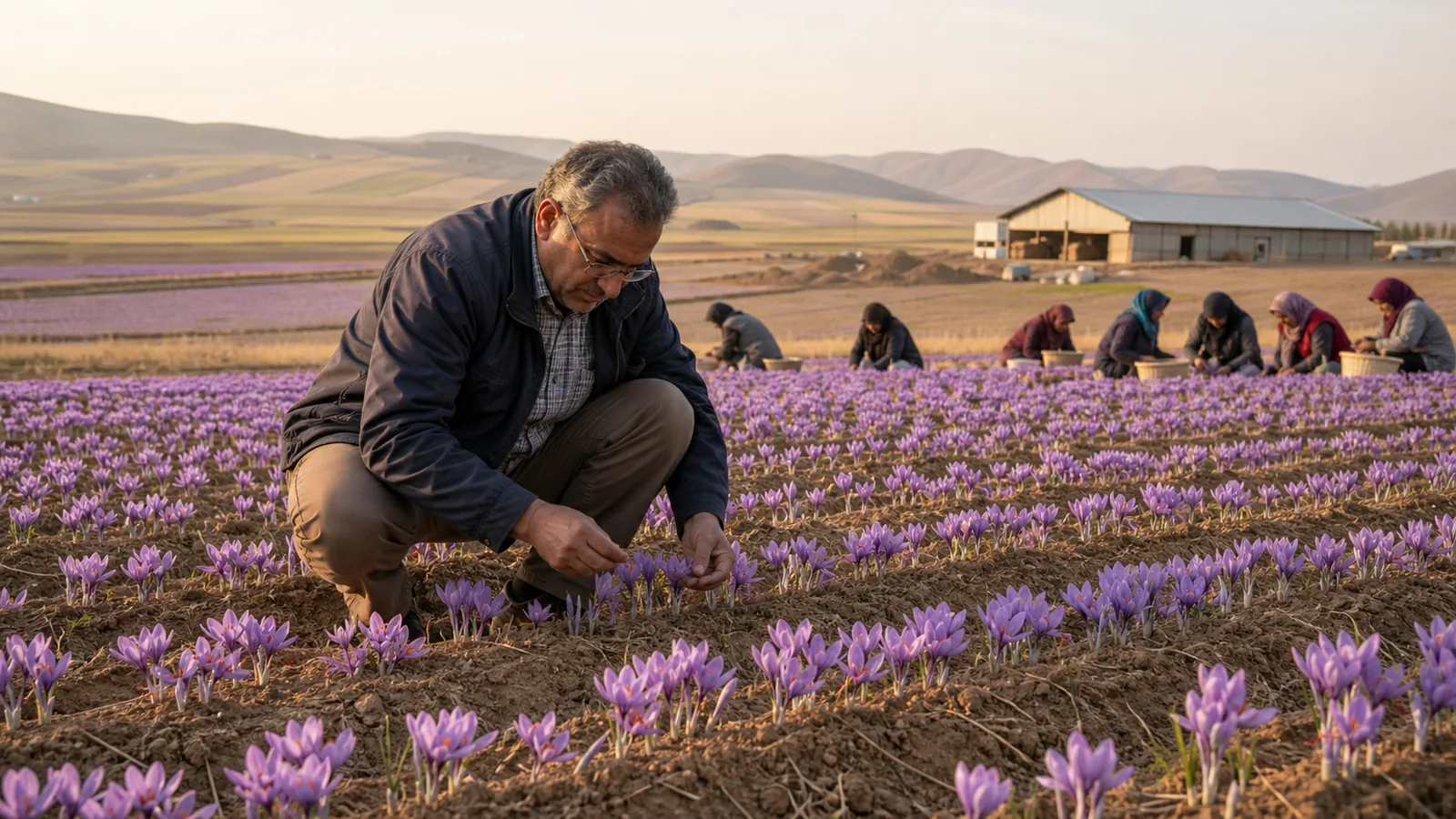
8 times saffron growth refers to the expansion of Iran’s saffron-growing area over roughly four decades. In a 2016 interview attributed to ISNA, agronomist Behzad Sadeghi said the planted area had risen from about 10,000 hectares to more than 80,000 hectares. He also described production increasing from 18 tonnes to about 250 tonnes.
Those two comparisons are not the same rate of growth. The area increased about eightfold; the stated harvest increased nearly fourteenfold. The distinction matters because a larger crop can come from more land, better yield per hectare, or both. This is a historical account, so its figures should not be mistaken for current national statistics.
What grew eight times?
The surviving English translation says saffron was cultivated “in 52 provinces about 10 thousand hectares.” Iran does not have 52 provinces, and the sentence conflicts with the interview’s 40-year timeframe. It appears to have lost part of a date during translation. What can safely be retained is Sadeghi’s central comparison: about 10,000 hectares at the beginning of the period and more than 80,000 hectares by 2016.
On that basis, “8 times” describes cultivated land. The output comparison is different:
- cultivated area: roughly 10,000 to more than 80,000 hectares;
- annual production: roughly 18 to 250 tonnes; and
- time covered: approximately 40 years, as described in the interview.
These are reported endpoints, not a smooth annual growth series. Weather, field age, corm quality, labour and market conditions can move production up or down from one harvest to the next.
Why production grew faster than the planted area
If the two reported endpoints are compared directly, average output works out to about 1.8 kg per hectare at the beginning and roughly 3.1 kg per hectare at the end. That does not prove every field became more productive. It indicates that the national production figure rose faster than the area figure.
Yield is shaped by several interacting conditions. A multi-location Iranian study found that temperature and farm management both matter, while field age, soil properties and irrigation frequency can affect performance. The researchers also found that yield tended to rise until the sixth or seventh year of a field and then decline. Their work on climate and management factors in Iranian saffron fields is a useful reminder that one national average cannot describe every farm.
Expanding the area can also change the mix of sites being averaged. An established Khorasan field and a new plot in another province may face different temperature patterns, soil, water, labour experience and post-harvest facilities.
Khorasan remained central to the industry
Sadeghi’s concern was not growth by itself. He argued that saffron supported a large rural economy in Khorasan and that unsold production could put farm households under pressure. The source gives 107,000 Khorasani farmers and about 800,000 people whose livelihoods were connected to production. It then says packaging and export supported “200 million people,” a figure that is plainly incompatible with the surrounding scale. That number is not repeated here as fact because the translated copy does not allow a reliable correction.
The broader point is credible and still important: saffron is closely tied to rural income in Razavi Khorasan and South Khorasan. Research in Gonabad, for example, describes saffron as a major source of agricultural income in a drought-affected county and reports 3,600 hectares producing 10.8 tonnes in the cited study area. The peer-reviewed Gonabad farm study also shows why land-use decisions cannot be reduced to a national production total.
For a wider, dated view of area, yield and output, see our saffron production statistics. Figures from different years should be compared only when their definition and reporting period match.
What expansion into other provinces changes
Sadeghi viewed the spread of saffron beyond Khorasan as a warning. His argument was economic as well as agricultural: Khorasan’s dry climate limits the range of crops that can support local households, while wetter regions may have other viable uses for farmland. He worried that moving production into those regions could weaken Khorasan growers and encourage unsuitable land-use changes.
That is an attributed policy position, not a reason to declare every non-Khorasan field unsuitable. A sensible site decision starts with evidence from the actual location. Temperature, winter conditions, water and soil quality, corm health, harvest labour, drying capacity and market access all deserve examination before planting.
Modern research supports that more careful view. Studies now sample saffron fields across several Iranian provinces rather than assuming that one boundary determines performance. High temperature can restrict development, but altitude alone does not guarantee high yield or high quality.
Altitude and latitude do not work alone
The 2016 translation says quality depends on latitude and altitude and suggests that higher elevation improves colour and fragrance. It compares Ghaen—rendered as “Cain”—with Bajestan and Bardaskan, but the sentence is too damaged to establish the direction or the stated 400-metre difference with confidence.
There is a useful idea underneath the broken wording. Location affects the temperatures a saffron plant experiences during corm development, flowering and leaf growth. The 2023 multi-environment study found altitude relevant to site choice and associated lower temperature with better quality in its observations. It did not establish a universal rule that every higher field produces better saffron.
Quality also has to be measured in the harvested product. Colouring strength, aroma-related compounds, bitterness, moisture and physical purity are properties of a particular lot. Origin and elevation provide context; they do not replace sampling and laboratory assessment.
Spain and the changing world saffron market
Sadeghi connected Iran’s production growth with changes in Spain’s saffron industry and Spain’s retreat from large-scale primary production. The surviving sentence is grammatically incomplete, so it does not show whether he meant cultivation, processing, packaging or market share. It is safest to retain the point as his explanation rather than reconstruct a precise claim.
The commercial lesson is clearer. Growing more spice does not automatically secure more value for growers. A functioning supply chain also needs careful drying, grading, laboratory control, traceability, suitable packaging and access to reliable buyers. If output rises faster than demand or market access, producers can be left holding inventory and prices can come under pressure.
How to judge saffron growth responsibly
A headline growth multiple is only a starting point. A serious comparison should ask:
- whether the number refers to planted area, harvested area, production or export volume;
- which crop years and geographic boundaries were used;
- whether production is measured as dried stigma, packaged product or another form;
- how average yield and field age changed;
- whether farmers could sell the additional crop at sustainable terms; and
- whether water, soil and labour constraints were considered.
This prevents two common errors: treating land expansion as the same thing as productivity, and treating a larger harvest as proof that growers are financially better off.
What the 2016 interview still tells us
Sadeghi’s “eight times” claim was about the scale of saffron cultivation, from about 10,000 to more than 80,000 hectares. His accompanying production numbers—18 to 250 tonnes—described an even larger change. He welcomed the crop’s long-term development but warned that expansion, unsold output and weak market access could threaten the Khorasan households that depended on it.
The article is most useful when read as a dated industry argument, not as a current statistical release. It captures the difference between producing more saffron and building a resilient saffron economy. The former can be counted in hectares and tonnes. The latter also depends on farm productivity, product quality, post-harvest work and whether growers can sell what they produce.
Sources reviewed
- The immutable 2016 site copy of Behzad Sadeghi’s interview attributed to ISNA.
- Agrosystems, Geosciences & Environment: climate and management factors influencing saffron yield.
- Agriculture: saffron production and land-use sustainability in Gonabad County.

![Exporting Saffron to Turkey + Price Guide [Complete 0 to 100]](https://img.rowhanisaffron.com/20260827003933/saffron-export-turkey-quality-inspection.webp)



