


Five hectares of agricultural land across Zahedan, Mirjaveh and Khash were allocated to saffron in a provincial plan that forecast five kilograms of dried red gold per hectare. The total target was therefore 25 kilograms, but the archived announcement described an expectation, not a recorded harvest.
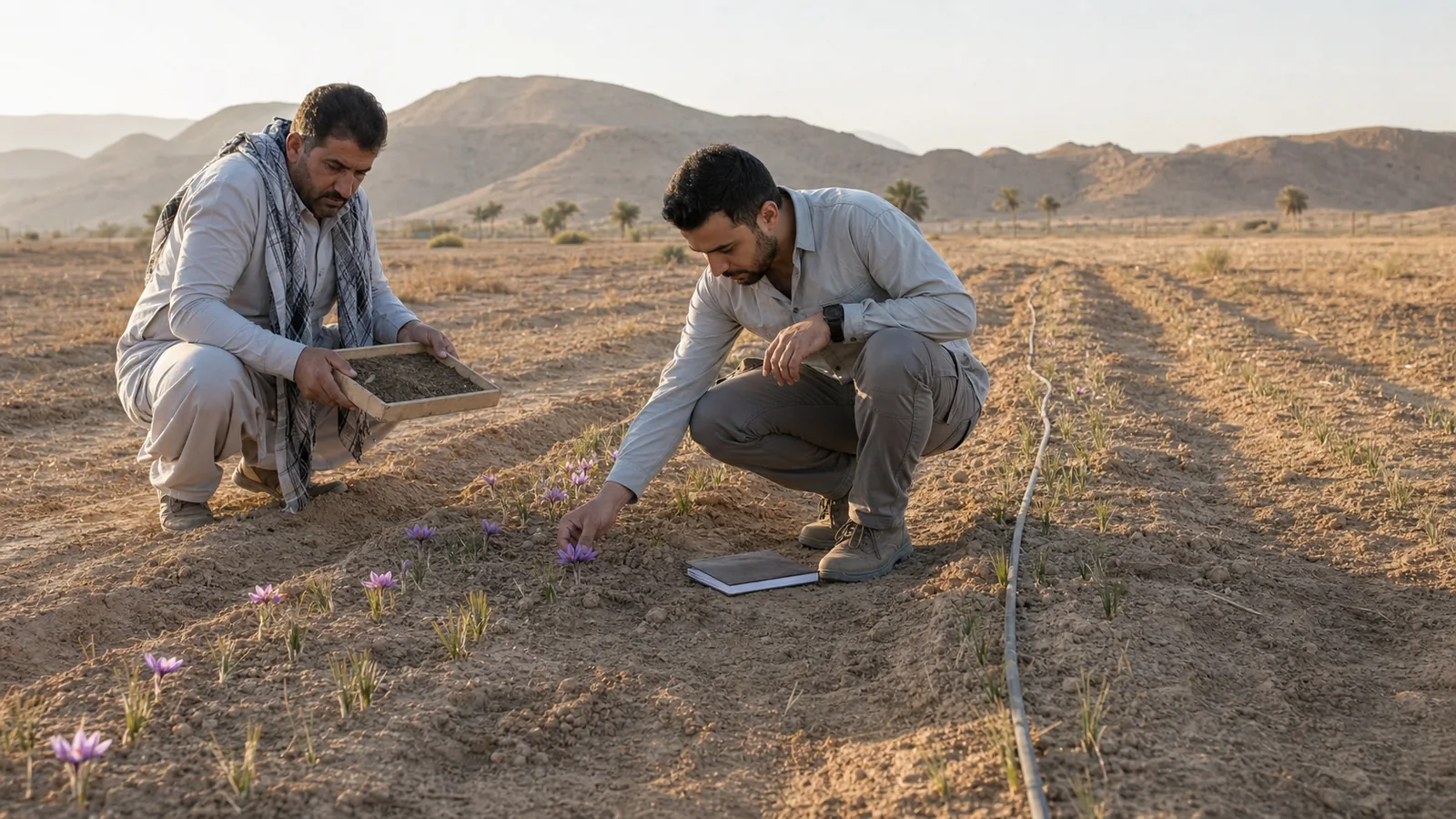
Reza Najafi, then head of the provincial Agricultural Jihad organization, presented the project as part of a wider effort to test saffron in Sistan and Baluchestan, use water more carefully and bring local agricultural knowledge into production. The source gives no event year, so its “this year” dates should not be read as a current schedule.
What the five-hectare Zahedan plan covered
The five hectares were not described as one field inside Zahedan city. Najafi grouped land in Zahedan, Mirjaveh, spelled Mirjavah in the old translation, and Khash. At the announced target of five kilograms per hectare, those farms were expected to supply 25 kilograms of saffron to the consumer market.
He also placed further development of saffron farms and the province’s suitable area on a five-year agenda. That language matters. The initial acreage was a starting point from which officials hoped to learn, not proof that every available hectare was suitable or economically successful.
The experimental fields extended beyond Zahedan
The same report said saffron had been cultivated experimentally in four other counties: Zabol, Zahak, Hirmand and Hamoun. The old English text called Hirmand “Helmand” and Hamoun “Hamoon”; in this provincial context, it was referring to Iranian counties, not Afghanistan’s Helmand Province.
Najafi said the economic efficiency of the crop on those agricultural lands would be assessed by early December. The article did not publish that later assessment, so it cannot tell us whether each trial met its yield, cost or quality objective.
This is what makes a pilot useful. It can reveal where soil, water, planting material, labor and timing work together and where a crop that looks promising on paper struggles in the field.
Why a five-kilogram yield was a forecast
Saffron yield changes with field age, corm quality, planting density, soil, temperature, irrigation, salinity and harvest management. Five kilograms per hectare may be a planning benchmark, but it is not a guaranteed output for a new Zahedan field.
A peer-reviewed agro-climatic suitability study identifies altitude, soil characteristics, temperature, photoperiod and topography as important to saffron performance. Its larger lesson applies here: suitability needs to be tested at the target location rather than inferred from the label “arid” or “semi-arid.”
New fields also change as the corm population develops. A first harvest should not be treated as the permanent annual yield, and a good early result does not remove the need to watch later stand density, disease and soil condition.
The planting calendar was local guidance
Najafi described preparing the land through ploughing and fertilizing, irrigating after preparation and planting saffron corms from early June to late September according to regional weather. He said the provincial harvest began around mid-November.
Those dates preserve the reported local sequence. They are not a universal calendar for saffron farms. Planting and pre-flowering irrigation should be timed for local temperature, rainfall, soil moisture, corm dormancy and the grower’s production system.
The quality of preparation matters as much as the month. A grower needs healthy, correctly identified corms, well-drained soil, a known field history and a plan for weeds, fertility and corm rot. Expanding acreage before these basics are reliable can multiply a problem instead of production.
Low water use still requires a water plan
Saffron is often considered for dry regions because its growth cycle and water use can fit conditions where more water-intensive crops are difficult. That does not mean the field can be planted without understanding water quantity, timing or salinity.
A long-term study of irrigation depth, salinity and planting method found that all three affected saffron yield and water productivity. For Zahedan-area trials, a credible economic assessment therefore needs the water source, salinity, seasonal rainfall, irrigation method and energy cost, not only kilograms harvested.
Drainage deserves equal attention. Water that remains around a corm can create a different risk from drought, especially in heavy or compacted ground. Site preparation should respond to the actual soil rather than repeat a standard recipe.
What “knowledge-based agriculture” meant here
Najafi said the province was moving toward knowledge-based agriculture and making modern production technology a normal part of its work. He connected that approach with employment for agricultural graduates and related specialists.
In a saffron pilot, technical work is not limited to machinery. It includes mapping soil and water, keeping lot records for corms, measuring emergence and flower yield, testing dried saffron, recording labor time and comparing results across sites. Those records make the early-December economic review more useful than a single headline number.
Najafi also wanted products whose quality matched export indicators. A harvest does not become export-ready because it reaches a target weight. Separation hygiene, drying, storage, testing, packaging, traceability and the buyer’s specification all affect whether the product can enter that market.
Greenhouses were part of the wider provincial strategy
The original account moved from saffron to Zahedan’s broader agricultural potential, especially greenhouse products. Najafi cited higher yields, reduced water use and off-season production as reasons to expand greenhouse units.
That point should not be confused with a claim that the five hectares of saffron were inside greenhouses. It showed the policy setting around the trial: provincial officials were looking for production systems that made better use of limited resources.
How to judge a trial after the flowers are picked
- Measure usable dried saffron. Flower numbers alone do not show the weight or quality of the finished spice.
- Record every major input. Corms, labor, water, energy, fertilizer, drying and packaging belong in the economic result.
- Compare sites separately. Zahedan, Mirjaveh, Khash, Zabol, Zahak, Hirmand and Hamoun should not be assumed to perform alike.
- Follow the field for more than one season. Stand development, corm multiplication and disease can change the result.
- Test quality, not only yield. Market suitability depends on the finished lot and the intended buyer.
The final part of Najafi’s message was about people. He said the province should use the knowledge of educated local youth to make better use of its agricultural resources and capabilities. For a small five-hectare saffron program, careful local measurement was the most practical way to turn that idea into evidence.

![Exporting Saffron to Turkey + Price Guide [Complete 0 to 100]](https://img.rowhanisaffron.com/20260827003933/saffron-export-turkey-quality-inspection.webp)



