


The “56 countries eat Iranian saffron” headline refers to export destinations, not measured consumption. During the nine months ending 21 December 2017, Iran was reported to have exported more than 160 tonnes of saffron worth over $219 million to 56 countries. Both weight and value increased from the same period a year earlier.
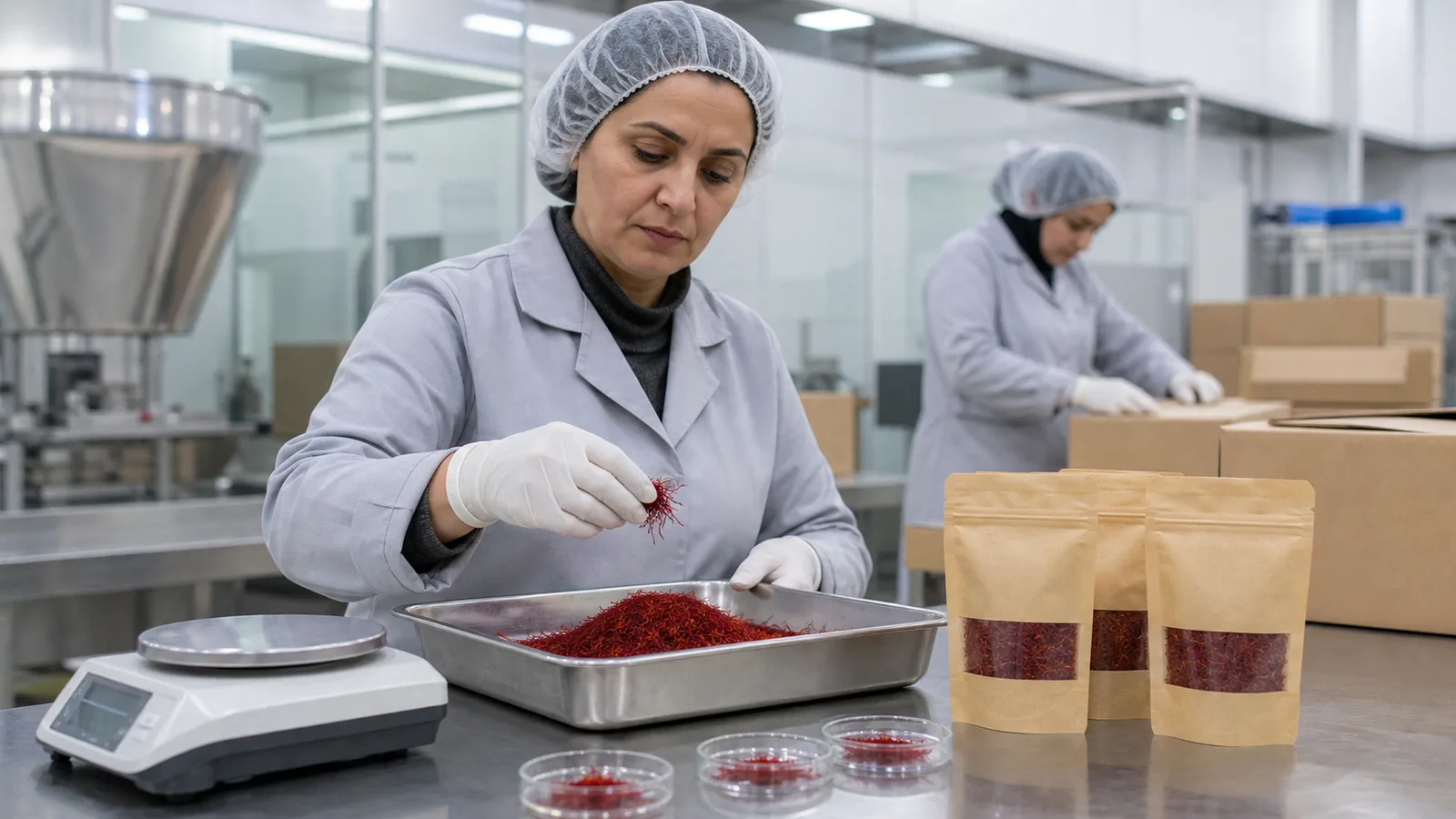
The date matters. This is a historical trade snapshot first reported in January 2018 and republished on this site in 2021, not a statement about exports today. It remains useful because it shows the breadth of Iranian saffron’s market and a long-running concern: too much value can be left to intermediaries when the product travels in bulk.
What increased in the nine-month period?
The reported export weight rose by 33.33% from the corresponding nine months a year earlier, while export value rose by 26.05%. “More than $219 million” is the reliably repeated value. The former article’s wording, “219 million and 270 dollars,” was a broken translation and implied unjustified precision.
A useful cross-check comes from the World Bank’s WITS presentation of UN Comtrade data. It records Iran’s full calendar-year 2017 saffron exports at 235,900 kg and about $325.65 million. Those full-year totals are compatible with, but do not independently reproduce, the nine-month report.
The difference between weight growth and value growth also deserves attention. If volume rises faster than declared value, the average value per exported kilogram may be under pressure, although product grade, package size, destination mix, exchange rates and reporting conventions all affect that calculation.
The five leading destinations named in the report
The United Arab Emirates led the list with more than 23 tonnes, followed by Hong Kong with more than 15 tonnes, Spain with more than 14 tonnes, Afghanistan with more than 5 tonnes and China with more than 4 tonnes. These hubs and markets have different roles: some saffron may be consumed there, while some may be sorted, packed, branded or re-exported.
The source also said the five destinations accounted for 78% of the product. Their stated tonnages add to a little over 61 tonnes—about 38% of a 160-tonne total, not 78%. The 78% may refer to value, a subset or a different dataset, but the report does not define it. It should therefore be preserved as an unresolved source claim rather than treated as a verified share of export weight.
All 56 destinations in the historical list
The country list was: Latvia, Austria, Jordan, Spain, Australia, Slovakia, South Africa, Afghanistan, Algeria, Germany, the United Arab Emirates, the United Kingdom, the United States, Italy, Bahrain, Brazil, Belgium, Bosnia and Herzegovina, Pakistan, Taiwan, Turkey, Turkmenistan, the Czech Republic, the Republic of Korea, China, Denmark, Japan, Singapore, Sweden, Switzerland, Serbia, Iraq, Oman, France, Finland, the Philippines, Kyrgyzstan, Qatar, Canada, Kuwait, Georgia, Lebanon, Poland, Madagascar, Malta, Malaysia, Hungary, Morocco, Mauritius, Norway, New Zealand, Vietnam, the Netherlands, India, Hong Kong and Greece.
This records 56 customs destinations. It does not prove equal market penetration, repeat purchasing, retail availability or consumption in each country. A small trial shipment and a major trading hub both count as one destination in a country tally.
Which markets were growing?
The report said purchases had increased year on year in the United States, Germany, the United Kingdom, Italy, Belgium, Sweden, Switzerland, France, Canada and the Netherlands. It also identified Madagascar as a new customer during that nine-month period.
These are historical comparisons, not permanent trends. Trade routes can shift with harvest size, prices, sanctions, logistics, payment access, buyer inventories and the emergence of competing origins. A destination that grew in 2017 may not have the same position now.
Bulk, whole and retail-packed saffron
The original translation made the package data almost impossible to read, changing tonnes into grams and combining unlike categories. The contemporaneous report is clearer: unpacked saffron accounted for more than 50 tonnes, uncut or whole saffron for more than 25 tonnes, and exports in 10-to-50-gram packages had increased.
These descriptions may overlap depending on the customs categories used, so they should not simply be added together. Still, the underlying concern is valid. A producer country that exports a large share in bulk can lose parts of the downstream value created by final grading, consumer packaging, brand ownership, distribution and retail relationships.
Why a bulk shipment is not automatically bad
Bulk trade can be efficient for industrial buyers and established business-to-business supply chains. Larger lots may reduce packaging material and allow a buyer to create formats suited to its own market. The problem is not the package size by itself; it is whether the exporter is paid fairly for quality and retains enough bargaining power, traceability and customer knowledge.
A serious export strategy needs more than putting small jars into cartons. It requires repeatable grading, contaminant controls, moisture management, secure packaging, batch traceability, accurate origin claims, documentation and dependable delivery. Branding works only when the product behind it is consistent.
What the 2017 figures say about market concentration
WITS data for the full year confirm that Hong Kong, the UAE and Spain were especially important destinations, followed by Afghanistan and China. That concentration can create volume, but it also exposes exporters to changes in a few intermediary markets. Direct relationships with a wider range of packers, food businesses and specialist retailers can reduce dependence—provided suppliers can meet each market’s requirements.
Country of destination is also not the same as country of final sale. A shipment recorded for a trading centre may later move elsewhere. Export statistics alone cannot tell whether the saffron kept its Iranian origin on the final package, was blended, or was sold under another company’s brand.
How to read this red-gold export story today
The central result is clear when dated properly: in the nine months ending December 2017, reported Iranian saffron exports exceeded 160 tonnes and $219 million, reached 56 declared destinations, and grew in both weight and value. The UAE, Hong Kong, Spain, Afghanistan and China were prominent buyers.
The lesson is not that 56 countries literally “ate” the crop. It is that Iranian saffron already had a broad international route to market, while the balance between bulk shipment and value-added export remained strategically important. Current decisions should begin with current customs data, then examine grade, price per kilogram, package type, destination and who owns the final customer relationship.

![Exporting Saffron to Turkey + Price Guide [Complete 0 to 100]](https://img.rowhanisaffron.com/20260827003933/saffron-export-turkey-quality-inspection.webp)



