


Saffron “onions” are the underground corms used to establish a crop. Buying infected, old, damaged or misidentified corms can carry a cheap purchase into years of weak growth and disease, so high-quality saffron planting material needs more than a seller’s promise.
This article preserves a historical warning from Zanjan and adds practical plant-health context. It does not endorse a supplier or diagnose corms from appearance alone. Commercial growers should follow the current requirements of their local agricultural and plant-protection authorities.
Why saffron onions are properly called corms
Crocus sativus grows from a corm, a short swollen underground stem. Growers and sellers often call it a saffron bulb or onion, which explains the wording in the original title, but “corm” is the accurate botanical term.
Saffron is sterile and is normally multiplied vegetatively. That makes planting material the beginning of every new field and a possible route for moving a problem from one farm to another. A corm may also suffer damage during lifting, cleaning, transport or planting, and wounds can make later decay more likely.
What the Zanjan warning reported
Mohsen Nourmohammadi, identified in the archived interview as a Zanjan program lead for saffron, Damask rose and medicinal plants, warned that some growers saved a small amount by buying corms from brokers or seasonal intermediaries. He said losses might become clear only after the crop had occupied the land for several years.
His first requirements were healthy saffron corms and a sensible match between planting material, climate and soil. He said the program supplied corms with help from Agricultural Research Center experts, while some applicants ignored repeated advice and bought from unknown sources.
The interview also alleged that some sellers mixed in gladiolus corms because they could be cheaper and look similar enough to mislead an inexperienced buyer. That is a report about misconduct, not evidence that every informal seller does it. A grower should verify species through a documented source rather than rely on a quick visual comparison.
Why an infected corm can affect a whole field
Corm rot is not a cosmetic defect. A peer-reviewed study that isolated the cause of saffron corm rot found Fusarium oxysporum associated with diseased material and emphasized healthy starting corms and pathogen-free fields. Infected corms can introduce inoculum to a new production area.
Another peer-reviewed investigation of injury and saffron corm rot showed why handling matters. Disease is a biological process involving the plant, wounds, microorganisms and growing conditions. A firm-looking corm is not a laboratory certificate, and one surface mark is not enough to name a pathogen.
The practical consequence is straightforward: do not plant doubtful material simply because the planting window is closing. Once a contaminated lot is distributed across a field, replacing it is harder than rejecting it before planting.
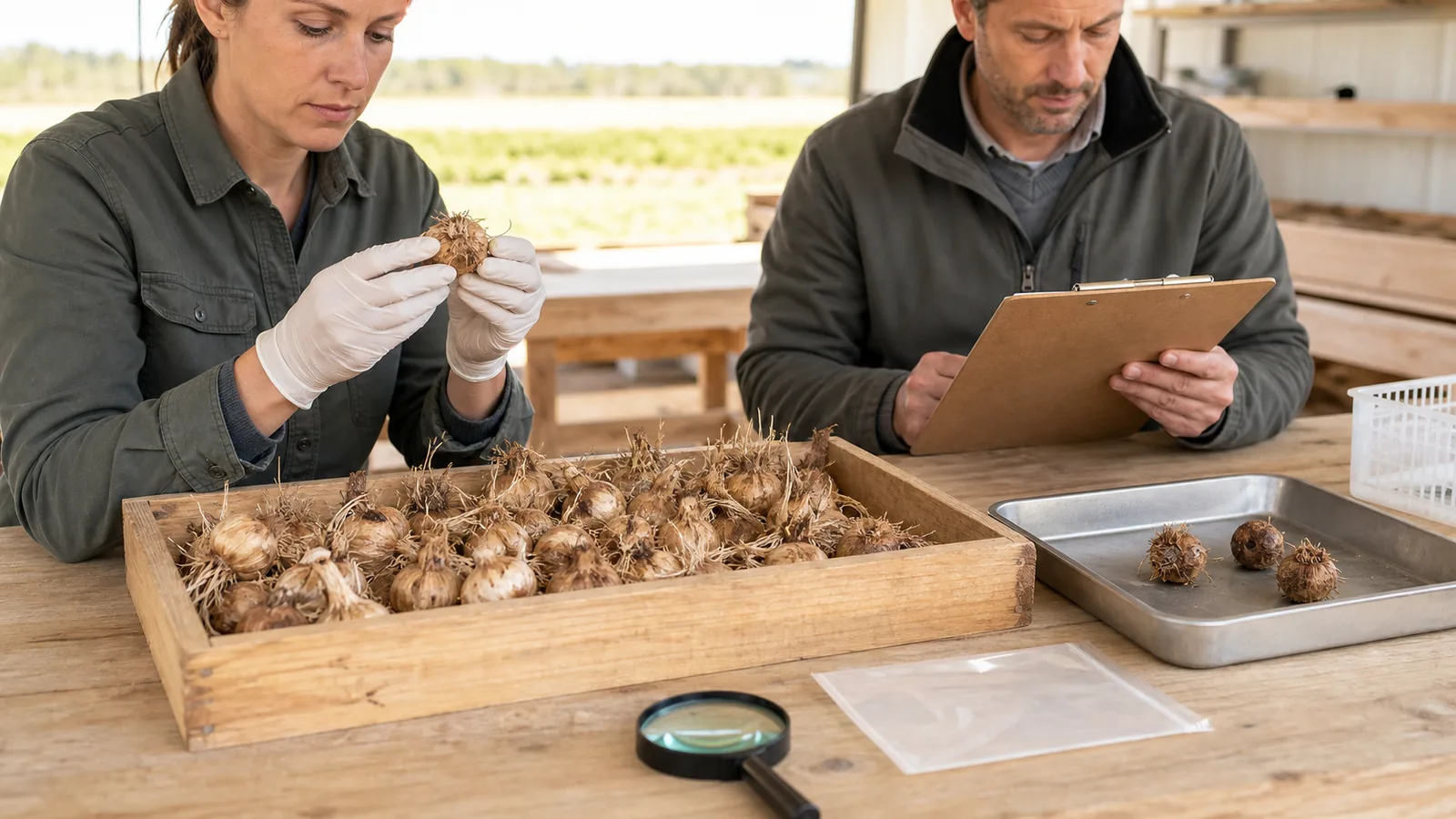
How to inspect saffron corms before purchase
- Confirm identity and source. Ask for Crocus sativus, the producing location, lot information and a supplier who can answer questions after delivery.
- Inspect more than the top layer. Look through a representative part of the lot rather than accepting a clean handful displayed above poorer corms.
- Reject obvious decay. Soft, wet, collapsing, badly shrivelled, mouldy or deeply discoloured corms do not belong in a healthy planting lot.
- Look for injury. Cuts, crushing and damaged basal areas deserve caution because injury can open a route for infection.
- Keep lots identifiable. Do not mix an unknown purchase into established clean stock before its source and condition have been assessed.
- Use expert or laboratory help when the risk is material. A plant pathologist or local plant-protection service can investigate suspicious symptoms; a web photograph cannot confirm the organism.
Corm size can influence establishment and flowering, but size alone does not prove health or authenticity. The local production system also matters. Soil drainage, planting depth, crop history and climate should be considered with an agronomist familiar with the site.
Symptoms to watch after planting
Research on saffron corm rot reports field signs such as poor emergence, yellowing, wilting, shoot collapse and decayed corm tissue. During storage or lifting, affected corms may show brown to reddish areas, softening, shrinkage or deeper rot.
These signs are reasons to investigate, not a complete diagnosis. Nutrient problems, waterlogging, physical damage and several pathogens can produce overlapping symptoms. Mark the affected area, avoid casually moving soil or corms to another plot, and seek local diagnostic advice before choosing a treatment.
The old article’s phrase translated as “disease and saffron tongue” does not identify a recognized diagnosis in usable English. It is safer to retain the documented warning about corm-borne disease than invent a disease name from a broken translation.
The old price was not a quality standard
Nourmohammadi gave an average saffron-corm price of 4,000 to 6,000 tomans, depending on quality. That figure belongs to the period of the interview and is not a current market quote. It is included because it explains the temptation to choose a cheaper broker, not because price can verify a lot.
A high price does not guarantee clean planting material, and a low price does not diagnose infection. The useful comparison is total field risk: purchase cost, land preparation, labor, the years a perennial planting occupies the ground and the cost of correcting a failed or diseased stand.
Zanjan’s expansion and the finance problem
Nourmohammadi said his work began in the Iranian year 1392, corresponding to 2013–2014. At that time, he recalled only six to seven hectares of small, scattered saffron farms in Zanjan. The interview placed the later cultivated area at about 70 hectares.
These are historical figures, not a present acreage claim. He wanted production and agricultural employment to grow but said access to affordable facilities was poor. In his view, support often went to activities with lower profitability and higher risk while saffron and medicinal plants struggled to obtain suitable finance.
The interview framed this within the “Resistance Economy: Production and Employment” policy language of its period. Nourmohammadi did not simply request cash. He proposed corm or medicinal-plant seedling vouchers so support reached applicants who were ready to cultivate and the money was tied to planting material.
Why approved planting material was the better proposal
Provincial Agricultural Jihad experts were reported to be following growers’ requests, although agreement had not been reached with every agency and bank. Nourmohammadi also noted that input support had a narrow margin and argued that increasing sound production was the route to benefits for both farmers and program supporters.
Non-cash support can still fail if the supplied corms are not healthy, correctly identified or suited to the farm. Its advantage is the opportunity to join finance with an approved source, agronomic guidance and an accountable lot record.
The central lesson from Zanjan is therefore larger than “avoid brokers.” Know what species you are buying, know where the lot came from, inspect its condition, protect it from injury and have a plan for diagnosis if symptoms appear. Saving money on saffron onions is useful only when the corms are fit to plant.

![Exporting Saffron to Turkey + Price Guide [Complete 0 to 100]](https://img.rowhanisaffron.com/20260827003933/saffron-export-turkey-quality-inspection.webp)



