


Saffron cultivation outside Khorasan was still small in the historical reports covered here, but several northern and northwestern districts were building distinct local programs. Gilan reported about 40 kilograms a year, Minoodasht in Golestan harvested more than 20 kilograms from mountain villages, and Marand in East Azerbaijan operated at a much larger scale with a reported 750 kilograms.
These are dated production snapshots, not current forecasts. Their value is in showing how growers adapted saffron to highland sites, organized training and promotion, and tested whether a crop associated with Khorasan could support rural income elsewhere in Iran.
Saffron production in Gilan
Habib Jahansaz, then deputy for plant-production improvement at Gilan’s agricultural organization, reported 13.3 hectares under saffron and annual output of about 40 kilograms. He placed the crop’s historical value near 200 million tomans.
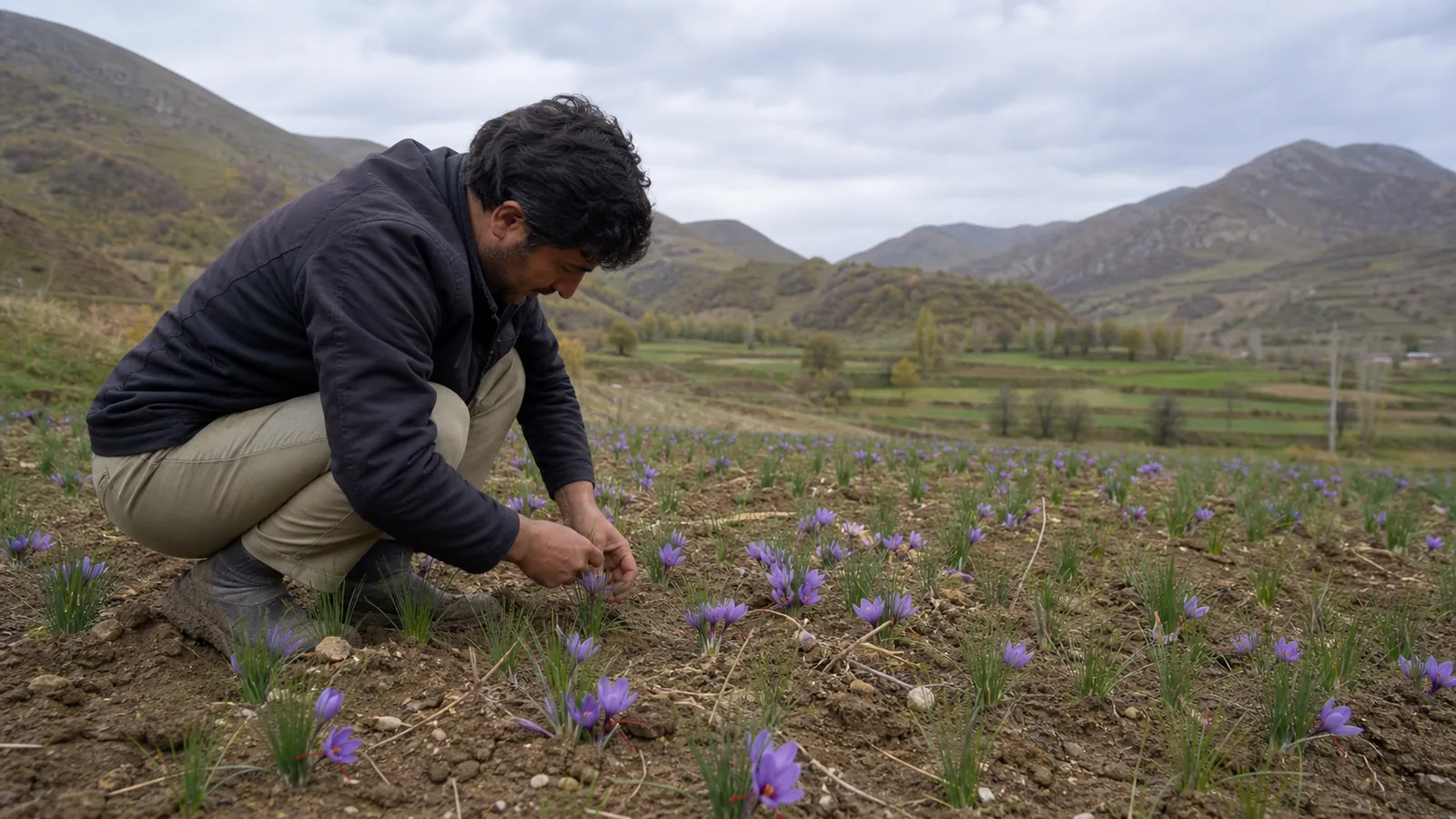
Reported cultivation was concentrated in Rudsar, Amlash, Rudbar, Siahkal, Talesh, and Rezvanshahr. The source placed suitable fields between roughly 1,200 and 2,300 metres above sea level. Flowering and harvest were expected in October, over a period of about 20 days, with flowers picked in the early morning before the day warmed.
An earlier Gilan report gave 12 hectares and 36 kilograms a year. Those figures are consistent with the later total: both equal roughly 3 kilograms per hectare and suggest modest expansion rather than a sudden jump.
The later report also lists 1,300 growers with about 1,000 square metres each. Those two numbers would imply approximately 130 hectares, not 13.3. At least one translated value is therefore wrong. The grower count is not used to calculate output or average farm size here.
Why Gilan’s highlands mattered
In the earlier account, provincial horticulture official Manouchehr Parsafar advised against planting saffron on Gilan’s humid plains. He recommended highland locations above about 1,300 metres with conditions closer to those found in saffron-growing parts of Khorasan.
This was local site-selection advice, not a universal rule that saffron can grow only above 1,200 or 1,300 metres. Elevation is a proxy for several conditions. Temperature pattern, drainage, soil, summer dormancy, disease pressure, and local rainfall all matter. A high field can still be unsuitable, while a lower site in a different climate may perform well.
Deylaman and Siahkal were the program’s clearest examples. Together they reportedly had 4.5 hectares producing about 13.5 kilograms annually—again, close to 3 kilograms per hectare.
The Deylaman-to-Anzali saffron cycling tour
Gilan’s development effort included an unusual promotional event: a three-day cycling tour from Deylaman to Bandar Anzali, held from August 19 to 21 under a motto translated as “Deylaman saffron, the pride of Gilan.”
Organizer Ali Asghar Jedinia described it as the country’s first cultural and sporting tour created to promote an agricultural product. The aim was not to harvest saffron by bicycle; it was to bring attention to the highland crop, share the Deylaman example with other districts, and encourage cultivation only where the conditions were suitable.
The event belongs in the production story because small regional industries need more than corms and fields. Growers also need training, a recognizable origin, buyers, and a way to explain why their product is different. Promotion can help, but it cannot replace consistent quality or reliable production records.
Marand: a larger East Azerbaijan production centre
Marand’s reported scale was very different. Manouchehr Rahmani, then director of the local agricultural authority, said the city produced about 750 kilograms of saffron annually from 184 hectares. East Azerbaijan as a whole had roughly 300 hectares, so Marand accounted for more than half of the province’s reported planted area.
The crop was credited with about 7.5 billion tomans in annual sales. That works out to an average historical value near 10 million tomans per kilogram, although it says nothing about grade, processing costs, or how the proceeds were divided among growers and traders.
The source calls Marand saffron the best in the country, but it provides no comparative laboratory or sensory evidence. The defensible point is that local officials considered quality a branding strength and wanted it recognized beyond the region.
Why the Marand yield figures need a caveat
Rahmani quoted an average yield of about 7 kilograms per hectare and contrasted it with claims of 30 kilograms elsewhere. Yet 750 kilograms divided by 184 hectares is only about 4.1 kilograms per hectare. The area, output, and quoted yield may refer to different seasons or different subsets of farms. They should not be combined into one precise benchmark.
The 30-kilogram comparison is also an attributed claim, not a normal yield promised to growers. Field age, density, weather, harvest skill, drying, and whether a figure describes fresh or dried material can all change the result.
Training and branding in Marand and Bonab
Marand planned a saffron festival to recognize growers, transfer field experience, and run training workshops. Rahmani argued that producing good saffron was not enough if the region could not market it effectively.
Bonab was described as the saffron capital of Iran’s northwest, and organizers discussed taking a joint Bonab–Marand festival to Tehran in a later year. The goal was to build national recognition and, eventually, an international identity for the region’s crop.
A festival can introduce an origin, but durable branding needs more: consistent grading, documented provenance, hygienic drying, suitable packaging, and repeatable quality. Those are the elements that turn a promotional claim into something a buyer can verify.
Minoodasht: growth in Golestan’s mountain villages
In Minoodasht, Golestan, saffron area reportedly doubled from 2 to 4 hectares in one year. The fields were in the mountain villages of Chenashk, Dozin, Chamani, Ten Chenar, and Ghafeh.
Farmers harvested more than 20 kilograms and earned close to 200 million tomans, according to the local agricultural authority quoted by Tasnim. The totals imply at least 5 kilograms per hectare and a rough average value near 10 million tomans per kilogram for that historical season.
The villages sit around 1,300 metres, which local officials considered appropriate for the crop. They reported a harvest beginning near the end of September and continuing for about 35 days. That timing should be understood as a local observation; saffron flowering dates shift with elevation, temperature, rain, corm condition, and season.
A local official also claimed Minoodasht saffron was better than Khorasan saffron because its leaves were slightly larger. The source provides no laboratory measurements, grade comparison, or tasting panel, and leaf size does not by itself establish dried-spice quality. The claim is therefore recorded as local advocacy, not a verified quality ranking.
The practical support was more concrete. Agricultural staff offered grower workshops and supplied planting material to help the new fields become established.
What the three regional programs have in common
Gilan, Marand, and Minoodasht were not one production zone. Their scale, climate, harvest calendar, and development priorities differed. Gilan emphasized careful highland site selection and public awareness. Minoodasht paired new mountain-village fields with training and corm supply. Marand already had a larger planted area and focused on yield, marketing, and regional identity.
All three accounts point to the same sequence for responsible expansion:
- test the field and local climate before expanding acreage;
- train growers in planting, flower collection, stigma separation, and drying;
- keep area, yield, and sales records that reconcile with one another;
- verify quality instead of relying on regional superlatives; and
- build promotion around a crop that can be produced consistently.
For the national context behind these regional snapshots, see our overview of saffron production in Iran. The historical numbers here should not be used as today’s acreage, income, or yield without a newer local survey.

![Exporting Saffron to Turkey + Price Guide [Complete 0 to 100]](https://img.rowhanisaffron.com/20260827003933/saffron-export-turkey-quality-inspection.webp)



