


172 kg of saffron in this province this year was a forecast for Hamedan, not a current production figure. Rahimi Bayat, then a horticulture official in the province’s Agricultural Jihad organisation, said the planted area was expected to rise from 48 to 53 hectares and dried-saffron output from 162 to 172 kilograms.
The old report is more useful as a harvest-planning document than as a headline. A Hamedan saffron harvest of that scale needs sound corms, realistic field yields, concentrated flower-picking labour and enough controlled drying capacity to handle each morning’s crop. If one part is missing, planted hectares do not become saleable saffron.
What the 172-kilogram forecast means
ISNA’s Hamedan service reported Bayat’s comments during the August 2014 publication period. The surviving translation calls the date the “fifth Sunday of August,” which is not precise enough to recover an exact day. The figures themselves are clearer:
- previous season: 162 kilograms from 48 hectares;
- forecast season: 172 kilograms from 53 hectares; and
- additional area: five hectares.
The forecast implies about 3.25 kilograms per hectare. The earlier figures imply about 3.38 kilograms per hectare. In other words, the expected production increase came from more planted land while average yield was projected to remain in a similar range.
A forecast is not a final harvest record. Flowering, weather, corm condition, field age, picking speed and drying loss can all change the measured result. The 172 kilograms should stay labelled as the official expectation for that season.
Hamedan sat outside the main Khorasan centre
The report assigned 78 percent of Iranian production to Razavi Khorasan and 18 percent to South Khorasan, leaving four percent for provinces including Kerman, Isfahan, Hamedan, North Khorasan and Fars. Its point was that Hamedan belonged to a small group of emerging areas while Khorasan dominated the crop.
Another line said Iran had about 79,000 hectares in year 1391 and produced “60 tons.” That output conflicts with the shares and nearby period data, so it is likely damaged translation. It should not be used to calculate national yield or Hamedan’s national share.
The complete statistical reconstruction, including period comparisons, is available in 172 kg of saffron production in Hamedan. This page focuses on what a 53-hectare provincial programme had to organise before the flowers opened.
Start with the fields that will actually flower
A planted-area total is not enough for a harvest plan. Each plot should be recorded by location, area, field age, planting density, corm source and expected flowering stage. A first-year field, a mature productive field and an old crowded field will not contribute equally.
Bayat described saffron stands lasting five to ten years in the soil, with three to seven years regarded as the stronger production period. Modern cultivation reviews likewise show that field duration varies with corm multiplication, crowding, disease pressure, soil and farm economics. A calendar rule cannot replace plot inspection.
The report mentioned cultivation around Hamedan, Tuyserkan and another district corrupted in English as “Skinheads,” which cannot be identified safely from the surviving text. It said Malayer had reached about 20 hectares. It also connected local saffron with place names such as Zafaranieh and a site near Tuyserkan and claimed roots in the Median period. Those are historical associations, not proof of uninterrupted cultivation over thousands of years.
Corm requirements drive the first-year plan
The source gave a planting-material range of three to five tonnes of corms per hectare and called it a major first-year cost. Across five additional hectares, that range would imply roughly 15 to 25 tonnes if the same density and corm-size assumptions applied.
That arithmetic is for planning, not a prescription. Tonnes per hectare change with average corm mass, spacing, planting depth and target field life. A grower needs both a count or density and a size distribution; two five-tonne consignments can contain very different numbers of viable corms.
Inspect the lot before planting. Confirm identity and source, sample corm sizes, reject rot and serious mechanical damage, and assess pests or disease. The original instruction to disinfect all corms with fungicide is too broad. Any treatment must follow an identified risk, a product authorised for that crop and place, and current local guidance.
Our practical guide to selecting and handling saffron corms explains the checks that come before a treatment decision.
Soil and climate claims need plot evidence
Bayat described temperate to semi-warm conditions, relatively mild winters, hot dry summers and light sandy-clay soils as suitable. Hamedan’s terrain makes those generalisations too broad for a farm decision. Elevation, winter exposure, drainage, soil depth, water access and disease history should be checked at the plot.
Neither “sandy” nor “clay” guarantees a good saffron soil. Coarse soil can drain rapidly but hold too little water or nutrition. Heavy clay can remain wet and restrict emergence. The practical target is a workable, well-drained root zone that can be irrigated evenly without prolonged saturation.
The statement that no part of the province faced a cultivation restriction was promotional language, not a survey of every field. Mice and fungal disease were named as risks. Both require observation and an integrated response rather than routine pesticide use without diagnosis.
Prepare for a short Hamedan saffron harvest
The source placed flowering and picking from early to late November. That is a useful historical local window, but temperature and autumn irrigation can move emergence. The programme needed daily field observations before the expected start, not one fixed date on a calendar.
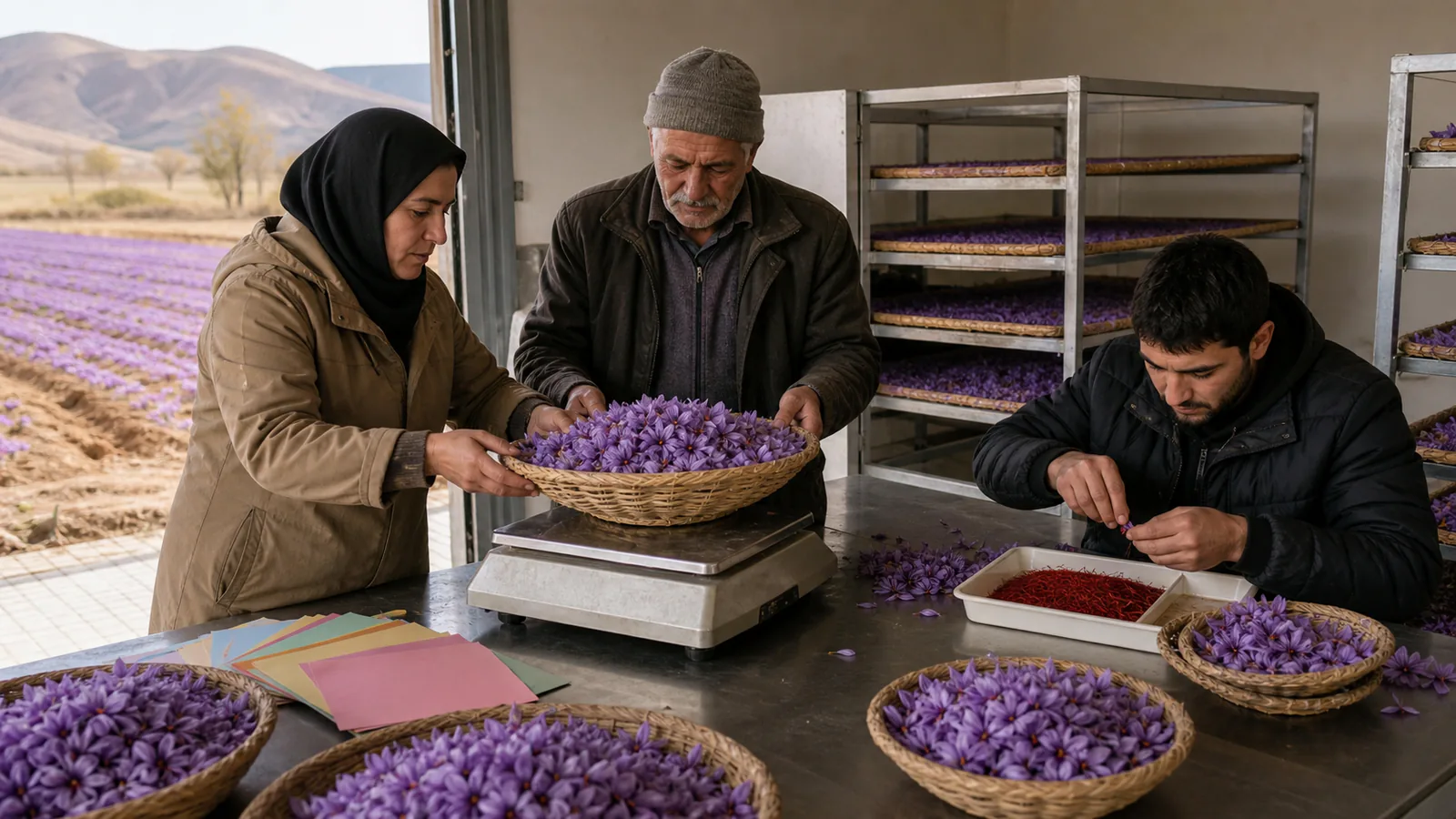
Flowers are best collected promptly and moved in clean, shallow containers so they are not crushed or heated in a deep pile. Separation space, food-contact surfaces, worker hygiene and dryer slots should be ready before the first large morning. Family labour, mentioned in the old report, can suit a small holding; a 53-hectare provincial total still requires coordination across many households and facilities.
Daily records should distinguish flower weight from dried stigma weight. They should identify the field, picking date, time received, time separated, dryer batch, final weight and storage lot. Without that chain, a provincial total cannot be audited and a quality problem cannot be traced back.
Drying time alone does not define quality
Bayat contrasted a “Spanish” method completed in 30 to 60 minutes with a traditional process lasting eight to 12 days. Rapid, controlled drying can protect quality, while an uncontrolled multi-day process can expose wet material to contamination and deterioration. Yet country names and time alone do not define a sound method.
Drying performance depends on starting moisture, load depth, temperature, air movement, equipment and endpoint. A 30-minute batch can be damaged by excessive heat; a longer low-temperature method can work when it is controlled and hygienic. The process should be commissioned with representative loads and a repeatable procedure.
The Codex Alimentarius standard for dried saffron, CXS 351-2022, evaluates the finished material through product definitions, quality provisions, contaminants, hygiene, packaging, labelling, sampling and analysis. It does not endorse a national drying tradition. A producer needs an endpoint that meets the intended specification and records that connect the result to the lot.
How much yield should a Hamedan field promise?
The article described five to six kilograms per hectare as an attainable yield and mentioned ten kilograms in connection with stronger farm management, soil, irrigation and fertilisation. Those numbers should not be turned into guarantees. The 172-kilogram forecast itself implied about 3.25 kilograms per hectare across the province’s expected area.
A provincial average, a target for well-managed plots and the best observed farm answer different questions. Yield varies with corm size and density, field age, water and temperature, nutrition, weed and disease pressure, harvest timing and the moisture basis of the dried product.
Set the labour and dryer plan from a conservative plot forecast, then include spare capacity for a concentrated bloom. After harvest, calculate yield from a defined area and final dried lot. Do not divide flower weight by hectares and call the result saffron yield.
Several claims in the translation should not guide a farm
Saffron is Crocus sativus in the iris family, Iridaceae, not the lily family as the old English version stated. It is sterile and propagated by corms, which is why daughter-corm multiplication matters to field economics.
The article’s producer-country sentence repeats China and mixes Iran, Morocco, Pakistan, Italy, Afghanistan, the United States, Argentina and Myanmar into an unclear ranking. It also gives Iran 80 to 89 percent of global production. These should remain historical claims, not a current league table.
Loan or facility figures were rendered as five million dollars and later 10 to 15 million US dollars. The original currency, programme and unit cannot be recovered from the English text. They should not be used as evidence of current grants, credit limits or planting cost.
Finally, the report said much of Hamedan’s saffron was consumed locally and that Iranian saffron also travelled to Spain for packaging and resale. It did not provide customs data proving how much Hamedan-grown product followed that route. Farm origin, exporter country and consumer-facing brand must remain separate.
What must be measured after the season
A useful close-out record compares forecast and result by plot. It includes flowering dates, flowers received, dried lot weights, labour hours, dryer batches, rejected material, test results, selling channel and actual net return. It also records what could not be processed on time.
That is the evidence needed before another five hectares are planted. The 2014 forecast documented a small Hamedan industry expecting 172 kilograms from 53 hectares. Its lasting value lies in the operational questions beneath the number: which fields will flower, who will pick them, where the stigmas will be dried and whether the final lot can be proved safe and consistent.
Research and standards
- Saffron cultivation systems, field duration and management review, Frontiers in Plant Science, 2025.
- Corm density, size and multiplication evidence, Frontiers in Plant Science, 2023.
- Codex Alimentarius commodity standards, including CXS 351-2022 for dried saffron.

![Exporting Saffron to Turkey + Price Guide [Complete 0 to 100]](https://img.rowhanisaffron.com/20260827003933/saffron-export-turkey-quality-inspection.webp)



