


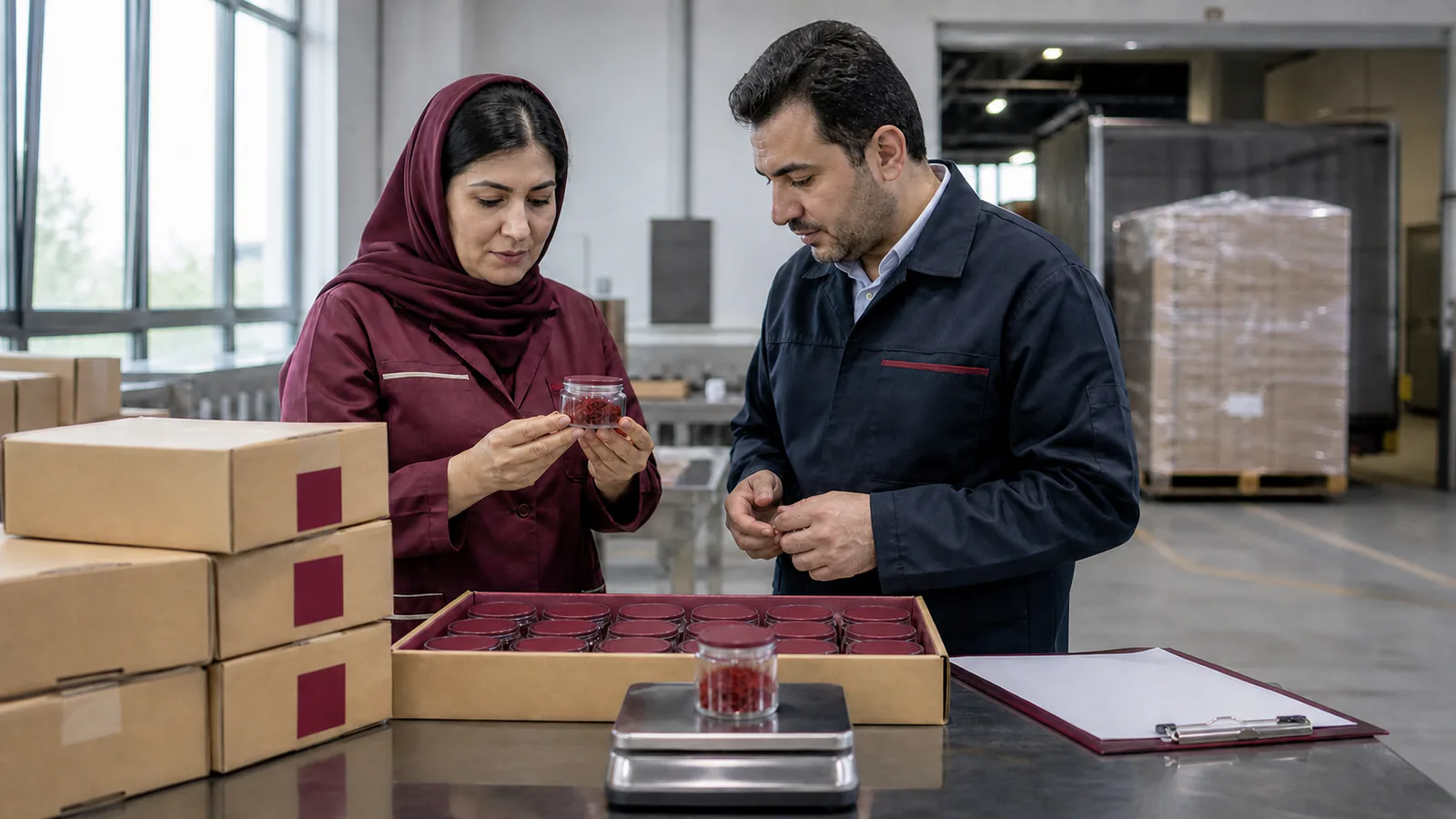
60 million dollar export saffron to 44 countries records a four-month Iranian customs snapshot from 2015. It does not describe current trade, and it does not identify a single “biggest saffron exporter.” The report is useful because it shows how export reach, package size, declared value and policy can be separated when a buyer or researcher evaluates saffron exporters.
The headline numbers were 42 tonnes and 22 kilograms of saffron and saffron powder, a declared value of US$60,800,059 and 44 unique destination names. Compared with the corresponding four months a year earlier, reported weight increased 19.04 percent and value increased 19.32 percent.
The 2015 saffron export record
The figures were reported by the Iranian Students News Agency and covered the first four months, or 120 days, of the source’s Iranian reporting year. That calendar point matters. The period should not be compared directly with January through April in another database unless the dates are aligned first.
The two growth rates are close. Dividing US$60,800,059 by 42,022 kilograms gives an implied average customs value of about US$1,447 per kilogram. This is an accounting ratio across different saffron forms, pack sizes, qualities and destinations. It is not a supplier quote, farm-gate return or retail price for a named grade.
A value increase also does not tell us that exporters or farmers earned 19.32 percent more. Freight, testing, packaging, finance, rejected lots, exchange rates and intermediary margins sit between a customs value and the money retained by a business.
Which 44 destinations were listed?
The damaged English version repeats Canada. Removing that duplicate leaves 44 names, matching the headline count. They are retained here as historical customs destinations, not as a claim that every route remains active:
- Asia and the Middle East: China, Japan, Jordan, Uzbekistan, Afghanistan, the United Arab Emirates, Bahrain, Taiwan, Turkey, Singapore, Iraq, Saudi Arabia, Oman, the Philippines, Qatar, Kuwait, Malaysia, Nepal, Hong Kong, India and Vietnam;
- Europe: Germany, Austria, Spain, Italy, France, Estonia, Scotland, England, Switzerland, Sweden, Belgium, Bosnia and Herzegovina, the Czech Republic, Poland, Luxembourg, the Netherlands and Greece;
- The Americas: Argentina, Canada and Brazil; and
- Africa and Oceania: South Africa, Australia and Mauritius.
A destination is not always the final consumer market. Saffron sent to a trading or packing centre can be stored, tested, repacked or re-exported. The list also treats England and Scotland separately and records Hong Kong as a destination entry. A modern database may group territories differently.
For that reason, “exported to 44 countries” measures the breadth of recorded routes, not 44 equal markets. The article gives no destination-by-destination value or weight. One large route could account for much of the total while several countries received small consignments.
The package-size figures and their gap
Most of the reported trade was divided into customs packaging bands:
- 29,871 kilograms of saffron in packs from 10 to 30 grams, worth more than US$43 million;
- 8,018 kilograms in packs over 30 grams, worth more than US$11 million;
- 2,804 kilograms in packs under 10 grams, worth more than US$4,385,804;
- 81 kilograms of saffron powder in packs under 10 grams; and
- 448 kilograms of powder in packs from 10 to 30 grams, with the two powder bands together worth more than US$1.6 million.
The listed weights add to 41,222 kilograms, 800 kilograms below the 42,022-kilogram headline. The category values are stated as minimums and add to at least US$59,985,804, leaving US$814,255 between those floors and the exact headline value.
The source may have omitted a category or rounded figures within its package breakdown. It does not supply enough evidence to assign the missing 800 kilograms. Preserving the reconciliation gap is more accurate than inventing a sixth band.
Nor should the 10-to-30-gram band be assumed to mean retail jars bought by individual consumers. Customs pack categories describe units presented for export. They can include packs intended for distributors, food businesses or later repacking.
Who counts as a saffron exporter?
A saffron exporter is the party responsible for selling and shipping the goods across a customs border. That business may grow the crop, buy from farms, process and pack it, or contract some of those tasks to other companies. “Exporter” describes a trade role; it is not automatically a claim of farm ownership or production origin.
Several roles can appear in one supply chain:
- Producer: grows and harvests the saffron;
- Processor or packer: cleans, grades, tests or packs a defined lot;
- Direct exporter: is the seller of record for the cross-border shipment;
- Broker or agent: introduces parties or arranges a transaction without necessarily owning the goods;
- Importer: takes responsibility for entry into the destination market; and
- Re-exporter: ships imported saffron onward from an intermediate country.
A company can perform more than one role. A buyer should ask which role it performs for the quoted lot rather than relying on the broad phrase “exporter of saffron.”
Does this prove the biggest saffron exporter?
No. The 2015 article shows a large Iranian export flow, but “biggest” needs a measure and a date. A country can lead in crop production, direct exports of domestic saffron, total customs exports including re-exports, export value or net weight. Those rankings need not identify the same country.
Current-looking trade tables can also be incomplete. The World Bank’s WITS presentation of UN Comtrade data for saffron under HS 091020 depends on which reporting countries supplied records for the selected year. An exporter ranking that lacks a complete Iranian reporter record cannot settle the producing-origin question. Partner-reported imports may help fill a gap, but they use a different flow and valuation basis.
Our full reconstruction of the US$60.8 million, 44-destination customs report examines every number in the snapshot. The Iran saffron export statistics guide explains how to compare dated claims with later datasets. This page has a different purpose: it uses the record to show what a buyer should establish about an exporter.
What to verify before choosing an exporter
The first check is legal identity. The quotation, invoice, bank beneficiary and shipping documents should name businesses whose roles can be explained. A trading name or social-media account is not enough. Requirements change by origin, destination and product form, so both exporter and importer should confirm the current rules for the planned shipment.
Next comes the product. “Iranian saffron” is too broad for a contract. The offer should define whether it is filaments, cut filaments or powder; the agreed quality characteristics; lot and crop or packing information where relevant; net weight; pack format; sampling method; test evidence; and the point at which a buyer may inspect or reject it.
The Codex Alimentarius Standard for Dried Floral Parts—Saffron provides an international baseline for product styles, quality, contaminants, hygiene, packaging, labelling, sampling and analysis. A buyer can require additional limits, but the same specification should appear in the approved sample, contract, certificate set and final shipment.
Traceability connects those documents to real goods. Lot numbers should follow the material through receipt, cleaning, grading, sampling, packing and dispatch. A laboratory result is weak evidence when the exporter cannot show how the sampled material relates to the cartons being shipped.
How to read a destination list during due diligence
A claim such as “we export to 44 countries” can demonstrate experience, but only after its meaning is clear. Ask whether the count refers to direct customers, customs destinations, importer locations or final retail markets, and over what period. Then request evidence relevant to your own route rather than confidential details of every buyer.
Useful evidence might include an anonymised shipping-document example, a pack approved for the destination, the current test specification, the importer’s required language and lot-marking fields, and a clear complaint or recall process. A long country list cannot substitute for knowledge of the one market where the next shipment must clear and sell.
Past volume does not guarantee present capacity either. Confirm how much of the quoted lot is available, where it is stored, whether it is one lot or a blend, when the test sample was drawn and how long packing will take. If a seller cannot answer those questions, an old export total offers little protection.
The 200-tonne statement was a forecast
Ali Hosseini, identified as a National Saffron Council member, told ISNA that stable trade policy could allow annual exports to approach 200 tonnes. His expectation was linked to estimated production of about 300 tonnes for that year. He said exports in preceding years had not exceeded 150 tonnes and suggested that monthly exports could rise above 16 tonnes if trade planning improved.
These were conditional statements made in 2015. The article does not give a final annual result or prove that the 200-tonne level was reached. Hosseini’s immediate concern was that export duties had been imposed and later removed, disrupting exporters’ plans.
The durable lesson is about predictability. A policy cost introduced after a contract is negotiated can affect price, timing and working capital even when it is later withdrawn. That does not make the old duty a current rule. Anyone preparing a shipment must verify today’s customs, sanctions, payment, food and labelling requirements for the parties and destination.
What the headline can safely support
The defensible statement is narrow: in the first four months of the 2015 reporting year, the source recorded 42,022 kilograms of saffron and powder worth US$60,800,059 across 44 unique destination names. Weight rose 19.04 percent and value rose 19.32 percent against the matching earlier period. The package detail accounts for most, but not all, of the headline weight.
For a buyer, the value of this old record is not a modern ranking. It is a reminder to separate origin, exporter role, customs destination, package category and final market. A capable saffron exporter should be able to make those distinctions for the lot offered today.
Sources and practical guidance
- UN Comtrade saffron export data presented by World Bank WITS, HS 091020, with reporter-coverage limitations.
- Standard for Dried Floral Parts—Saffron (CXS 351-2022), Codex Alimentarius.
- Terms and checks for Iranian saffron exporters, including how to date legal and customs requirements.

![Exporting Saffron to Turkey + Price Guide [Complete 0 to 100]](https://img.rowhanisaffron.com/20260827003933/saffron-export-turkey-quality-inspection.webp)



