


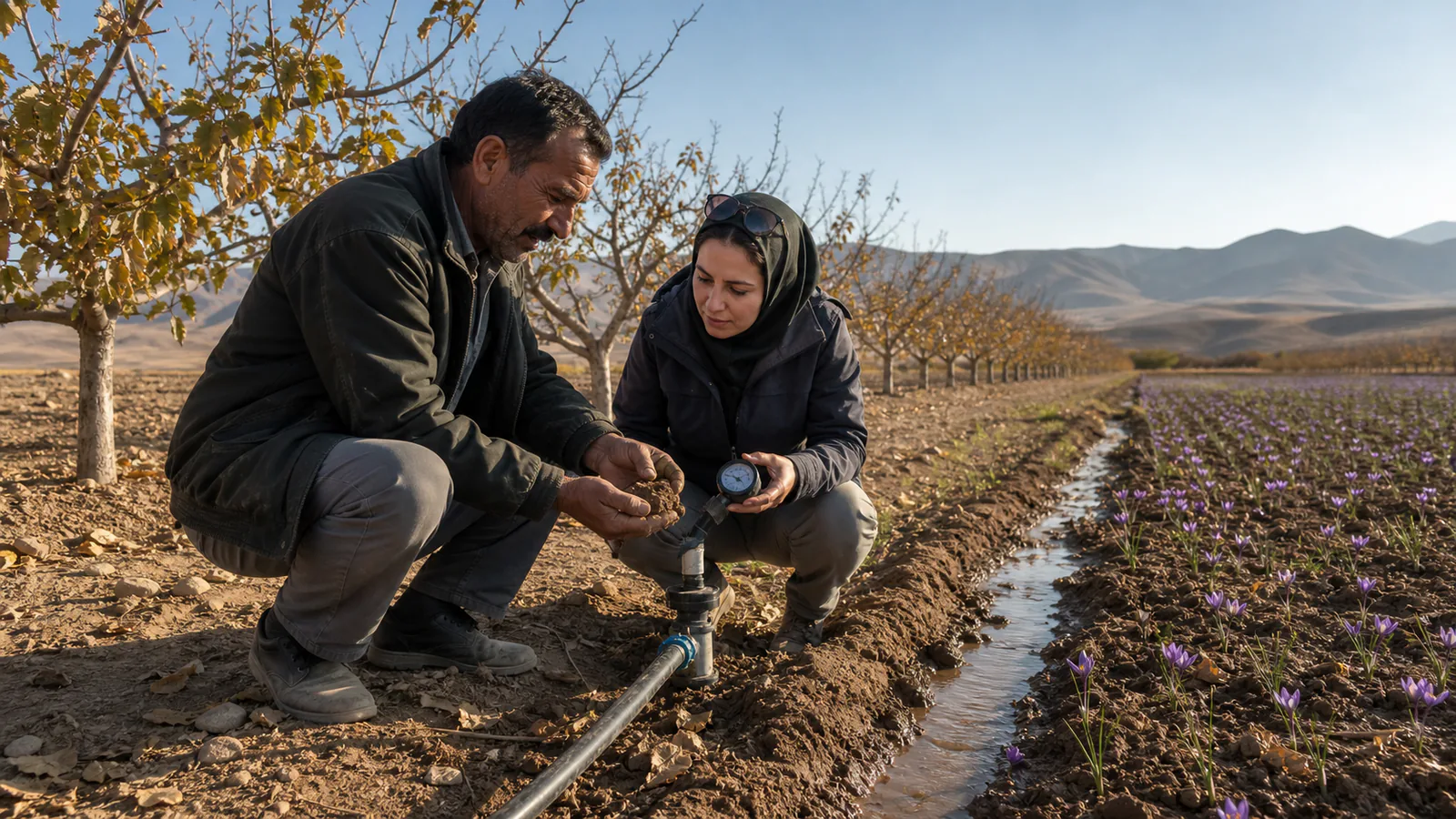
Perfect replacement for saffron pistachio is the original headline of a 2013 report from Kerman Province. Its word order is confusing. The proposal in the article was to consider saffron as an alternative crop on some land where water scarcity made continued or expanded pistachio production difficult. It did not show that every pistachio orchard should be removed, provide a Bardsir pistachio production total, or prove that saffron would be a “perfect” substitute on every farm.
The report remains useful because it records where saffron cultivation was expanding, the figures officials used, and the practical work they believed a change of cropping pattern required. It also needs careful reading. Some translated numbers are ambiguous, the two crops have different production systems, and a lower-water crop can still fail when soil, water quality, labour or the market is unsuitable.
Why Kerman farmers were considering saffron
According to the Iranian Students News Agency, officials were responding to limited water resources across Kerman. Saffron was attractive because its active growth falls largely in the cooler part of the year and it can produce high value from a small harvested weight. The old report also expected cultivation to support seasonal work and exports.
That case should not be reduced to “saffron needs little water.” Crocus sativus still needs well-timed moisture for establishment, flowering and corm development. A review of saffron water requirements notes its drought tolerance and high water productivity, while also explaining that satisfactory yields in dry Iranian conditions normally require irrigation. Field age, soil, climate, water quality and irrigation timing all affect the requirement.
Pistachio trees can tolerate drought, but commercial orchards remain exposed to water shortage, salinity and heat. In a 2026 account from Rafsanjan, the Food and Agriculture Organization described water shortage and climate variability as the primary local challenges and focused on practical orchard management rather than abandoning pistachios. Changing crops is therefore one option within a water plan, not a universal instruction.
The towns named in the original Kerman report
The article identified more than ten parts of the province as suitable or already active in saffron cultivation. The translated place names can be standardised as Zarand, Rabor, Ravar, Shahr-e Babak, Bardsir, Baft, Sirjan, Bam, Rafsanjan, Kerman and Kuhbanan. Zarand was described as having the province’s largest saffron area at the time.
Mahmoudi, identified as the provincial horticulture director, gave a 500-hectare distribution:
- Zarand: 160 hectares;
- Kuhbanan: 120 hectares;
- Baft: 70 hectares;
- Shahr-e Babak: 50 hectares;
- Sirjan: 35 hectares;
- Kerman: 20 hectares;
- Bardsir: 14 hectares;
- Rabor: 14 hectares;
- Rafsanjan: 12 hectares; and
- Ravar: 5 hectares.
These values add to 500 hectares, which gives the translated list an internal check. They are historical saffron-area figures, not current areas and not pistachio tonnage.
Bardsir pistachio production and Shahr-e Babak: what this page reports
Bardsir pistachio production in Kerman, Iran, and pistachio production in Shahr-e Babak, Kerman, are reasonable subjects to investigate when comparing crop choices. This historical article, however, does not provide the quantity of pistachios produced in either county. It reports 14 hectares of saffron in Bardsir and 50 hectares of saffron in Shahr-e Babak within the provincial 500-hectare total.
That distinction matters for anyone searching for pistachio production in Bardsir, Kerman. The headline connects saffron with pistachio replacement, but the body’s town-by-town numbers measure saffron cultivation. They must not be relabelled as pistachio hectares, harvest volumes or evidence that orchards in those two counties were removed.
A proper local comparison would need the orchard area and age, the well’s reliable annual yield, salinity, irrigation method, pistachio yield and alternate-bearing history, and the likely cost of keeping or rehabilitating the trees. For saffron, it would need suitable soil drainage, corm cost and health, available autumn labour, expected field age, drying capacity and a conservative sales route. The old article does not supply that farm-level evidence.
What the provincial expansion plan said
Saeedi, then head of Kerman’s Agricultural Jihad Organization, said about 500 hectares were under saffron and that another 605 hectares were planned. He linked the expansion to water shortage and to a wider review of the provincial cropping pattern.
For the additional area, the report estimated a need for 3,630 tonnes of saffron corms and a credit of 121 billion rials. It said officials were coordinating with private suppliers for towns unable to obtain enough planting material. Those were plan inputs, not confirmation that all 605 hectares were eventually planted.
The account placed the start of the crop year in Mehr 1392, which spans September and October 2013. It reported 2,460 kilograms of saffron worth 123 billion rials as extracted and supplied to the market during the period. The article does not define whether that value was farm-gate, wholesale or another measure, so it should not be converted into a current price.
Saeedi also spoke of 20 jobs per hectare during a cultivation period. Another translated sentence referred to about 200 person-days per hectare during harvest. Neither figure supports a claim of 20 or 200 permanent full-time jobs. Saffron concentrates substantial hand work into planting, flower picking, stigma separation and drying, and labour should be budgeted by task and day rather than advertised as a permanent headcount.
The Zarand figures provide a useful cross-check
Seyyed Ali Amiri, identified as Zarand’s agricultural director, named Dashtkhak, Sarbanan, Jarjafak and Hotkan as saffron-producing areas. The report put their combined planted area at about 170 hectares and forecast a harvest of roughly 800 kilograms, with an average of four to five kilograms per hectare.
Multiplying 170 hectares by four to five kilograms gives a range of 680 to 850 kilograms, so an 800-kilogram forecast is arithmetically consistent with the stated area and yield. This does not prove the field survey or final harvest, but it shows that those three figures were probably intended to describe the same Zarand season.
The article said Zarand’s saffron area had increased by ten hectares and described seasonal harvest employment as 12,000 person-days. Its old English rendering said “12 thousand people daily,” which would be a very different claim. Person-days is the cautious interpretation; no daily worker count or payroll record accompanied the report.
One provincial yield appeared in translation as 15.6 kilograms per hectare. That may be a decimal value or a collapsed range such as 1.5–6, and it conflicts with the clearly stated Zarand average of four to five. Without the original table or notation, it should not be used as a precise benchmark.
A replacement decision begins with the water account
A farmer cannot compare an established tree orchard with a new saffron field using a slogan about water. The first calculation is how much usable water the holding can supply during each crop’s critical stages, not merely the annual entitlement. Water quality matters alongside quantity. Salinity can reduce saffron performance and damage pistachio orchards, although the two crops respond differently.
Saffron also changes the timing of demand. Flowering creates an intense autumn labour requirement, when every day of delay affects handling quality. Pistachio orchards demand year-round management and represent a long-lived capital asset. Removing mature trees destroys that asset immediately, while a saffron field takes time and healthy corms to establish.
A sensible trial starts on a suitable, limited plot. Record the water applied, corm source and size, planting density, labour hours, flower weight, dried stigma yield, drying loss, test results and actual selling price. Compare net return after corms, land preparation, irrigation, labour, drying, storage and rejected material. One good harvest is not enough to justify a whole-farm change.
Training and drying were part of the plan
The Kerman programme was not described as seed distribution alone. It included fast-return facilities for establishing saffron fields, classes on cultivation and hygienic harvest, and special credit for mechanised drying equipment. Rastegari, the provincial extension director, said workshops covered planting, harvesting, pests and diseases and had reached 136 saffron farmers.
That detail is important. A larger planted area can produce a weaker result if flowers wait too long before separation, dryers are overloaded or unrelated lots are mixed. Equipment must be commissioned for the intended batch size and operators need a repeatable method. Training attendance shows that advice was offered; only field adoption and measured lots show whether it worked.
The source also named packaging, international marketing, smuggling and the cost of traditional harvesting among the obstacles. These are commercial and operational risks, not agronomic footnotes. A grower needs a credible buyer and post-harvest route before committing land and corms.
Saffron can complement pistachios without replacing every orchard
Kerman’s agricultural economy includes pistachios, walnuts, cumin and other crops adapted to different districts and holdings. Saffron can diversify income and shift some production into a cooler growing season. It may suit parcels where the water schedule, soil and labour fit. Barberry was also mentioned as a possible crop for colder parts of Zarand.
None of that makes healthy pistachio trees disposable. FAO’s work with Rafsanjan growers shows another route: improve orchard resilience through better monitoring and research-based practice where pistachio remains viable. On some farms the answer will be orchard improvement, on others a saffron trial, and elsewhere a mix of crops rather than a single replacement.
The historical Kerman report captured a real response to drought, but its headline promised more certainty than the evidence allowed. Saffron is a candidate in a farm-specific transition. The decision becomes defensible only after water, soil, labour, capital and market results have been measured on that farm.
Sources and further reading
- Water scarcity and the pistachio predicament, Food and Agriculture Organization of the United Nations, 23 February 2026.
- Saffron water requirements, peer-reviewed book chapter, 2020.
- Crop and pan coefficients for saffron in a semi-arid region of Iran, Journal of Arid Environments, 2008.
- Saffron in water-scarce regions, a practical guide to the limits behind the low-water description.

![Exporting Saffron to Turkey + Price Guide [Complete 0 to 100]](https://img.rowhanisaffron.com/20260827003933/saffron-export-turkey-quality-inspection.webp)



