


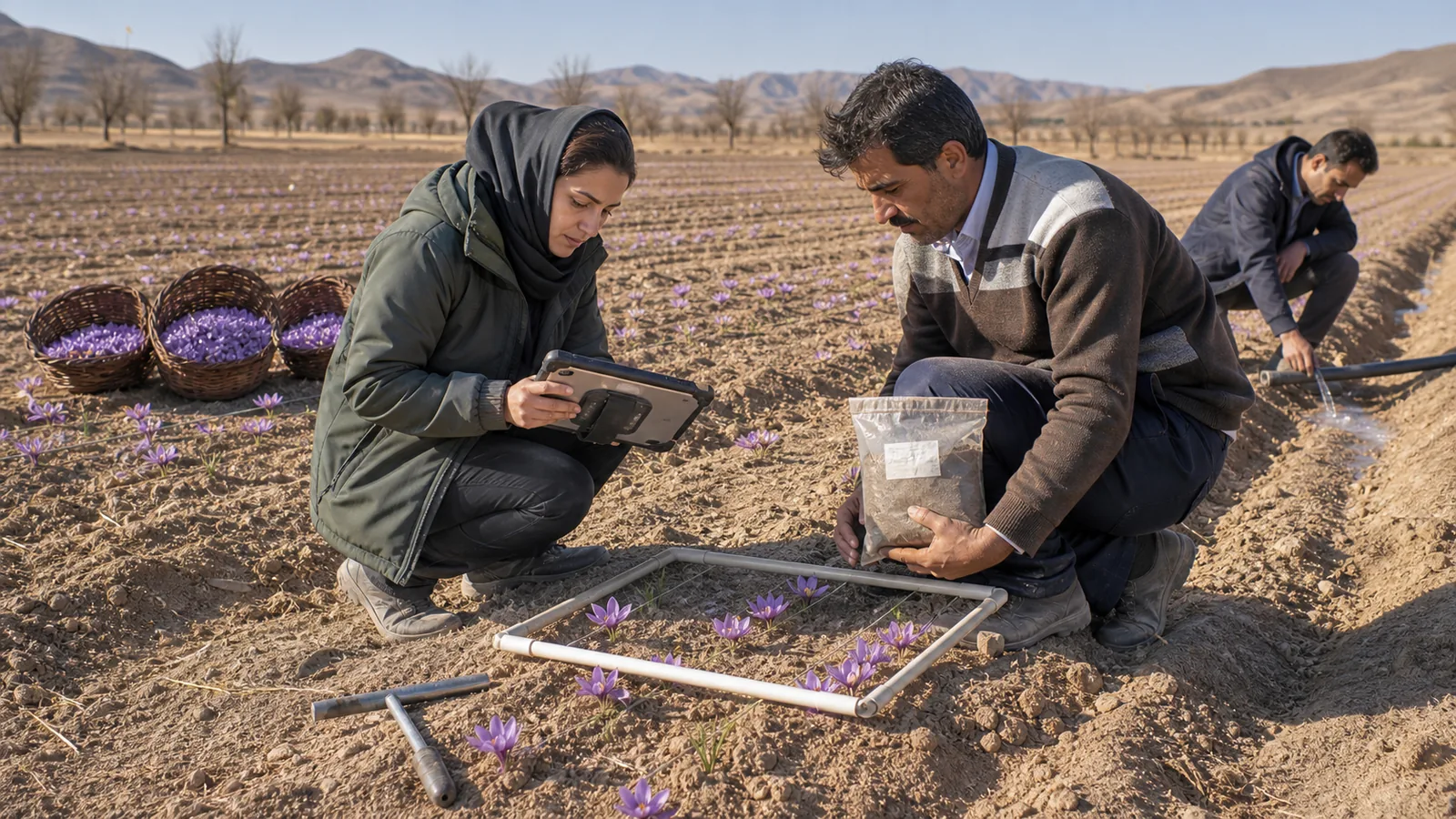
Monitoring “UNIDO” to improve saffron fields referred to a 2015 project in Gonabad, not to surveillance or an international certification of individual farms. The United Nations Industrial Development Organization and local Agriculture Jihad specialists planned to follow field and post-harvest improvements through a network of rural saffron producers.
The announcement named training, local coordination and a standard dryer, but did not publish results. This article preserves the historical record and explains what evidence a monitoring programme needs before it can claim that saffron fields or the finished product actually improved.
The Gonabad project and its 17-county setting
Mohammad-Bagher Jahedi, then director of Agricultural Jihad in Gonabad, told the Iranian Students News Agency that the project began as saffron harvesting and processing started. UNIDO monitors and local agricultural experts were to work in Gonabad and, in parallel, in 17 saffron-producing counties across Razavi Khorasan and South Khorasan.
The stated goal was better quality and quantity through a network of rural saffron operators. The network mattered because a field recommendation only has value when growers can understand it, test it under local conditions and report what happened. The same is true after harvest: training, processing equipment and packaging have to stay connected to identifiable batches.
Fatemeh Gavahi Kakhki, identified as manager of Gonabad’s Red Gold Operators Network, said an office had been formed at the Kakhk saffron education, processing and packaging centre. Specialist training activity had begun in Kakhk, Sanou and Zibad. The source also said UNIDO experts would soon install and commission a standard saffron dryer at the network site.
“Would soon” is important. The report announced a planned installation; it did not confirm that the dryer arrived, passed commissioning, processed a stated volume or improved a measured quality result.
The scale the network was meant to serve
The historical account put Gonabad’s saffron area at about 3,500 hectares and its production capacity above 14 tonnes of dried saffron. Capacity is not the same as actual harvested output. It describes what the local system was believed capable of producing under the period’s assumptions.
From the first of Aban to the middle of Azar—roughly late October to early December—the article said about 12,000 households participated in collecting and processing the crop. It did not call them 12,000 permanent jobs or 12,000 farm owners. The number described seasonal household involvement across an intense harvest and post-harvest period.
That concentration creates the case for monitoring. Thousands of small decisions about picking, transport, stigma separation, drying and storage occur within weeks. A programme needs comparable records if it is to distinguish a useful practice from a good harvest caused by weather or a better field.
Monitoring should start with a baseline
A field cannot be described as “improved” unless its starting point is recorded. At minimum, the baseline should identify the farmer and plot, field age and area, corm source and condition, planting arrangement, soil and water evidence, irrigation practice, input history, previous flower and dry-stigma yield, and the method used to dry and store the product.
Definitions must stay stable. Fresh flower weight cannot be compared directly with dry stigma weight. A farmer’s estimate and a measured lot should not be merged. If area, sampling method or the farms in the network change, the report needs to say so.
UNIDO’s 2014 diagnostic of Iran’s saffron value chain described weaknesses across cultivation, farmer coordination, processing, packaging and market relationships. That wider diagnosis supports a chain-based monitoring design: field yield alone does not show whether quality survived drying or whether the producer gained a stronger route to market.
What to monitor in saffron fields
Useful field monitoring follows decisions that can be acted on:
- Planting material: corm source, health, size distribution, density and field age;
- Soil and nutrition: representative sampling, amendments actually applied and the reason for each application;
- Water: source, quality, dates and quantities where measurement is practical;
- Crop condition: emergence, flower count, weeds, disease, pest damage and weather events;
- Harvest: dates, labour available, flower weight and delay before separation;
- Yield: dried stigma weight from a defined field and moisture condition; and
- Traceability: a lot identifier that remains with the product through drying, storage and sale.
These records are not a quota for paperwork. The smallest workable set is better than a long form that nobody completes accurately. Field advisers also need a comparison group or several seasons where possible, because saffron yield varies with field age and weather.
The dryer needed its own evidence
A “standard dryer” is not proven by the machine’s label. Commissioning should confirm that it reaches and holds intended conditions, handles the stated batch size safely, can be cleaned, and does not create cross-contamination. Operators need a repeatable method for loading, time, temperature, cooling and protected storage.
Evaluation should compare the new process with the previous local method using representative lots. Relevant measures include final moisture, colour-related crocin response, picrocrocin- and safranal-related characteristics, contamination controls, rejected material, processing time, energy use and labour. Buyer acceptance and lot traceability matter alongside laboratory results.
The old announcement gives no such commissioning or before-and-after dataset. The absence is a reporting limit, not proof that the equipment failed. It means the project cannot be scored from the announcement alone.
Training is an intervention, not an outcome
Counting workshops or participants shows reach. It does not show that practice changed or that saffron improved. A stronger evaluation asks whether growers adopted a recommendation correctly, whether that change persisted the following season, and whether results improved without shifting an unacceptable cost or risk elsewhere.
Network governance matters here. Farmers need a way to question advice, report a failed recommendation and see how decisions are made. The programme should state who owns field and lot data, who may use it, and how individual records are protected. Buyers or officials should not treat network membership as a quality certificate unless a separate, defined certification system exists.
How the historical UNIDO description should be read
The original article noted that UNIDO was established in 1966, became a specialised United Nations agency in 1985 and is headquartered in Vienna. It described 172 member states and an Iran office opened in 1999, working with ministries, public and private bodies, civil society and research institutions through six strategic areas.
Those details belong to the period. UNIDO’s current official site lists 173 member states and describes five complementary functions: technical cooperation, policy and statistical advice, work on norms and standards, convening and partnership development. Its present mandate is inclusive and sustainable industrial development. Current institutional facts do not prove that the 2015 Gonabad activity continues.
What the 2015 announcement did not establish
The report does not provide a list of all 17 counties, the number of enrolled farms, field baselines, training attendance, dryer specifications, installation record, laboratory results, cost per kilogram, buyer response, farmer income or a final evaluation. It also does not show that UNIDO certified any field or saffron lot.
Those gaps should stay visible. A development project can be worthwhile and still require evidence before its effect is claimed. For the full dated narrative of the Gonabad network and UNIDO’s Iranian saffron diagnostic, see Monitoring “UNIDO” to improve farms. This page serves the complementary purpose: it turns the word “monitoring” into a concrete field-to-dryer evidence plan.
The practical standard for improvement
An improved saffron field should show a measured gain that matters to the grower and buyer—such as stable yield, better usable quality, lower loss, safer handling or stronger traceability—without hiding the cost, water use or changed risk. The claim should name the baseline, farms, season, method and uncertainty.
In that form, monitoring is not inspection theatre. It is the feedback loop that tells farmers, advisers and processors which changes deserve to continue and which need to be revised.
Official sources
- Saffron Industry Value Chain Development in Iran: Diagnostic Study Report, UNIDO (2014).
- Who we are, UNIDO current mandate and functions.

![Exporting Saffron to Turkey + Price Guide [Complete 0 to 100]](https://img.rowhanisaffron.com/20260827003933/saffron-export-turkey-quality-inspection.webp)



