


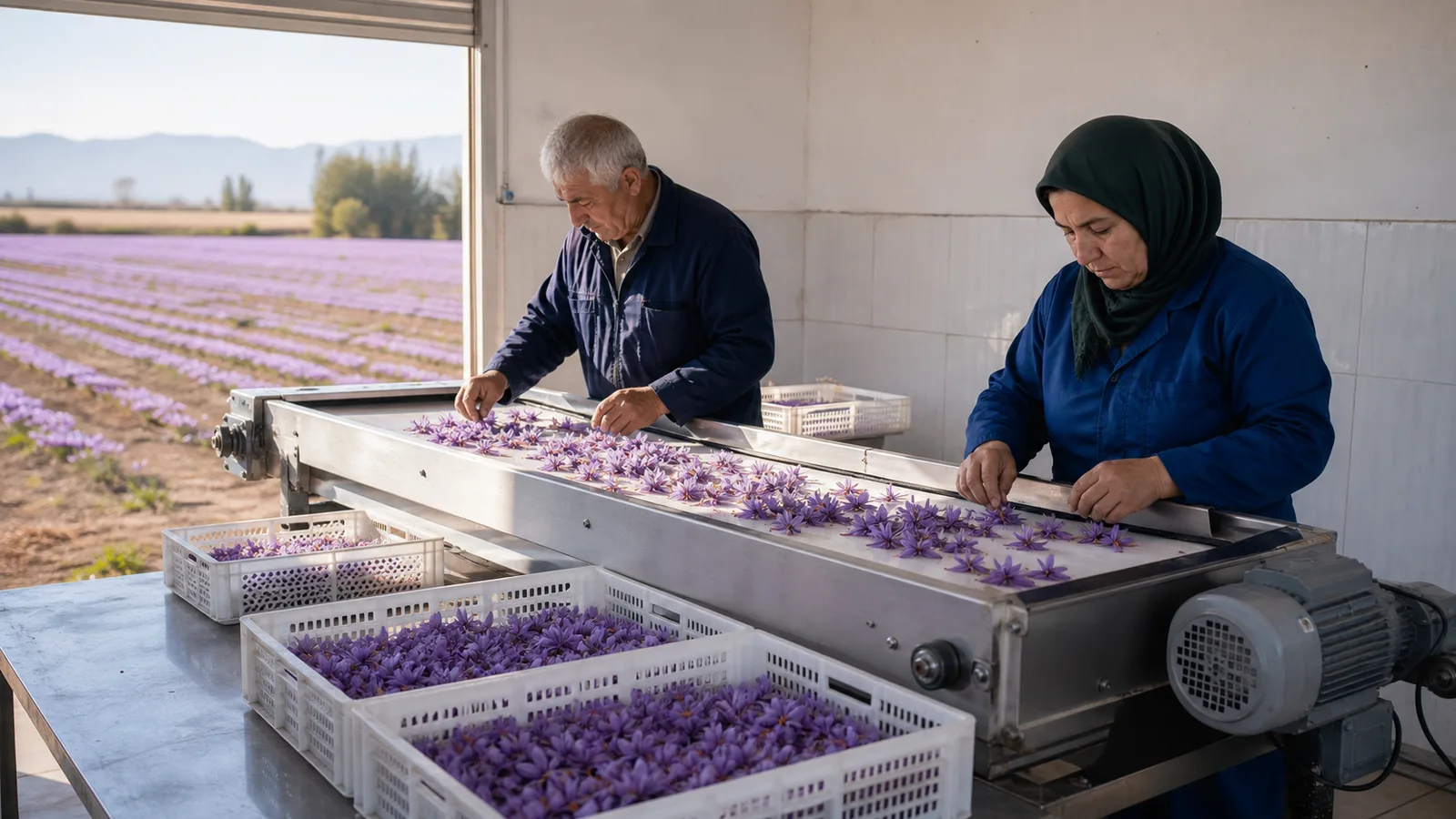
“Mechanized harvesting saffron to favor production” was the central argument in a 2015 Khorasan Razavi agriculture briefing. Engineer Sabour Bilandi, then the province’s deputy for crop-production improvement, said carefully chosen machinery could raise efficiency and protect quality. He also acknowledged the harder side of that choice: a technology programme had to consider farm employment as well as output and exports.
This is a historical report, not a description of today’s machinery grants, crop area or purchase prices. The inherited English copy also damaged several names, dates, units and currency labels. The figures below are retained because they form the record of the briefing, but unclear translations are identified instead of being silently converted into apparently precise facts.
Why saffron mechanization was the focus
According to the report attributed to the Khorasan bureau of the Iranian Students News Agency (ISNA), Bilandi spoke at a provincial Agriculture Department press conference dated 25 June. The old translation rendered his name as “Mohammad patient Bilandī”; other contemporary references identify the official as Engineer Sabour Bilandi, without establishing a first name securely enough to add one here.
His point was not that every hand operation should immediately disappear. Mechanization from cultivation through harvest could improve consistency and reduce pressure during a short season, he said, yet poorly planned adoption might also reduce agricultural jobs. For saffron, that tension was especially visible because the report put labour and related operations at about 75% of production cost.
Bilandi linked the decision to a broader competitive problem. Other countries were planting saffron, while Iranian saffron corms were reportedly being smuggled abroad. In his view, policy had to balance local employment with export growth and the defence of established markets. Machinery was a way to support a strategic crop, not a substitute for a market plan.
What mechanized harvesting saffron actually involves
Saffron production is a chain of very different jobs. Ordinary farm equipment can help prepare beds, manage soil and lift corms. Purpose-built tools may assist planting, flower collection, movement from field to workroom, stigma separation and controlled drying. Flower picking remains unusually delicate because blooms emerge close to the ground, appear over a short period and need prompt handling.
A research review on mechanization of saffron production makes the same distinction: existing equipment can handle several field operations, whereas planting and harvest require specialist designs. Mechanization can lower labour pressure and may reduce contamination during flower and stigma handling, but those benefits depend on the machine, operator and process.
Field harvesting and indoor flower processing should not be confused. A portable picker assessed by Iran’s Agricultural Engineering Research Institute collected 5.5 kilograms of flowers per hour. In the same FAO AGRIS research record, a flower-cutting machine processed 4.85 kilograms per hour with a reported 2.51% cutting error. Those results describe evaluated devices, not a universal rate for every farm.
Another peer-reviewed prototype used computer vision to locate the cutting point and worked about eight times faster than the manual method in its tests. The automated cutting study concerned removing stigmas from collected flowers; it was not a combine driving through a commercial saffron field. That distinction matters when judging claims about a “fully mechanized” harvest.
Quality still depends on timing and gentle handling
A useful machine must collect or process flowers without crushing them, mixing soil and leaves into the load, or delaying stigma separation. It also needs to work at the pace of flowering rather than forcing growers to harvest immature blooms or leave open flowers exposed. Throughput alone is not a quality measure.
The safest practical sequence is to plan each stage separately: prepare a level field suitable for equipment; keep rows and access paths consistent; pick at the correct maturity; move flowers promptly in shallow, clean containers; separate stigmas accurately; and dry them under controlled conditions. A weakness at the end of that sequence can erase a gain made at the beginning.
Readers planning a crop can compare these machinery questions with our guide to saffron cultivation and plant care. Field shape, corm depth, irrigation and access all affect whether a particular device will help or merely add cost.
The province’s mechanization credit
The briefing compared two provincial credit allocations as 80 billion for the current year and 52 billion for the previous year. The inherited English article labelled both amounts “USD,” which is not credible for the local programme described and is almost certainly a translation error. The surviving copy does not provide a dependable original currency, so the numerical comparison is preserved without inventing one. Bilandi said applicant cities had been notified so they could seek their allocation.
He presented mechanization and newer technology as routes for developing both agriculture and horticulture. His concern was that production systems which failed to modernize could lose their position. That is an argument for selecting equipment around a real bottleneck, however, not for buying machinery simply because funding exists.
Greenhouse development needed an export market
The press conference ranged beyond saffron. Bilandi reported 184 hectares of greenhouse cultivation in Khorasan Razavi: 150 hectares for vegetables and summer crops and 27 hectares for ornamental plants. Those categories add to 177 hectares, leaving seven hectares unexplained in the source. It would be misleading to force the totals to agree.
He counted 879 greenhouse units and 3,719 direct jobs, with another 70 hectares planned for that year. Asked whether the province could reach 1,000 hectares by Persian year 1404, he said the physical expansion was possible but should be tied to dedicated facilities, export arrangements and identified target markets. Expansion without a route to market, he warned, would not be useful.
The inherited passage also says hydroponic greenhouses held “first place” with 40% coverage across the country. It does not make clear whether that ranking and percentage referred to Khorasan Razavi, a greenhouse type or another measure. The statement therefore remains part of the historical record, not a verified national ranking.
Wheat purchases, rainfall and mechanized combining
Bilandi said guaranteed purchases had reached 93,300 tonnes of farmers’ surplus wheat, an increase of 200% over the previous year at that point. He forecast provincial wheat output of 664,000 tonnes and expected 410,000 tonnes to be surplus eligible for guaranteed purchase. These were interim figures and a forecast, not a final harvest account.
The province had avoided major frost and heat damage, according to the report. It gave total wheat area as 193,000 hectares and then referred to 125,000 hectares in a sentence damaged in translation. That second number may have described irrigated wheat, but the surviving wording does not prove it, so it should not be relabelled as such.
Rainfall through 22 June was reported as 202 millimetres, 22.8% above the previous year and 3.8% below a comparison period. The English copy calls that period “last month,” an unlikely basis for the comparison; it may have meant the long-term average. What can safely be retained is Bilandi’s conclusion that crop conditions looked better than in the preceding year.
About one-third of the wheat area or production was associated with improved seed in the report. More than 20,000 tonnes of improved seed for irrigated and rain-fed farming were said to be available, and the four-year goal was 75%. Again, the first denominator is not clear enough in the translated text to manufacture a more exact claim.
Harvesting involved 540 resident combines and 600 visiting combines. Bilandi estimated that machinery handled 80% of the province’s wheat and barley harvest. Unlike saffron flowers, cereal crops are well suited to conventional combining; the figure illustrates why “mechanization” cannot mean the same machine or maturity level for every crop.
Barley and pest-control figures that need caution
The barley paragraph is the most badly damaged part of the inherited report. It gives an irrigated and rain-fed area of “160 hectares,” followed by a guaranteed purchase of “55 tons” at “920 USD.” In the provincial context, one or more missing thousands and a mistranslated local price unit are likely. Without the Persian source, changing the record to 160,000 hectares, 55,000 tonnes or a particular rial price would still be guesswork. These numbers should not be used for planning or historical comparison.
A separate figure is clearer: weed and pest-control work had been carried out across 245,000 hectares of wheat and barley land that year. The report does not identify each pest, product or treatment. It therefore supports the area reported as treated, not a claim about residue status, pesticide absence or the success of every intervention.
The “healthy crops” certificate programme
Bilandi also described an incentive programme for healthier crop production, said to have begun in Persian year 1390. The briefing recorded 27 licences in 1390, 47 in 1391, 210 in 1392 and 667 in the year before the interview. The old translation repeatedly uses the word “butterfly,” evidently a literal error for a permit or certificate.
It then associates 135,000 tonnes of melons, tomatoes, potatoes and other produce with only 74 hectares. That area and output do not form a plausible pair at face value. The area may have lost “thousand” in translation, but this article does not silently add it. Both inherited numbers are retained with the discrepancy stated.
Integrated pest-management work covered 37,277 hectares in crop year 1393–94, according to the briefing. Bilandi described biological and mechanical controls alongside pesticide management and estimated that 90% of provincial production had the potential to qualify for the programme. “Potential to qualify” is not the same as already certified, pesticide-free or organic.
What survives from the original argument
The strongest part of Bilandi’s case is not any single budget or production number. It is the idea that mechanization should solve a defined production problem while respecting quality, work and market demand. Saffron growers face a concentrated flower season and costly manual handling. Appropriate machinery can ease those pressures, but only when it is accurate, clean, serviceable and matched to the field.
That also explains why the greenhouse and cereal sections belonged in the same briefing. Greenhouse expansion without buyers, improved seed without clear denominators, and machinery without suitable crop conditions can all create impressive statistics without a durable result. The policy test is what happens to the product and the people after the equipment arrives.
Mechanized harvesting saffron can favor production when it protects the bloom, shortens handling delays and helps skilled workers manage the seasonal peak. It can harm value when speed replaces care or when an untested machine is treated as a complete system. The practical goal is not automation for its own sake. It is better saffron, handled on time, with a market ready for it.

![Exporting Saffron to Turkey + Price Guide [Complete 0 to 100]](https://img.rowhanisaffron.com/20260827003933/saffron-export-turkey-quality-inspection.webp)



