


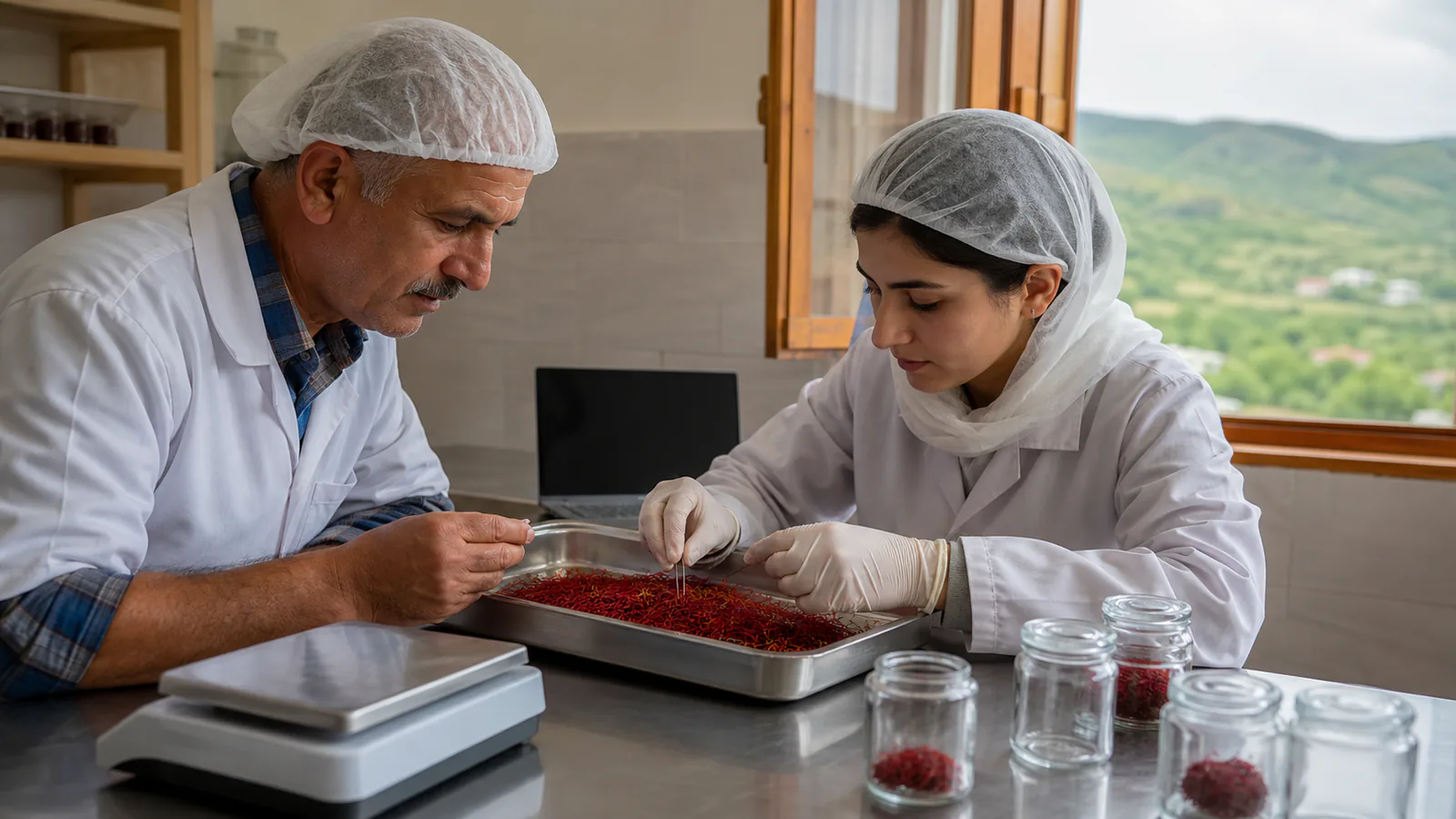
Developing knowledge-based saffron industries in Namin means building more than fields. It requires local trials, trained growers, clean post-harvest work, quality testing, traceable packaging and products designed for a real market. Without that chain, expanding cultivation alone can leave farmers with risk rather than durable income.
The idea appeared in a 2016 report from the chamomile-flower festival at Fandoghlu Forest in Namin County, Ardabil Province. Provincial officials presented saffron, medicinal plants, honey, handicrafts and tourism as connected opportunities. The language was ambitious; the useful question today is what would turn that ambition into a working local industry.
The Fandoghlu festival that framed the proposal
The report described more than 10,000 people attending the festival, with some families camping in the area for two days. Fandoghlu’s landscape and chamomile flowers were the immediate attraction, while the programme was designed to introduce Namin’s tourism potential, crafts and local foods.
More than 20 stands reportedly displayed handicrafts, visual arts, traditional cuisine and economic products. Music, poetry and youth gymnastics were part of the public programme. Namin’s carpet weaving was singled out as a skill with a wider reputation, and officials invited investors interested in nature tourism and local production.
Saffron entered that discussion as a possible knowledge-based crop deserving government support and farmer facilities. The same speech used honey packaging as a simple example of value addition: selling smaller, convenient jars instead of only three- or four-kilogram containers could make a local product accessible to more buyers.
What “knowledge-based” should mean for saffron
Start with evidence that the crop fits the site
Namin’s county-wide potential cannot establish that every field suits saffron. A pilot needs soil texture, drainage, salinity, water quality, temperature and frost records. Corm health and local labour availability matter just as much as climate.
A small trial plot followed for several seasons is more informative than a promotional target. Records should include planting material, field operations, irrigation, flower weight, dry stigma yield, quality results, labour hours and sale price.
Make post-harvest handling part of the business
Flowers have to be collected promptly, separated hygienically and dried under controlled conditions. A local workshop needs food-safe surfaces, clean containers, documented lots, moisture control and staff training. These are not decorative extras; they protect the aroma, colour and safety for which the crop is sold.
Test identity and quality
Saffron’s value makes adulteration a persistent risk. A knowledge-based chain should be able to identify a lot, trace it back to suppliers and verify the promised grade with suitable laboratory methods. The current FAO–Iran saffron programme emphasises authenticity, supply-chain management, standardisation and quality control for exactly this reason.
Design packaging around use
The honey example at the festival applies directly to saffron. Customers normally use the spice in very small quantities. Packaging should protect it from moisture, light, contamination and substitution, while offering a practical unit for the intended buyer.
Good packaging carries clear identity and traceability information. It should not make medical promises or use an ornate box to conceal an unverified product.
Develop products only when their value is real
Innovation may include measured portions, food-service packs, tested extracts, beverages or other saffron-derived products. Each format brings different safety, shelf-life, labelling and regulatory requirements. A new product is valuable when it solves a buyer’s problem and can be produced consistently—not simply because it sounds advanced.
Why Namin needs a local value chain
Rural products often lose value when they leave the farm in bulk and return as branded goods made elsewhere. Local cleaning, grading, testing and packaging can keep more skilled work in the county. Cooperatives or shared facilities may help smaller growers access equipment and buyers they could not reach alone.
That does not guarantee profitability. A facility has to match real throughput, pass food-safety requirements and operate beyond festival season. Market research should come before equipment purchases.
FAO’s work on saffron now brings together growers, processors, cooperatives, traders and laboratory specialists. Its focus—from farm practice and post-harvest safety to traceability, modern marketing and digital branding—shows how broad a functioning value chain must be.
Saffron, honey, crafts and tourism can reinforce one another
The original Namin proposal was strongest when it treated local development as a portfolio rather than a single crop. A visitor drawn to Fandoghlu can encounter local honey, medicinal plants, carpet weaving and food traditions in one place. A producer can tell a regional story without pretending that every product has the same origin or standard.
For that connection to work, tourism must respect the forest and the community. Stalls need reliable provenance, realistic prices and consistent quality. Events can introduce a product, but repeat purchases depend on what happens after the visitor leaves.
A practical development sequence for Namin
- Map suitable plots. Use soil, water and microclimate evidence, then validate it with pilot fields.
- Train a first group of growers. Cover corm selection, field hygiene, irrigation, harvest and records.
- Measure real performance. Follow yield, labour, quality and profit over more than one season.
- Build shared post-harvest capacity. Size equipment to actual flower volume and food-safety needs.
- Create traceable lots. Connect farm records, testing, packaging and buyer documentation.
- Choose markets before products. Develop sizes and formats for households, retailers or food businesses with demonstrated demand.
- Use festivals as a bridge. Let tourism introduce the work, then provide a reliable route for later purchase.
From festival promise to knowledge-based industry
The 2016 festival captured Namin’s combination of landscape, medicinal plants, craft and agricultural ambition. It did not document that a saffron industry was subsequently built, so the proposal should remain a historical starting point rather than a completed success story.
A credible path is patient and measurable: prove the field, train the grower, protect the harvest, test the product and build the market. That is how knowledge-based saffron industries can grow in Iran—through evidence at every link, not through acreage alone.

![Exporting Saffron to Turkey + Price Guide [Complete 0 to 100]](https://img.rowhanisaffron.com/20260827003933/saffron-export-turkey-quality-inspection.webp)



