


An archival local forecast expected saffron production in Izeh city to rise 30% from the preceding year, with about 500 grams harvested from one hectare. The same agricultural update covered pomegranates, rice, autumn rainfall and 1,000 hectares prepared for seasonal crops.
Editorial note: “last year,” the harvest forecast and rainfall total belong to the unnamed period of Iraj Almasi’s original statement. They are not current 2026 figures.
What the 30% increase in Izeh meant
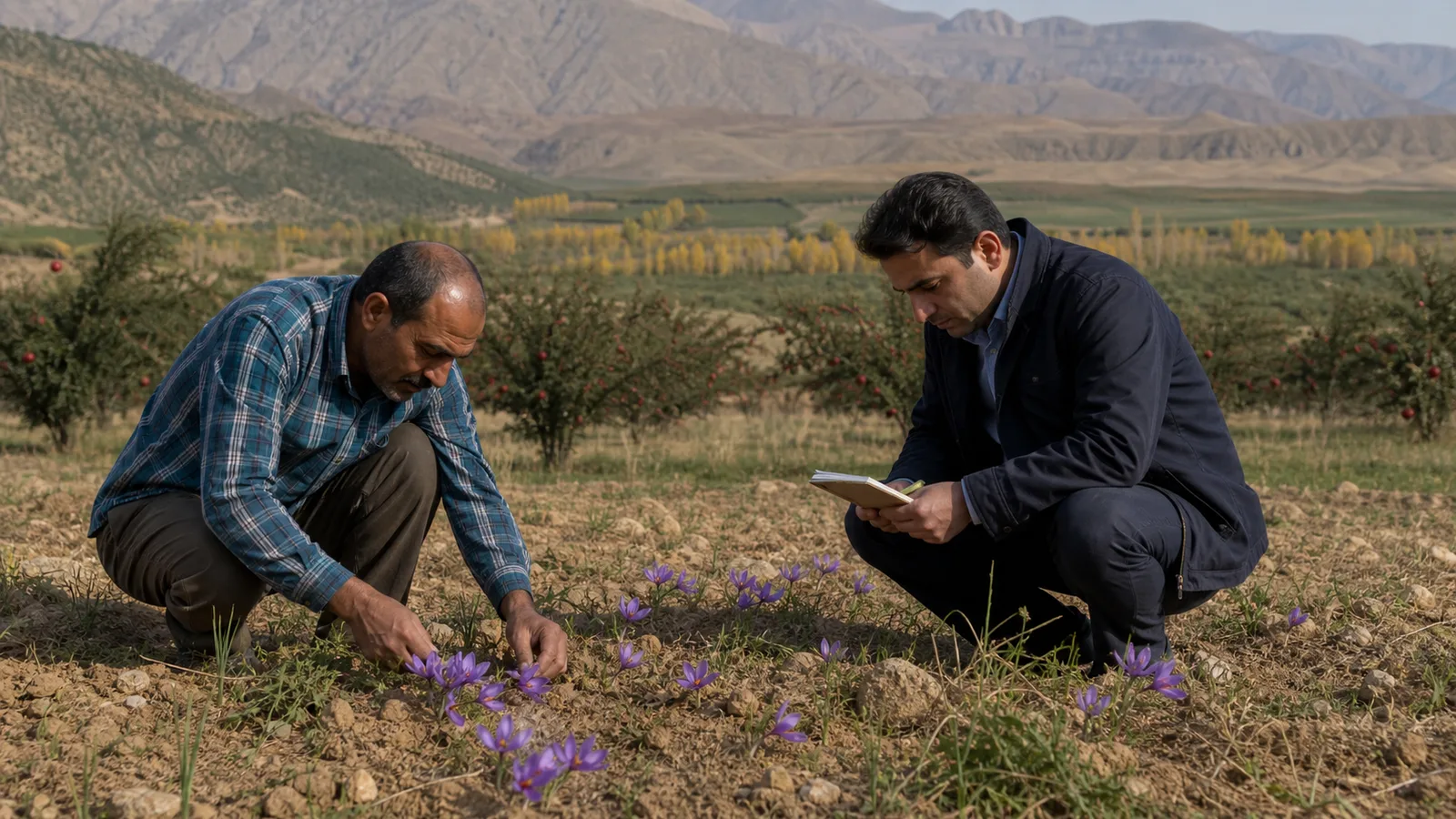
Iraj Almasi, identified as director of Izeh Agricultural Jihad, said the saffron harvest had begun and was expected to continue until the second half of December. He forecast 500 grams of saffron from one hectare and described production as 30% higher than the previous year.
A percentage by itself can sound larger than the underlying change. If the entire reported area was one hectare and the expected harvest was 500 grams, the programme was small. The archived copy does not give the previous year’s weight, planted area or final measured harvest, so it cannot show whether the 30% reflected higher yield, more planted land or both.
Nor should 500 grams per hectare be treated as Izeh’s permanent yield potential. Saffron fields often change substantially as daughter corms multiply and the stand matures. Corm size, planting density, field age, soil, irrigation, weather, nutrition and harvest timing all affect dry-stigma yield.
Why a one-hectare saffron crop still mattered
The production volume was modest, but a local trial or early commercial field can answer practical questions before expansion: whether flowering fits the climate, when irrigation is needed, how much harvest labour is available, how flowers will be separated and dried, and whether buyers reward the finished quality.
A 30% increase is useful only if quality, cost and water use move in the right direction too. Our review of Khorasan saffron yield and irrigation claims explains why a headline kg-per-hectare target needs field age, water and input context.
Harvest timing through the second half of December
Almasi said the Izeh saffron harvest would continue until the second half of December. That is a regional forecast, not a universal saffron calendar. Flowering responds to temperature, altitude, pre-flowering irrigation and the seasonal pattern of each site.
Individual flowers remain usable for a short time. They need prompt picking, stigma separation and controlled drying even if different fields across the city flower over a longer overall window. A new production area therefore needs post-harvest organisation as much as planted land.
Pomegranate production in Shivand village
The same statement said the pomegranate harvest had finished across 400 hectares in Shivand village, producing about 600 tonnes. That works out to roughly 1.5 tonnes per hectare if both rounded figures cover the same orchards.
The article did not give variety, orchard age, marketed yield, losses or a statistical year, so the figure should remain an attributed local estimate. Its inclusion shows that saffron was one small part of a much broader agricultural season around Izeh.
Rice harvest and the local market
Almasi reported that the rice harvest was nearing completion. He expected rice farmers to consume 30% of production themselves and send the remaining 70% to market.
That division was a forecast of use, not a nutritional recommendation or a measured market balance. Household consumption, seed retention, on-farm loss and saleable surplus need separate definitions in a formal crop report.
What 61.7 mm of recent rain changed
Recent rainfall in Izeh was reported at 61.7 mm. Almasi called that amount very good and said it had prepared agricultural land for autumn cultivation.
Rainfall totals need a measurement period and station before comparison. Agronomic benefit also depends on when rain fell, how quickly it infiltrated, prior soil moisture, runoff, erosion and the needs of each crop. The archived 61.7 mm number cannot be used as today’s field condition.
One thousand hectares prepared for autumn crops
The director said 1,000 hectares of Izeh land had been prepared for autumn sowing. The planned main crops were:
- wheat;
- barley;
- canola; and
- lentils.
These crops operate at a very different scale from the one-hectare saffron programme. Comparing them is still useful: saffron offers high value per unit weight and autumn labour demand, while grains, oilseed and pulses serve other farm, household and market needs.
What can be concluded from the Izeh report
The original update supports a narrow conclusion: Izeh had an active saffron harvest on about one hectare and local officials expected production to rise 30%, while the wider district was moving through pomegranate, rice and autumn-crop work after 61.7 mm of rain.
It does not establish a current production trend. A proper follow-up would need the year, final saffron weight, field age, previous-year baseline, planted area, drying basis, water use and quality results. Those details would show whether the increase became a durable local crop rather than a one-season percentage.

![Exporting Saffron to Turkey + Price Guide [Complete 0 to 100]](https://img.rowhanisaffron.com/20260827003933/saffron-export-turkey-quality-inspection.webp)



