


An archived official statement said saffron export from Khorasan Razavi was proceeding “without any special problems” after roughly 160 tonnes were exported from a reported 218-tonne crop. The statement captures one historical season. It does not mean exporters face no documentation, quality, logistics or market barriers today.
The exact headline, “There is no problem in exporting saffron to Khorasan Razavi,” has earned a search impression and remains unchanged. Its wording is awkward: the article concerns saffron exported from Khorasan Razavi to foreign markets, not saffron exported to the province.
What the historical saffron export figures said
Hashem Naghibi, identified as Director of Horticulture at the Khorasan Razavi Agricultural Jihad Organization, said 160 tonnes had been exported from a total of 218 tonnes in the previous year. If both figures describe the same crop and period, exports represented about 73% of the stated volume.
The article supplies no calendar year, customs dataset, product form or export value. It also shifts between the province and Iran as a whole. The ratio is therefore useful only as arithmetic on the quoted figures, not as a current provincial or national export statistic.
Naghibi listed Persian Gulf countries, Central Asia and European countries as major destinations for Iranian saffron. “Etc.” in the original source cannot support a longer country list, and the article does not show how the 160 tonnes were divided among those regions.
What “no special problems” can and cannot mean
The phrase appears to describe the official’s view of that season’s export flow. It is not a permanent finding that saffron can cross every border without difficulty. Each shipment still depends on the buyer’s specification, food-safety controls, customs documents, packaging and labelling, payment arrangements and the rules of the destination country.
Those requirements can change. A processor or exporter should verify the current rules for the actual market and shipment rather than rely on an undated news statement.
Harvest hygiene begins before saffron reaches a factory
Naghibi said Agricultural Jihad had trained farmers on health standards during harvest. He specifically mentioned using clean collection containers and said compliance with Iranian and international hygiene standards had improved compared with the previous year.
Clean containers are important, but hygiene is a chain. Flowers should be protected from soil, dust, fuel, animals and dirty surfaces. Stigmas need prompt separation and controlled drying. Workers, tools, rooms and storage containers must be clean, and finished lots need protection from moisture, pests, odours and cross-contamination.
The archived report does not provide inspection results, laboratory data or the training programme’s coverage. Its claim of improvement should be read as an attributed statement, not proof that every farm or lot met an export standard.
Processing and packaging do not remove every risk
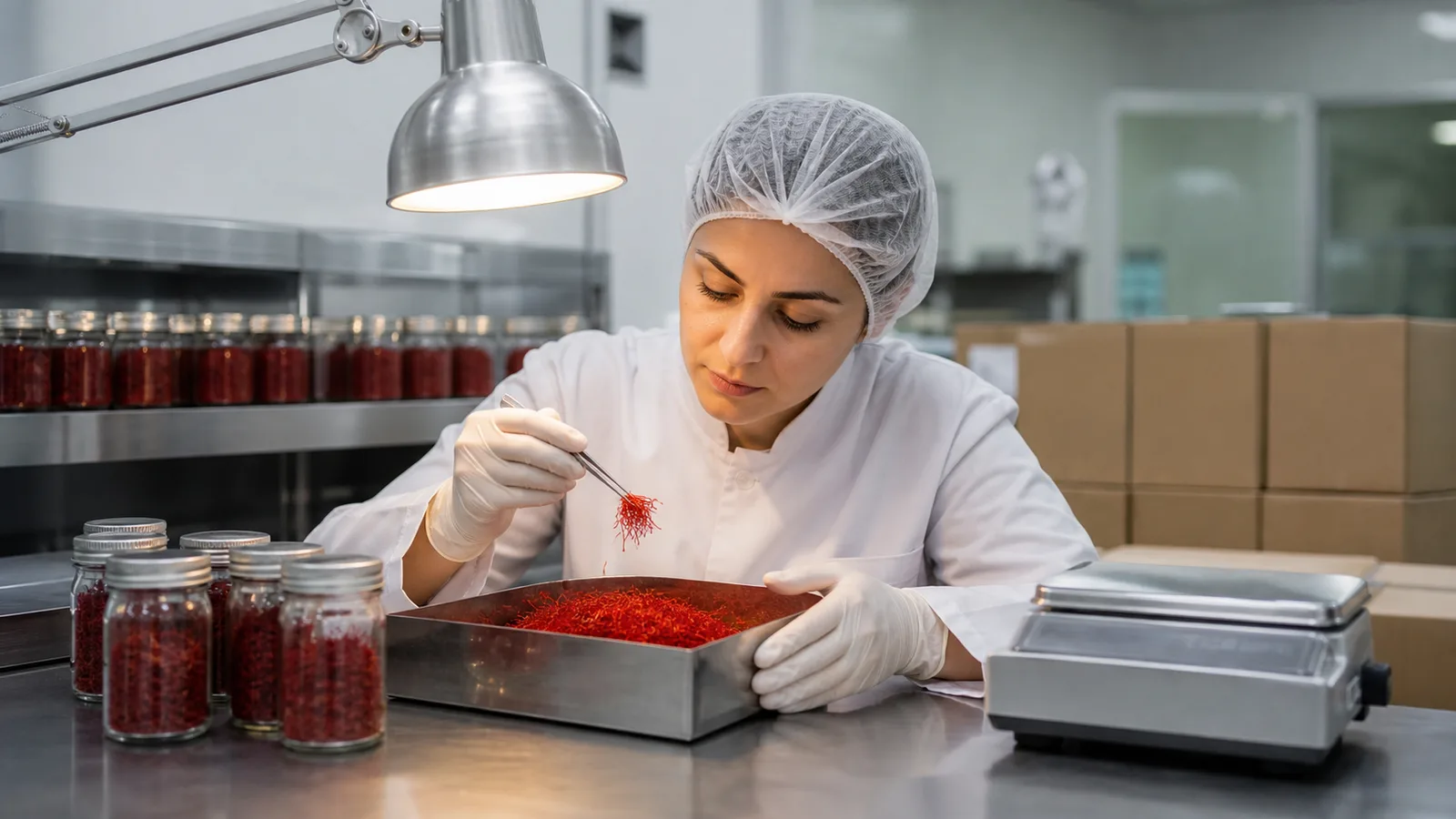
The official said saffron processing and packaging took place in factories and that efforts were made to keep the product away from contamination. A controlled facility can reduce risk, but a factory setting alone does not certify safety or authenticity.
A credible operation needs lot identity, supplier records, defined cleaning and drying procedures, calibrated equipment, suitable packaging, pest control, staff hygiene, traceable test results and a way to isolate any non-conforming batch. Those records are what allow an exporter to demonstrate control rather than merely assert it.
What an exportable saffron lot should demonstrate
The current Codex Standard for Dried Floral Parts—Saffron (CXS 351-2022) provides an international reference for product identity, styles, quality classes, defects, moisture, contaminants, hygiene, weights and labelling. The standard was adopted in 2022 and amended in 2025, so it did not exist in its current form when the archived statement was made.
Meeting a general standard is only part of the job. A buyer may set tighter limits or ask for particular analytical methods, residue testing, packaging formats and traceability. Export acceptance is decided against the applicable contract and destination rules, not a vague label such as “premium.”
Quality integrity now covers the whole value chain
A 2025 programme run by the Food and Agriculture Organization with Iran’s Ministry of Agriculture-Jahad brought farmers, processors, cooperatives and traders together around production, post-harvest handling, safety, traceability, marketing and authenticity. The programme’s scope shows why successful export cannot be reduced to the absence of a single obstacle.
For Khorasan Razavi, protecting market confidence means connecting field practice to the final pack. The origin and history of a lot should remain clear as it moves through aggregation, processing, testing, storage and sale.
The reported price and harvest delay
The final sentence links lower saffron prices to a delayed start to harvest during days of mourning. The translation does not explain the mechanism, identify the observance, quantify the delay or provide price data. It may refer to labour availability or timing of flowers entering the market, but the article does not establish either explanation.
Harvest timing is primarily driven by flowering and local conditions. A short social delay can affect picking labour or market arrivals, yet it cannot by itself explain price without evidence about supply, grade, demand and transactions. The statement should not be used as a general forecasting rule.
How to read the old export claim today
The useful part of the report is its operational sequence: hygienic harvest, clean containers, controlled processing and packaging, then export to established regions. The claim that there was “no problem” belongs to one official’s account of one unnamed year.
A current exporter should begin again with the actual lot and destination. Confirm product identity and grade, document the supply chain, test what the buyer and regulator require, use compliant packaging and labels, and check current customs and payment conditions before shipment. That is how historical export capacity becomes reliable present-day trade.

![Exporting Saffron to Turkey + Price Guide [Complete 0 to 100]](https://img.rowhanisaffron.com/20260827003933/saffron-export-turkey-quality-inspection.webp)



