


“The yellow facade of Persian saffron should be considered magenta” is a translated metaphor about restoring strength and recognition to Iran’s saffron trade. It is not advice to colour saffron threads. Iran produces most of the world’s saffron, yet production leadership does not automatically mean that Iranian farmers and businesses retain the strongest identity, customer relationships or final margin in every market.
What the yellow-to-magenta headline means
The original Persian idea appears to contrast a pale or troubled face with a healthy crimson one. In plain English, the article argues that the commercial outlook for Persian saffron should be revived. “Magenta” is an awkward literal choice for that image.
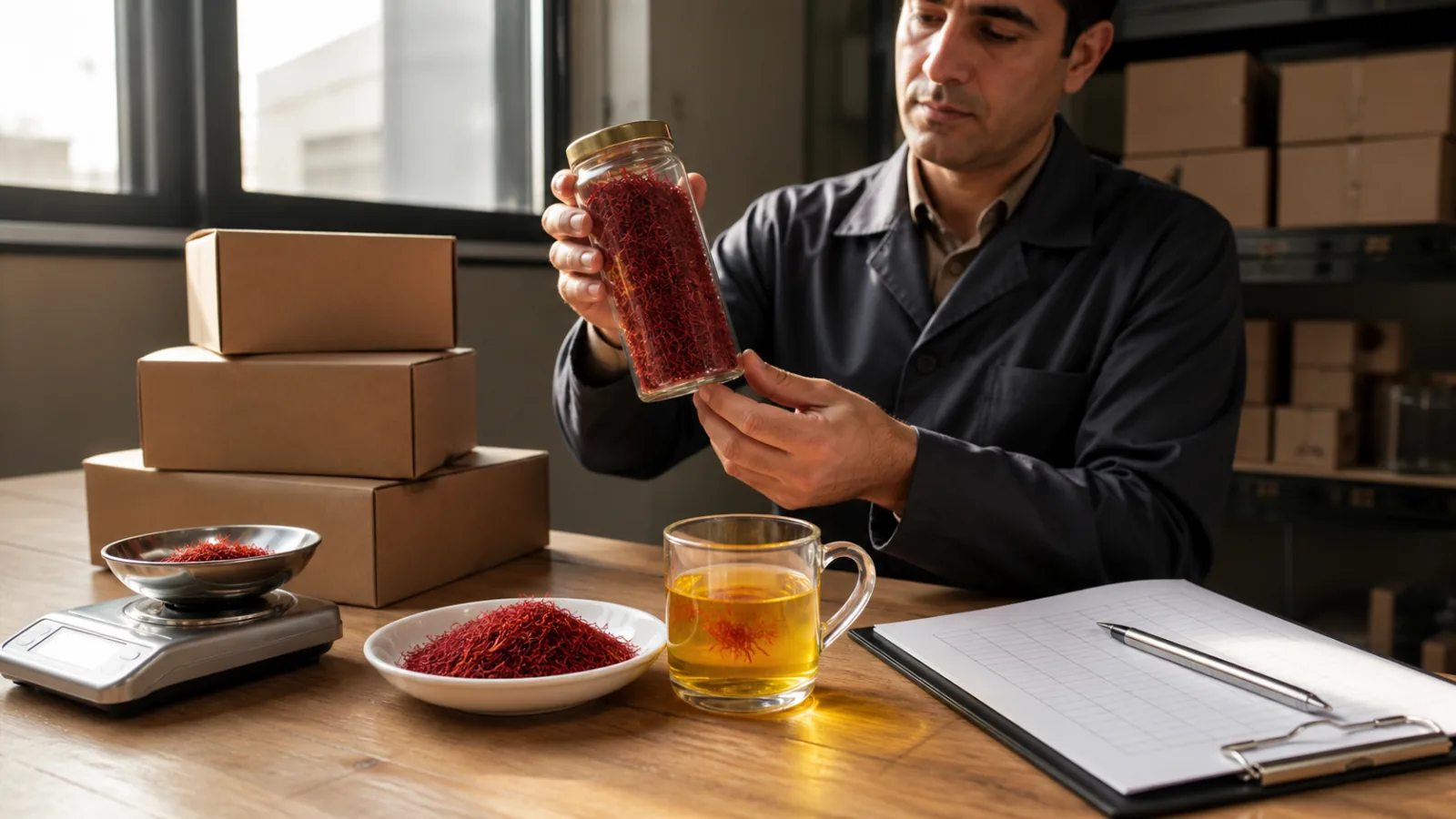
Real saffron needs no added colour. Good dried stigmas are naturally deep red, sometimes with a small amount of yellow style depending on the cut. When infused, their crocin pigments produce a yellow-to-golden liquid. Threads that bleed a harsh artificial colour immediately or have been dyed to look redder are a quality concern, not a sign of stronger Persian saffron.
Iran’s production lead is real
The 2019 article described Khorasan Razavi as the centre of Iranian saffron and assigned it about 80% of national production. That provincial share belongs to the period and source; it is not labelled with a crop year, so it should not be repeated as a current statistic.
The wider position is well supported. FAO’s page for the Qanat-based Saffron Farming System in Gonabad identifies Iran as the world’s largest producer and puts its share above 90%. The page also explains why saffron fits an arid region: its water requirements and the timing of irrigation can work with the traditional qanat system.
Production concentration gives Iran expertise, scale and a deep farming culture. It also concentrates risk. Drought, corm disease, labour shortages, poor post-harvest handling or an export disruption in Khorasan can affect a large part of global supply.
Saffron is a spice, colour and aroma—not a cure-all
Saffron is the dried stigma of Crocus sativus. Food producers use it for aroma, flavour and colour in rice, desserts, drinks, bakery products and other preparations. It has also appeared historically in dyes, perfumes and traditional medicine.
Those uses should not be collapsed into medical promises. A traditional use, laboratory result or small clinical study does not mean ordinary culinary saffron treats a disease. Commercial labels and articles need evidence appropriate to the exact claim and must follow the rules of the destination market.
The plant’s origin and Iran’s heritage are different questions
The old text calls Crocus sativus native to Southeast Asia and says it was first cultivated in Greece. Modern genetic work provides a clearer picture. A 2019 genome-wide study of saffron’s origin concluded that cultivated saffron is an autotriploid derived from wild Crocus cartwrightianus near Attica, Greece. Because it is sterile, the crop has been propagated vegetatively since its origin.
That finding does not diminish Iran’s heritage. A crop’s genetic domestication site is not the same as the place where generations of farmers refined cultivation, drying, trading and culinary use. Saffron has been part of Persian agriculture and culture for centuries, and Iran’s present production system is central to the global supply.
The original article credits Iranians with introducing saffron’s properties to Greek, Roman and Chinese civilizations and says hosts once offered gold and saffron to guests. These are broad cultural statements without a cited historical source. They are better treated as expressions of saffron’s prestige than as a documented route of transmission between specific civilizations.
Production leadership is not the same as market leadership
A farmer creates the crop, but the final retail price also pays for sorting, testing, documentation, storage, packaging, finance, distribution and customer access. If those later functions happen elsewhere, some of the margin and name recognition move with them.
The 2019 article singled out Spain, the UAE, Afghanistan and China as countries that had gained influence despite lower production capacity. Their roles are not identical. A country may grow saffron, import and re-export it, blend or pack it, serve as a logistics hub, or build consumer-facing brands. Export weight alone cannot show which role produced the margin.
For the year the article appeared, the WITS presentation of UN Comtrade data records Iranian saffron exports of about $297.2 million and 282,996 kg. The largest destinations by recorded value were the UAE, Hong Kong and Spain. These flows confirm their commercial importance, but they do not prove that every shipment was relabelled or that its Iranian origin was hidden.
What “sold under another country’s brand” can conceal
The phrase can describe several situations. An overseas company may legally import Iranian saffron and sell it under its own trademark while still declaring the product’s true origin. A distributor may pack an Iranian lot for a private-label customer. Saffron from different origins may be blended where rules allow and disclosed accordingly. At the other end of the spectrum, a label may mislead buyers about origin.
These cases should not be treated as one accusation. Repacking is a commercial activity; false origin is a truth and compliance problem. Shipment records, package labels and the law in the selling market are needed before judging a particular product.
Sanctions and export barriers change the route to market
The article said recent sanctions and export barriers encouraged indirect routes. Restrictions can affect banking, insurance, freight, buyer due diligence and the willingness of distributors to contract directly. A product may pass through a trading hub because payment or logistics are easier there.
An indirect route is not automatically improper, but it makes traceability and margin allocation more complicated. More hand-offs create more places where lot identity can be lost, documents can diverge and the producer’s name can disappear from the customer relationship.
How Persian saffron can retain more value
The commercial answer is not simply smaller packaging. Different buyers need different formats. The stronger approach is to make the Iranian offer easier to trust and harder to substitute:
- keep farm, harvest, processing and lot records connected;
- use a defined physical form and grade basis;
- provide representative, lot-specific testing where the transaction warrants it;
- protect saffron from moisture, light, contamination and odours;
- state origin and responsible seller accurately;
- design retail or bulk packaging for the buyer’s actual use;
- quote clear delivery, payment and complaint terms; and
- build direct relationships that survive beyond one harvest or price cycle.
Our review of Persian saffron and the branding gap explains the Iranian expert study behind the related packaging, fraud and cooperative recommendations. The central lesson is that a brand is evidence and repeatability before it is design.
What a buyer should see in a credible offer
A buyer should be able to identify the growing origin claimed, the lot supplied, its physical form, the net saffron weight and the date context. For a significant wholesale order, the offer should also make the sampling and test basis clear. A decorative country story cannot replace those facts.
The title’s colour metaphor works only at that level. The way to give Persian saffron a stronger commercial face is not to make it look more red. It is to ensure that the quality grown in Iran remains identifiable, verifiable and connected to the people and businesses that produced it when it reaches the final market.

![Exporting Saffron to Turkey + Price Guide [Complete 0 to 100]](https://img.rowhanisaffron.com/20260827003933/saffron-export-turkey-quality-inspection.webp)



